
Episode 330
Managing Geopolitical Risks in Treasury
In this episode, Craig Jeffery of Strategic Treasurer and Sourabh Verma of ION Treasury discuss the critical role of geopolitical risk management in treasury. They explore the impact of major geopolitical events like elections, military conflicts, and trade agreements on financial operations and risk exposure. Listen in to learn more.
Learn more at: iongroup.com/treasury
Host:
Craig Jeffery, Strategic Treasurer


Speaker:
Sourabh Verma, ION Treasury


Subscribe to the Treasury Update Podcast on your favorite app!



Episode Transcription - Episode # 330: Managing Geopolitical Risks in Treasury
Announcer 00:05
Welcome to the Treasury Update Podcast presented by Strategic Treasurer. Your source for interesting treasury news, analysis, and insights in your car, at the gym or wherever you decide to tune in.
Craig Jeffery 00:19
Welcome to the Treasury Update Podcast. I’m Craig Jeffery, your host today, our topic is called Managing Geopolitical Risks in Treasury. Geopolitical risk, as most of you know, impact almost every area of business and treasurer’s need to be attentive and active in managing the impact of these threats. What geopolitical risks are noteworthy and which can be managed? What are some leading practices to managing the impacts of these risks? I’m joined by Sourabh Verma from ION Treasury. Sourabh, welcome to the podcast.
Sourabh Verma 00:19
Thank you, Craig. Excited to be here.
Craig Jeffery 00:39
Just from a general definitional standpoint, we look at geopolitical risks. They may include election outcomes, war and military actions, trade agreements, tariffs, the impact and influence on market activity and the uncertainty on financial performance. Sorb, when we talk about geopolitical risk, I think it makes sense to start by identifying some of the more significant items. 2024 has had such a large number of elections for head of country. Across the globe, there are multiple armed conflicts. There’s attacks on shipping. Can you give us a run through on some of the noteworthy geopolitical risks you see, and maybe throw in some of the implications as you go through those
Sourabh Verma 01:32
Sure, Craig, let me start with United Kingdom. Since I’m currently sitting in United Kingdom, London, the local elections have concluded in May and Keir Starmer led Labor Party formed the government after, I think, 20 years or so. Then there were European Parliamentary elections, which were concluded in June, and Ursula won. LED Europeans people party won the most seats. I think what was really shocking in terms of result, was French legislative elections, which was concluded in two rounds and left wing new popular Alliance landed a shock success in in round two. Why I’m calling this a shock success is because the first round indicated a thumping majority for far right national rally. However, after round two, things, of course, changed drastically during this entire period. Financial markets, of course, saw seesaw activity throughout the period. Then there were Indian general elections, which were concluded in June, and Narendra Modi led BJP government. They basically formed the government for a third term, though, with a bit of a difficulty and smaller number of seats than the last two terms. India is one of the largest and actually the fastest growing major economy in the world, and has been attracting a lot of attention as well as capital in the last few years. So a third term for BJP, of course, indicated stability and continuation of policies. This was actually something of a confronting factor for the markets, and now we are almost there with the most awaited election of 2024 which has the biggest impact and implication for the entire world. United States election will be held on Fifth November, and by the way, the Fed rate cut decision is on seventh November, which is just two days after markets are pricing about a 90% chance of 25 basis cut. But just because of timing, anything can happen. So expect a very volatile period in the next few weeks.
Craig Jeffery 03:28
So quite a few elections around the globe, maybe a run through on the war and military actions or threats that are occurring.
Sourabh Verma 03:36
Sure, Craig, so let me first start with Russia, Ukraine. There are continued escalations on both sides are as both both are inflicting heavy damages on each other. Russia has attacked key thermal power plants in the past in Ukraine, and as a result, 60% of power generation is disabled there. Ukraine is more reliant on nuclear power and imports from European partners, and now they are facing the next winter season in Ukraine. So of course, this is not a good position to be in. Similarly, Russian oil and energy facilities, as well as military bases and storage depots, were targeted by Ukrainian forces via cross border drone attacks, and Russian forces are still advancing within UK, Ukraine region. It was just reported this week that Zelensky has proposed a mutual agreement on halting all aerial attacks on energy targets and cargo ships. So maybe this could pave way for negotiations to end the war. But as we speak, this war continues. There’s no respite on this front. Now, if you go towards Middle East and Palestine and Israel, there are continued escalations there as well, and now there is an entry of Hezbollah and Lebanon in the picture. This has huge implications for Middle East and oil prices. And on top, there are now tighter sanctions on Iran, which impacts its. Or daily export capabilities if we go towards Asia, then, you know, we have the issue of China and Taiwan. This is a threat, definitely for the markets. And China just conducted military drills around Taiwan for a second time this year simulating a full scale attack. This, of course, has huge implications on global trade, shipping lines and economic stability. But as of now, it’s, it’s a, it’s a threat that should be considered from from risk management perspective.
Craig Jeffery 05:28
Any particular economic impacts from any of these conflicts or issues that you’d want to cover?
Sourabh Verma 05:35
In terms of impact, I would say there are really two outcomes, and probably for the first time, these are very, very different outcomes. If we go by reports by various journalists and economists, as well as announcements made by parties and their candidates, I think I would probably summarize the outcomes into two different parts. One outcome could lead to tax cuts and deregulation, especially in the energy and business sectors, which is aimed at boosting economic growth. Though I feel nominal growth in us is not an issue. The real issue is real growth. There is still a strong chance of inflation raising its head again in us, particularly with us, economy still strong. We just saw the first Fed rate cut in September, but it can’t be termed as a start of a rate cut cycle. Yet Jeremy Powell at fed maintains that fed remains data dependent, so anything can happen. You know, when it comes to the interest rate scenario, from there further, they could be rolled back on environmental regulations and promotion of fossil fuels production. And there is, there is a chance that there could be escalation in trade war with China, with increase in tariffs and focus on domestic manufacturing. The other part of the outcome, or the other different outcome could be we could have a increase in government spending, which can further have an impact on budget deficit. Now we probably have to think of it from the perspective of regardless of outcome, I think what we need to realize is America’s cross debt. Cross national debt has already topped 35 trillion for the first time earlier this year. And as for Congressional Budget Office, us, national debt can actually top 56 trillion by 2034 currently, the average interest rate is 3.32% which has been rising consistently from 1.67% in 2021 so given the forecast for 2034 This means a huge rise in interest costs for us, from 892 billion this year to 1.7 trillion in 2034 think about the Gravity of these numbers and the risk it poses to stability of us, dollar and global economy. So this is a big risk that, you know, I think corporate treasurer should consider, even beyond a big event like election.
Craig Jeffery 07:52
Maybe you could comment also on any trade agreements or trade conflicts that are, that are brewing.
Sourabh Verma 07:59
Yeah, I think at this point, it’s really the trade conflicts risks which can be between US and China, depending on, of course, the election results outcome. Then there are a handful of trade agreements which are currently in proposal or in progress stage. Countries, of course, seek to navigate the economic growth and supply chain challenges and wake of geopolitical tensions Some. Some of the noteworthy trade agreements currently in progress are the US led Indo Pacific economic framework for prosperity, the Trans Pacific Partnership expansion, the UK India Free Trade Agreement and US Taiwan initiative on 21st Century trade. What’s really, you know, important to note is, you know, all of these, these trade agreements which are currently in progress, they have a huge focus on Asia. So India, China, you know, some other Asian countries getting, you know, getting to be on the table for these negotiations, and which has huge impact on the shipping lines, the global trade, and the trade between US, EU and Asia as well.
Craig Jeffery 09:12
Do you see those as representing they go through very positive impact on the overall economy, neutral or something else?
Sourabh Verma 09:20
It really depends. Craig, because, see, these are all under negotiations or proposal stage right now, now which way it or it all goes, we don’t know. I’m going to hope that these trade agreements resolve some of the challenges that these countries are having. They can resolve that they can go past that and come to a mutual ground in terms of how they want to trade with each other, which will result in increased activity in terms of global trade. So my hope is that this, this will have an have a positive impact. But again, you know, each trade agreement is different. We will have to see how everything pans out.
Craig Jeffery 09:54
There’s a difference between good trade agreements and bad trade agreements. Right? Good trade agreements are great. Left. You to just introduce yourself and the company. Maybe you could go through your role at ion and provide just some some information on the business for our listeners.
Sourabh Verma 10:09
Sure. I’m Head of Product Marketing at ION Treasury, and I also run hedge accounting technical task force team at ION. I have spent majority of my last 14 years at ION Treasury in consulting where I worked with over 50 clients in solving their complex treasury problems. I’m a subject matter expert on financial risk management and hedge accounting, so that would be a brief overview about me. And if I talk about ION Treasury, ION Treasury is the largest treasurer systems provider in the world supporting corporate treasurer requirements with a portfolio of seven unique products which are designed to cater to each customer’s unique needs. In addition, we provide value added solutions such as machine learning, payment hub, bank account connectivity, and services such as Center of Excellence and hedge accounting technical task force, which are all geared towards making sure that our customers get anything that need in treasurer or any problem that they have in treasury, we are able to help them resolve that.
Craig Jeffery 11:13
Thanks for the introduction. Sourabh, not all risks or exposures are created equal, as I think we all know, and our response may vary depending upon the specifics. If you look to calibrate those risks, maybe you could talk me through some of the risks that you identify and how significant are they.
Sourabh Verma 11:29
You said very well, not all risks are equal. It really depends on the type of business, business model, financial position, leverage, your exposure to different geographies, which really defines the risk exposure that you have, and what really is a needle mover for you. With that in mind, let me start with commodities with geopolitical risk and background. I think commodities price is the biggest risk. So if a company is engaged in buying or selling of commodities, let’s say an airline company that buys jet fuel and a large proportion of their costs can be attributed to jet fuel price, then that becomes a key risk, which needs to be managed by them. If there’s an overnight escalation in Israel, Palestine or Russia, Ukraine war, then of course, all prices would just shoot overnight. And I don’t think markets are currently pricing that risk appropriately as crude oil prices hover around 7075 US dollars per barrel, I think markets are probably taking into consideration a trade war with China, which can impact their oil demand, and also already excess supply by Saudi Arabia to cushion any of the supply shocks which which can take place later and with us, elections on Horizon. Coal is trading at highest level, demonstrating flight to safety, a situation which may change post post election. So really is all about assessing your exposure to commodity price, figuring out what exactly is your risk exposure, if you want to protect yourself against the volatility then some, some decisions like investment or hedging decisions are probably warranted at this point.
Craig Jeffery 13:07
So some of the, some of the commodity price volatility is, you know, might fall in the highest range of all of these areas, from FX and interest rate. And I guess part of that depends on your exposure to those whether that’s number one, that’s the highest rate. So number two, I think you had indicated, was foreign exchange. Your thoughts on that?
Sourabh Verma 13:28
Sure, I think in today’s world, exposure to multiple currencies and even exotic currencies, is unavoidable. And FX rates get influenced by a variety of factors, which include geopolitical tensions, upcoming elections, economic growth, interest rates, sovereign ratings, government borrowings, etc. So there are a host of factors which really influence FP, X rates. And what we’ve seen in recent weeks is that markets are following a theme of flight to safety, which is classic at this point, apart from gold, dollar has also seen some fun flows. And as a result, Dollar Index has risen to one or three. I think this is quite natural, because every time you know you have a big event, like elections in us, or anything which is connected to a big event, then currencies such as Japanese yen, Swiss franc or US dollar, see flight to safety, and that’s really coming from the belief in the market participants that these really are safe currencies, and if things are volatile, then you should really park your money there. I think corporate treasurer’s can easily forecast these scenarios based on the past movements and take decisions to protect treasurer as well as maximize your excess cash returns, in case your treasurer is also operated as a profit center.
Craig Jeffery 14:46
What else should we be looking at?
Sourabh Verma 14:49
Sure. And then interest rate, as I mentioned earlier, I wouldn’t say that fed has started the rate cutting cycle yet, not from my perspective. They just delivered the first rate cut in September. And Jeremy Powell. Has been found that fed remains data dependent. So the next Fed meeting is on seven November, and the market is currently pricing about a 92% chance of a 25 basis points cut since it’s right up after US election, very difficult to say what will happen in that meeting, whether we will see a continued rate cut cycle, pause in rates or even increase, is dependent on a lot of factors. One factor is inflation can raise its head again, particularly with strong US, economy and background. When I say strong, I think relatively strong, when you compare with Europe, then there are geopolitical tensions and risks which persist, and things can escalate even further overnight. So it really can go anywhere from here. I don’t think it’s possible for anyone to be sure whether we are at the point when we will see reduction in interest rates from here, whether it’s a start of our rate cutting cycle, whether the rate rates are going to stay at the same point, or even rates will rise from here. It’s all data dependent. We have to see how things pan out and but essentially, what’s important for corporate treasurer’s is to assess different scenarios and assess the impact on their treasuries and and then have a plan in place so that they can avoid this volatility and they can, they can manage the financial risk for the treasurer.
Craig Jeffery 16:21
So one of the things I hear you saying on this whole calibration of risks is that it has to do with the magnitude of the exposure that a company has, coupled with the level of volatility. Those two things help you prioritize what what risks need to be managed, and the fact that even if there’s a 90% probability, like you said, with with interest rates decreasing, that’s not a given. And so you have to be mindful of both, both directions, absolutely anything else that you wanted to cover on the calibration of risk and exposures.
Sourabh Verma 16:56
I think Additionally, there is the element of counterparty risk, liquidity risk, supply chain risk, each of these points have to be considered and assessed from the perspective of the impact and then managed accordingly.
Craig Jeffery 17:08
If we look at calibration of risk in terms of what we just summarized, the magnitude of your exposure and the level of volatility, how do you track that? Monitoring and management is extremely important. How are these managed? Can you give us a view on what a company should be doing to better both monitor and manage these types of risks, right to see the level of threat and the ways of managing or moderating these either through financial instruments or through some other method.
Sourabh Verma 17:38
One very useful tool for this heat map for your risk exposures. Now, what a heat map does for your financial risk exposures is it really creates a visualization and prioritization of potential impact for you and likelihood of different risk so you have a cockpit style view of this risk is really important for me. This has much more of a potential impact on my cash flows. So with this information and insights, you can actually take decisions on some of these important risks when it comes to hedging. The purpose of financial risk management is to identify the risk exposures, analyze the potential impact and make investment or risk mitigation decisions based on that. I think corporates can benefit from having a sound risk management policy, mandating the risk exposure assessment prior to each big event, like elections, and making investment hedging decisions way ahead of these events closer to time, the volatility is usually higher, and as a result, the cost of hedging that you pay, such as time, value for options, forward, points or currency basis, is generally higher, while you can amortize these costs to PNL, but overall it may have an impact on benefits that you would realize from risk management. So if, let’s say you’re a corporate treasurer that have not taken any decisions as yet, I think last minute decisions are best avoided because these may have negative implications for a business when it comes to some of the practices and processes that I see corporate treasurer is deploying is really, you know, with the help of a sound financial risk management framework that involves identification of risk exposures, measurement of risk exposures, and doing a scenario analysis to assess the impact on risk exposures. One can develop various scenarios based on election results, outcome, geopolitical tensions, and then assess the individual as well as comprehensive combined impact on cash flows, liquidity, borrowing cost, and overall financial performance of the business. And this really is is fundamental for any any corporate treasury. Because I think the point here is that you don’t have to wait for big events to force you into making risk management decisions. Rather, it should be a continuous. 24/7, process when it comes to a corporate treasurer.
Craig Jeffery 20:04
So what actions might companies take to bring their risks in line with their risk appetite?
Sourabh Verma 20:13
I think the first thing is forecasting highly accurate cash flows, as that will give you the much needed visibility to plan these actions. And once you’ve done that, you should conduct risk assessment using various tools such as scenario analysis and and then after that, you know, once you have information, once you have insights on on these risk exposures, then maybe you should take action to minimize the volatility as an immediate aftermath of the big event. What corporate treasurer’s can do. And what I generally see some of the companies doing is they undertake foreign exchange interest rates or commodity hedges in advance to lock in favorable exchange rates. Then I also see companies adjusting their company’s debt structure to balance between fixed and floating rates, particularly when you’re not sure about where the interest rate markets will go from here, it makes sense to balance between fixed and floating rates, so that you’re not just exposed to floating rates movement and all of a sudden, you find yourself in a situation which has rather big ramifications For your operations if you expect a rise in interest rates post election, then increasing fixed rate debt or converting floating rate liabilities to fixed rate with the help of interest rate swaps can be helpful further. If a company is expecting a refinancing event closer to a big event like election or immediately after, it’s probably best to consider refinancing earlier and in advance. This just addresses the volatility aspect right away. Companies should also focus on increasing liquidity buffers by increasing liquid assets and arranging for credit lines to weather any potential market disruptions. Additionally, I think working capital should be optimized by accelerating receivables and negotiating better terms with suppliers so that you can get extended payment terms. And I generally also feel that companies should have slightly excess inventory just before a big event like this, so that any immediate aftermath of a big event does not translate into, you know, a huge operating risk for you. Now, I know that a lot of companies operate on just in time inventory principle, but it’s better to be safe by having slight excess and inventory around these times.
Craig Jeffery 22:35
Yeah, the just in time, inventory seems to be giving way to the just in case, inventory level.
Sourabh Verma 22:41
Absolutely, yeah. Beyond that, companies should also also anticipate tax policy changes and review their potential impact with the external help from consultants or advisors, and they should engage in active monitoring of this. So once they’ve implemented a sound risk management framework with some hedging programs, then it’s not like they should review this only on a quarterly basis or a monthly basis. Just when you get closer to a big event like this, a very active monitoring is required, if not daily, then at least weekly, just to make sure that the programs and hedging practices that you have in place are working. They’re still doing doing good for you as compared to market situations evolving.
Craig Jeffery 23:24
Sourabh, thank you for that. Give you a chance for a final thought or point of emphasis to leave with our listeners.
Sourabh Verma 23:31
Sure, Craig. I think financial risk management backed by a solid risk management policy is crucial. I see more and more treasurer’s deploying consistent hedging programs along with the layered hedging strategy, looking out to next 36 months with what’s happening around us, I don’t think we should wait for big events to force us into making risk management decisions. Rather, it should be a continuous 24/7 process. That would be my final thought that I would want our audience to take away.
Announcer 24:03
You’ve reached the end of another episode of the Treasurer Update Podcast. Be sure to follow Strategic Treasurer on LinkedIn. Just search for Strategic Treasurer. This podcast is provided for informational purposes only, and statements made by Strategic Treasurer LLC on this podcast are not intended as legal, business, consulting, or tax advice. For more information, visit and bookmark StrategicTreasurer.com.
Related Resources
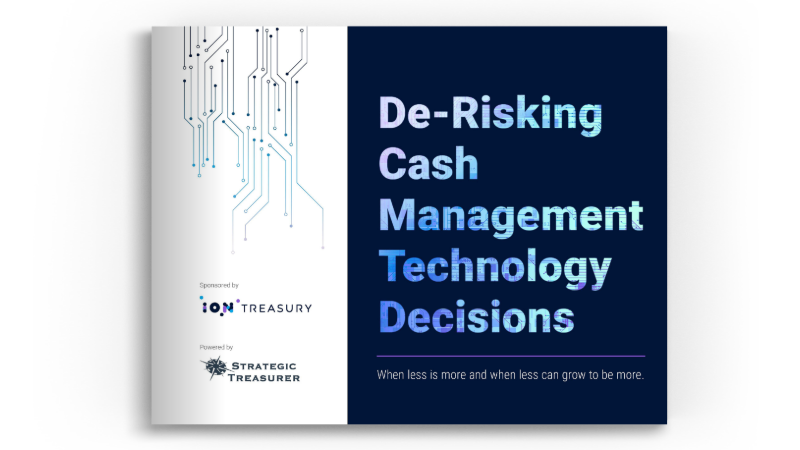
De-Risking Cash Management Technology Decisions
This mini ebook addresses the challenges that these companies face in choosing technology that properly suits their needs. It walks the reader through identifying their organization’s unique complexity, discusses factors to consider in potential solutions, and offers practical guidance for the mid-sized company’s technology search.
Episode 212: Scenario and Sensitivity Analysis
Rising interest rates, geopolitical issues, inflation, and supply chain disruptions all play a major role in your decisions about acquisitions, product investments, and raising capital. Putting together a well-rounded analysis before making decisions may change how and when you approach each investment. In this podcast, Craig Jeffery and Paul Galloway of Strategic Treasurer discuss the differences between scenario and sensitivity analysis.