
Episode 331
Generative AI’s Impact on Treasury: Workplace, Cashflow Forecasting, and Cybersecurity
In this episode, Craig Jeffery and Royston Da Costa explore the impact of generative AI in the workplace, with a focus on large language models (LLMs) and tools like ChatGPT. They discuss how AI is transforming cashflow forecasting, enhancing cybersecurity, and strengthening risk management. Listen in to learn more.
Host:
Craig Jeffery, Strategic Treasurer


Speaker:
Royston Da Costa, Ferguson PLC


Subscribe to the Treasury Update Podcast on your favorite app!



Episode Transcription - Episode # 331: Generative AI’s Impact on Treasury: Workplace, Cashflow Forecasting, and Cybersecurity
Announcer 00:00
Craig, welcome to the Treasury Update Podcast presented by Strategic Treasurer, your source for interesting treasury news, analysis, and insights in your car, at the gym, or wherever you decide to tune in.
Craig Jeffery 00:20
Welcome to the Treasury Update Podcast. I’m Craig Jeffery. I’m your host today. I’m joined here by Royston da Costa.
Royston DaCosta 00:26
Hey, Craig, good to be here.
Craig Jeffery 00:28
We are coming to you live from the general site of the AFP conference in Nashville, Tennessee. Our topic for today is generative. AI, what’s the impact on and then there’s an underscore impact on the workplace, cash flow forecasting, risk management, cyber security and whatever else pops into our minds. So I don’t know how many podcasts we’ve done over the seven years. The Treasurer Update Podcast is going is it 7, 8, 10?
Royston DaCosta 00:56
At least, I’ll say one a year, probably, in some cases twice, at least two.
Craig Jeffery 01:00
With with generative AI, you know, the broader category of artificial intelligence breaks into a couple different sections, and you’ve explained that before. There’s machine learning, you know, pattern detection to determine what’s going on. And then there’s generative AI, which is making new things. So I guess the first question, I want to start with cash flow forecasting first to help make a distinction in people’s minds, and maybe my mind, too, is using generative AI or machine learning for cash flow forecasting. Which, which is it? Is it a combination of those two? Or is that not an important distinction?
Royston DaCosta 01:35
If we look at the overall definition of AI machine learning, and, for that matter, rpa, robotic process automation, are both actually derivatives of AI. When we talk about generative AI, we are really talking about content creation. So AI is artificial intelligence. So you could argue that AI is the broader category. And you know, we all have and use AI, whether we realize it or not. I was thinking the other day, actually, if you have security cameras around your house, which a lot of people now do, that’s using AI, even fridges now include AI. You know, it’s impossible in my mind, to live in this world today and not come across AI. I do accept and recognize in treasurer. It’s a bit more challenging sometimes to recognize how AI is a present and B more importantly, how is it adding value? How is it being used? And so let’s, let’s, let’s talk about that. Shall we So machine learning, as I said previously, is that it’s really a good example, is what we use in our spam filters. That’s machine learning pattern recognition. And so that’s constantly evolving. It’s learning those patterns, and, you know, kind of improving on those patterns. But that’s very much AI, a part of AI, or a version of AI, robotic process automation is another type of AI where, basically, you can perhaps use a way of how you automate receiving invoices attached to an email, and how that email is then dealt with. So that’s, again, another version or example of how AI works. And this is where we’ve now come into a new era, let’s say, and let’s be clear, AI has existed for many, many years. This is not a new technology in terms of its birth for Treasury. The big change the way it’s being adopted and how it’s being so powerful and valuable to treasurer. And now we’re going to get into the generative AI bit the content creation and more specifically, how it’s benefiting treasurer. So we mentioned cash flow forecasting. First of all, I think we’d all agree cash flow forecasting huge pain point probably still is today, frankly, for treasurer. In my mind, it’s been a big game changer having generative AI, because up till now, there’s some excellent cash flow forecasting solutions out there. Invariably, companies like Ferguson have been challenged by our internal infrastructures, many disparate systems, or there’s other challenges in terms how we get the data, or many stakeholders, I think with this generative AI and certainly AI as a whole, there’s the ability now to use that technology to automate processes where previously you couldn’t, so you’re kind of almost simplifying and to some degree eliminating the silos that might have existed before, because it’s more an internal solution that we can we can use and apply when you look, though, specifically at cash flow forecast, and I’m going to bring in risk management as well, because that’s all because that’s also very good way of demonstrating how gentle AI works. What it’s doing is it’s first of all analyzing a much larger data set, because that’s what AI does. That’s the benefit brings. But then it’s also helping to assess, analyze and provide a kind of summary or proposal, if you like, on in the risk side, how you want to manage your risk, on the cash flow forecast thing, how you manage your cash. So this is where the important game changer comes in. I mean, one would argue in the past that might have been done manually to certain degree, using spreadsheets, whereas now with generative. AI, a lot of this can be done almost automatically. They are two caveats, and I think I’ve mentioned this before, health warnings, if you like, AI as a whole is not perfect. We cannot and should not will rely on the data 100% now to me, as much as I say that, one thinks, oh, well, why? Why we are evolving with AI? Well, how’s that any different from what we normally do in treasurer? I think there’s a perception in my mind, when we look at technology, it’s got to be perfect to a degree, maybe so. But no, there’s also this aspect with AI where everyone, I believe, everyone industry, recognize it’s evolving. So my view, like maybe, well, certainly, in a year’s time, it will be a lot better than it is today, but it’s going to take time for it to be, let’s say, call it perfect. So let’s say, for now, it still needs to be validated. The important part here is it’s giving us the automation and the low hanging fruit that we kind of wanted to capture in getting to that point where, then, yes, we still need to think about it, analyze data, make sure it makes sense. The other point, which is not it’s relevant, but it’s not so critical to this issue here, is about not uploading data into the internet because it’s sensitive. It’s if it’s confidential, but I mean, that goes without saying for anything, frankly, but just bear in mind with AI, especially because some of the solutions that offer AI or gentive ai require to upload the data. So if you’re thinking, Oh, well, I’m going to use this solution because it’s going to do all this for me, well, just be wary. Don’t put any sensitive data. By all means, use dummy data and get the kind of solution, or at least the the answer that you’re looking and then use real data internally. In fact, this is what’s happening in Treasurer, and I think we’re going to talk about this later on. Companies have already recognized because there’s another dimension to the whole AI debate, which is around the legal, regulatory require framework Europe have already brought out AI Act, which a number of companies have, most all companies have to apply. But it’s important to recognize that that you will be penalized if you do not apply the rules that they are required on the AI act, and a lot of it’s around privacy, around sensitive data, making sure that you’re not, you know, giving your client or your customers data. So this is one of the aspects, again, of the evolution of AI. And I think in the US, they’re bringing out an AI shortly, but they haven’t done it yet. Number of moving parts that will come together. But it’s important that when we look at this area, there’s one on one hand, as a treasurer, I’m thinking, we can’t ignore it. We need to try and be open to what’s happening out there. Be very cautious, obviously, but don’t be afraid. This is the other point, and it seems like a lot of contradictions. They’re not. You can use a sandbox. Sandbox is where you just do a test system and you play around with it. There’s no harm of getting it wrong, and that’s what that technology allows you. The other point I did want to make is that the number of companies because of the AI legal requirements are now ring fencing, how the employees access generative AI, which I think is again, another great idea, because then you’re protecting you, allowing your your your employees, to have access to this technology, but then you’re not exposing them or exposing the company to the outside world.
Craig Jeffery 08:25
That’s an excellent point about protecting the data. If you have to, if AI requires large data sets to to learn and you need to train it on those that’s great, and but most of those models pull that data into the into the ether at some level that’s used and so that that ring fence and you’re protecting it, so you’re learning on your data, but it’s not being shared, as seems vital. I do want to ask another question on the cash flow forecasting, because AI is being used in cash flow forecasting in two primary areas. One, one main of the primary areas is some of the different technology vendors and banks provide forecasting models within their systems, so they have that the ability to use pattern detection and some AI for forecasting. We see that on the receivable side. We see that in Treasury systems, where it’s learning quite a bit from you know what’s gone on and the forecasting, one of the things that’s interesting, let’s say, on the receivable side, is the forecasting changes from using regression analysis large numbers and detecting fitness to detailed forecasts by trading partner. And that level of accuracy, it just wasn’t possible to do that, and so it provides some superiority there. That seems to be the primary area that treasurer is using. AI is delivered through a bank, through a TMS vendor, through a different technology provider. The second area seems to be far more limited. It’s where generally high tech companies are using that with their own large data sets, and they’re using. Their engineers to help run and do those models. That’s much more limited with the changes over time. What’s going to change in the workforce? What needs to change in the workforce to support that? Because maybe you agree with this or not, but it seems to me that there’s going to be far more capabilities available to almost everybody, through systems and through their banks, through their tech vendors and the banks versus those that can build their own models. That seems a little farther away from most companies, high tech companies, non bank, financial institutions. Banks will be building their own. They are building their own. And then there’s most of the rest of the companies, which seems to me will rely on that. Is that true? And then what should the workforce do to to contemplate those differences, and is there anything different between those two?
Royston DaCosta 10:44
This is an excellent question, because it actually really demonstrates how big a challenge this is for not for treasurer, actually today, specifically, because it’s all about, mainly about treasury, but for the wider world, try and address the kind of the different buckets that you’ve kind of included in your question. You mentioned the banks and the TMSs, and you mentioned the solution providers, technically, and then the corporates. And you’re absolutely right. That’s kind of broadly speaking, to three different groups that deal with cash flow forecasting. Certainly the banks have invested a lot more in AI and in offering cash flow forecasts. They are probably mostly for small to medium sized companies. That’s kind of where I see it at the moment, the more bespoke solution providers, absolutely, they have tended to be more successful with not just small to medium sized companies, but even some of the larger ones. But in both those cases, what you’re dealing with is a bespoke solution. Fundamentally, I know sometimes it can be some customization for the technical solution providers, but there’s only so much they’ll be willing to do for particular corporate and overarching all these three groups is a big question mark, in my view, in terms of where are you regarding if you’re small, medium or large in your journey on technology, it’s fine that you and I are now talking about cash flow, fast generation, AI, and all these other amazing technologies. But if you’ve got a corporate that’s whatever reason still resisting even using cloud based solutions, you’ve got not a problem, but you’ve got a major obstacle, in my view. So that’s why I say sometimes, you know, with any corporate you really need to address where you are in your journey and say technology specifically, and where do you want to get to? Coming back to those two groups, they’re limited to the degree that they have a bespoke solution. You take it or leave it, it’s off the shelf. It’s unlikely say a bank would offer you solutions. Say it will customize it for you. Doesn’t make sense. Where I see the big game change of cash flow forecasting is that third group corporates that so far have not found the bespoke solutions or the off the shelf solution suitable, but with generative AI now on the scene, there’s that huge potential for these corporates to develop their own solution. And you made a point early on where you thought it might not happen that soon. I would kind of disagree to point there. I’m not sure in terms of what that quantum will look like globally. But I would say those companies that have so far found it difficult, let’s say, to find that perfect solution, would be more likely to implement something within the next two years, because, and this is now the other area where it kind of slightly goes into, you know, what will Treasury look like in the next let’s say two years. Might say five years, but I think five years a long way away. I think two years is more realistic, ironically. So we talk about generative AI. Now, the thing with generative AI is, yes, you can argue it offers a particular benefit, and you don’t need to know more than that. If it’s got a solution that happens to generative AI, great, as long as it gives me what it says on the tin. There are treasurer’s, particularly the new generation, but there are some of my generation as well that are looking at the coding languages, like Python and what generative AI is able to do, like chat, GPT, for example, and Claude AI is you can get these applications with very limited coding language to write code for you and to provide almost or create, if you like, a solution for you. Now you have to be a bit more switched on in terms of open to that language and the coding, and also willing to invest the time and so on so but the potential is there, and I know from personal experience that this generation are studying coding at two universities to a degree, I mean, depending on what your particular major is. But nevertheless, they’re teaching as a standard. In fact, actually, I’ll go one step further. I asked the question. I said, What’s the youngest age that asks our education system in the UK is teaching children to code? Oh, do you want to guess five? Yes, five years old, and they’re going, which is brilliant in some ways, because you kind of, you know where we’re keeping up. But the point behind that is that there’s for my generation might be quite sort of, this is not something we’re comfortable with. Which is, which is fine, because there are solutions. There are other resources you can use, and in fact, people you can use that can do that. But my point is that when I came to workplace, we’d be looking at Excel spreadsheets using macros, pivot tables. That’s that sort of thing. That was the limit of programming again, that opened this whole box door, if you like, to creating solutions that using AI, that can automate, and you’re again looking at very limited resource, and, to some degree, very limited experience. These are not people have been in the industry for 3040, years, because that’s, again, it’s a quid pro quo with AI. You know, it has this huge amount of potential, but the same time, you don’t need to have that huge amount of insight and knowledge. Necessarily, it helps, but you don’t need to. So this is going forward.
Craig Jeffery 16:07
I liked your your point about, you know, using some of the generative AI tools to generate Python code. If we think about where we were as like, we used to have to keep all that stuff in, and we keyed it in and put it on cards, and we ran that was run through systems and and now it’s, you know, you had to know, Python or c+ or whatever. And now it’s, we can use the tools to generate that code. The promise is, you know, natural language. You want to ask questions of the data in a natural language. And so sometimes we’re doing that. We do that in if you’re using copilot or chat GPT, you ask question, and then you refine the question to get the answer you want. And so sometimes we’re tapping into that. Others, it’s a two step process. Build the code that I can run in this engine that works. We’ve done a shortcut to natural language, even for creating Python code. Write code for this spits it out. You run it just simplifies and shortens the process.
Royston DaCosta 17:06
I’ve got a question for you with your podcast. I know it’s recorded, but say, for example, if you’re ever in a situation where you’re interviewing someone, have you got any tools that transcribe what they’re saying? Yeah, yeah, exactly.
Craig Jeffery 17:21
So we have, so when we record our podcast, right now, we’re doing it live. We just have recording devices, old school recording devices, maybe not that old, but when we do it, we’ll have people have a record or for the highest quality audio, and then we’ll use Zoom or teams, but and that can provide a clear transcription. It records the audio as a backup for it. I’m sure you’ve used those at work for like, meeting summary teams do it if you like the meeting summary notes, they’re pretty good, I know, like it summarizes and cuts out all the nonsense and gives you a pretty clear like you read through it’s like, I don’t have too much to add to that. You know the action items, especially if you’ve stated them clearly. It comes through and it’s it’s a better note taker than almost every note taker.
Royston DaCosta 18:07
And this another excellent example of generative AI, in my view. Because why is it so powerful? Why is why are we even talking about it? It’s because it’s efficient. It’s saving time, it’s adding some value. We know it’s not perfect, as you say. You say, you still have to check it to make sure it makes sense. But it’s another tool, and I know many people in your position, I journalists or editors are using it to create effect, especially if you’re doing a lot of these on the road, type podcasts and interviews. Time is limited, and unfortunately, this is kind of a it is a double edged sword, and we’ll come on to dynamic terms of how we manage this from a mental health perspective, because we mustn’t forget about our well being. But there’s so many cliches I can bring up the trains left the station. So whether you’re on it or not, you have the choice. You know, even if you’re not on it, you can still kind of follow closely behind it, but it’s your choice whether you want to completely ignore what’s happening around you. What we’re talking about today, we all know this for sure. Is a fact, in my view, is going to be outdated in today, tomorrow, and in fact, more than likely in six months, 12 months time is for sure, because we’ve had these podcasts before and we were talking, I don’t know, maybe even digital twins are still around, but the degree to which it was impacting treasurer, you know, we’ve moved on from there. It’s something that we should all be conscious about.
Craig Jeffery 19:30
On another podcast, I want to talk about the technology changes with you, and the different scenarios. One is the train has left the station like you have to be on it because the tech is moving. And then other situations where there’s examples of countries we were talking before this podcast about they’ve been extremely far behind on technology, and then you go and implement the newest technology, and it’s five to eight times better than what everyone else is using. But everyone else has that tech debt out there, I think there’ll be a. An interesting conversation. The last thing I want to talk about on this one, if you had another moment, was to talk about cyber security, the use of AI on cyber security. It’s being used in payment hubs, Treasury systems, to spot anomalies or differences, right? If you can spot anomalies, that’s, I mean, that’s how something seems off. You know, that’s the whole thing. It’s like, I got intuition. It’s like, No, you spotted something was off. You can’t articulate what it was. And that’s why I got that weird feeling as soon as, you know, it’s like, Oh, that guy was, you know, whatever, had a trench coat in summer. Maybe not like that, but it’s, it’s some, some way of spotting that. And is there more to cyber security than just anomaly detection. Do you think?
Royston DaCosta 20:43
Yeah. I mean, it’s toughy, that one in some ways, because when we talk about cyber security, I’m an expert in terms of, you know, the wider remit for cyber security, let’s limit it to what I’m more familiar with, in terms of treasurer and most often, when you talk about cyber security, it’s around payments and data protection. Frankly, if you talk to someone today, a young person about technology we use that will limit technology, even fax machines or some modems, they’d look at you blankly and think, What on earth are you talking about? Some would argue that’s actually more secure than the technology we’re using today. But that doesn’t mean we need to go back to those times and use that technologies as much as if you said to someone, okay, the iPhone smartphone potentially came in 2006 onwards. Would you ever consider going back to before that day and having a smartphone that didn’t have internet access? Again? Ironically, there is a movement, particularly for young children, where parents of young children, and certainly in the UK, have formed a group or association to limit their children to having a phone that’s just allowed to make send messages and and make calls, because access to internet for particularly under 12, let’s say, not always a healthy thing. So there’s, there’s obviously dangers in everything that we have kind of seen as a benefit. But you know, really, coming back to your point about cyber security, the challenge we face, I think, is that whereas previously, you’ve had human interaction, mostly in making payments, whether admitted not so much through a modem, but if you gone into a branch, or you’re in talking to your branch manager on the phone, those sort of things we used to have to do 2030, years ago, maybe. And there was always an element where the human involved knew whether this was looking right, like you said, this doesn’t smell right. Today, with the technology, it’s kind of impossible to do that, just purely with the human eye, so to speak. So this is where the technology comes in, as much as it’s been used by these nefarious perpetrators, we are also using, or need to use, the technology to protect us from what they’re trying to do. My personal belief is that the technology will come most powerful in terms of cyber security when we’re able to use more of our biometric data. I mean, a lot of banks are already using it, whether it’s through voice or through your iris or even your thumb print. I think these are definitely positive and strong forms of how you use cyber security. Perhaps if you go further down, might be a bit tennis. My personal belief is we do end up with some sort of digital ID. I know some countries have that already, but I would go as far as to say maybe if it’s in it may even be embedded in our body, in our wrist, something along those lines. Sounds a bit, you know, spooky, but it’s just about, how do we stay, not only one step ahead of the bit in the criminals, but also, importantly, protect ourselves, ensure that we’re able to protect our companies and make those payments. We’ve heard about the deep, the dark web. We heard about the the the scam the Far East that was using fake, kind of fake teams to convince employee to make payments. So all of these are part of that journey, which are making us making sort of cyber security professionals aware what we need to do to ensure that we don’t get scammed or we then fall for these type of scams. One thing I will say, though, Craig, on top of everything else that I’ve said so far, technology, I’ve always raved about it, but it’s and I always say the same breath, it’s not the be an end or because when you think in terms of Treasurer, and people say, Oh, technology is going to make us redundant or replace it, it can never do that, not at the moment, for the simple reason we need human intervention. And so I come back and take that same thought and say, with treasurer in particular, I’ve always maintained it’s about the processes fundamentally, first and foremost, before you even think about the technology. So if you’re looking at a payment process, just as an example, I would say, make sure you identify all of your steps through that process and hopefully identify. Why are there any loopholes or weaknesses in that chain? And then when you mitigate those, those loopholes or the weaknesses, typically, I would expect technology to play a part in that. But as you do that, and a given example, in our case, we, like most companies, when we set up a new supplier, we have to have that independently verified. That, at the moment, is done through human intervention. There are solutions out there that can do it for you, and possibly in the future, we’ll consider doing that. I mean, I think a lot of TMS already work, and banks are working with these third party security firms, which would be great. That’s, again, great value for us corporates. But the point of them days that in order to ensure that we are using, first of all, the point that then there should be, we’re maintaining where we’re retaining cyber security, you know, we’re keeping our company secure, ideally makes sense to use the technology. But doesn’t always have to be that, you know? So what if you have to use someone, a human being to to make sure that process secure. Well, that’s more important, but ultimately, I can see the technology offering us those efficiencies by enabling a lot of these checks and balances to take place. And I mean, there’s so many case studies I’ve seen where companies have argued that their whole process end to end is pretty much automated. And you know, any kind of like you mentioned earlier on, pattern anomalies throw up red flags. Well, that that’s fine, as far as I’m concerned, where we are at the moment, but I wouldn’t even want to, and I think you may have heard this as well, look at what’s happening on the dark side in terms of the amount of money that’s lost through cyber crime. It’s it’s horrendous, and that’s something that we still, I think, the banks, fintechs, corporates, are all trying to address, but it’s not something that can be done overnight. But we don’t stop.
Craig Jeffery 26:58
Recent article about in the US say, let’s just call it. Enforcement used AI to find much, much more fraud than they’ve ever been able to find. They’ve started using that, and it’s been helpful for them to detect anomalies and patterns. And so it’s this escalating warfare of of AI, offense and defense. Thank you so much.
Royston DaCosta 27:19
Royston, thank you. Great. That’s great.
Announcer 27:26
You’ve reached the end of another episode of the Treasurer Update Podcast. Be sure to follow Strategic Treasurer on LinkedIn. Just search for Strategic Treasurer. This podcast is provided for informational purposes only, and statements made by Strategic Treasurer LLC on this podcast are not intended as legal, business, consulting, or tax advice. For more information, visit and bookmark StrategicTreasurer.com.
Related Resources
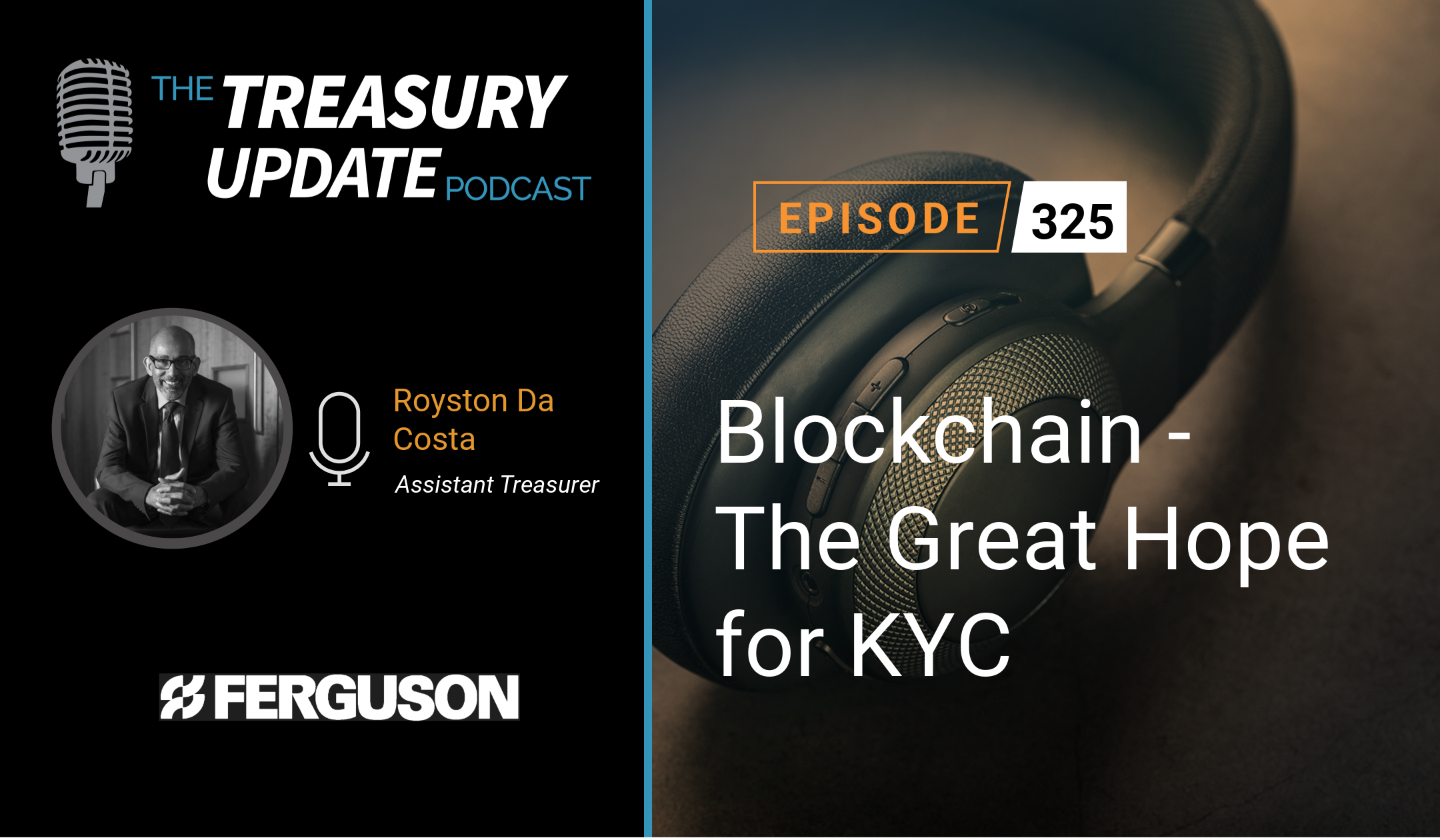
Blockchain – The Great Hope for KYC with Royston Da Costa
In this episode, Craig Jeffery and Royston Da Costa discuss blockchain’s potential for revolutionizing KYC. They cover its benefits, limitations, and how it could enhance transparency. Craig reviews past tech predictions, and Royston shares his outlook on when blockchain might fully deliver on its promise, along with real-world examples.