
Episode 332
Making Payments Intelligent: The Paradigm Shift
In this episode, Craig Jeffery, Managing Partner of Strategic Treasurer, and John Rubinetti, President, B2B Payments at Deluxe, discuss the evolution of payments modernization. They explore how banks are shifting from isolated automation to end-to-end solutions, prioritizing data insights, speed, and collaboration. Listen in to learn more.
Host:
Craig Jeffery, Strategic Treasurer


Speaker:
John Rubinetti, Deluxe


Subscribe to the Treasury Update Podcast on your favorite app!



Episode Transcription - Episode # 322: Making Payments Intelligent: The Paradigm Shift
Announcer 00:00
Craig, welcome to the Treasury Update Podcast presented by Strategic Treasurer. Your source for interesting treasury news, analysis, and insights in your car, at the gym, or wherever you decide to tune in.
Craig Jeffery 00:19
Welcome to the Treasurer Update Podcast. This is Craig Jeffery. I’m your host for this episode. The episode is called Making Payments Intelligent: The Paradigm Shift. I’m here with John Rubinetti from Deluxe. John, welcome.
John Rubinetti 00:32
Thank you, Craig, always good to see you and be here with you.
Craig Jeffery 00:35
Just a notice for those who are listening. This session is really aimed at bankers. The conversation, episode is geared towards bankers who are focused on payments, but there’s certainly no harm in attending if you’re a corporate practitioner in receivables, treasurer or it it certainly may be helpful to listen. But we want you to know the primary audience for this discussion is bankers. So let’s, let’s begin. I want to start off with the perspective, you know, this idea of a mind shift or a paradigm shift. You know, payment modernization is certainly a really, really key topic that’s discussed in every event. There’s even whole conferences on payments, and you have made note of some of the key changes in the perspective of bankers. And I’d love it if you could begin by describing what you are seeing is changing in this, in the perspective arena.
John Rubinetti 01:28
It’s been a really nice mind shift from the bankers. I think we spent a lot of time for the last few years kind of answering the what and why questions about digital, right? What is this thing going to do for me? Why should I make this transformation? What you know, really trying to like it just kept feeling like it was asking more questions, and kind of getting to the Okay, we’ll look at that, then we’ll analyze it, and we’ll be paralyzed when we’re done. So I feel like they’ve gotten past that, which, which is exciting for us, right? And, and they’re now in the, what I’ll call the how phase. How does this integrate within our systems? How can this enhance the customer experience for my customers? That’s the those are the good conversations, and that’s why, honestly, I’m really excited about it. Because, you know, it took a lot to get here, honestly, but I feel like the banks are on board and they’re asking the right questions. And have that thought, you know, as to how.
Craig Jeffery 02:28
Interesting you mentioned how in terms of integration and the user experience, I think, I think we’ll probably circle back to those as well. When we talk about payments modernization or updating payments. You know, sometimes people think, oh, it just has to be faster payments. And I know that’s not the case, but I was wondering if you could talk through what do you see as you know, maybe from your perspective as a provider to banks and to corporations, but also maybe of what you’re hearing from bankers. What are the goals of payment modernization you had mentioned too, the user experience and efficiency, and whether you go into those more deeply, or you bring up other ones. And just love to hear what you think.
John Rubinetti 03:08
Those I see as part of this, right? I think in my mind, there’s, there’s really, it revolves around three things. I think the first and probably the most important, right, is improving the data utilization. Having payments data is one thing, but really utilizing it in the right way, that’s what customers and businesses are asking for. They want to extract more value from their payments right and have actionable insights. I think the second thing is really around automating the end to end process. You and I have talked about this multiple times, automating part of the process is not the answer, right? It typically leads to still more manual efforts and things like that. So automating it end to end, right? Reconciliation, settlement, you know, and reporting, those three things are critical. And that’s not just on the AR side. It’s on both the AR and the AP side, right? So automating that is very, very important and needs to be a goal. And I think the third thing is really speed and scalability. Enabling Faster Payments is one thing, but helping that be more efficient and moving the money while being able to scale and utilize more of the solution, touch more of your customers, impact more your customers. That’s where the customer experience probably comes in. Is it frictionless? Do your customers have to do more that speed and scalability is so important? So those would be the three kind of goals that I would kind of put as high level priorities from the bank’s perspective and the business perspective.
Craig Jeffery 04:40
That’s great. I’ll just ask a couple of questions on the ones that you mentioned. So improving data, data utilization, you mentioned, extracting more value, and I and the second, the second item was automating and then process, which certainly uses data. So I’ll just assume that there’s other uses of that data. Maybe you could describe what. That is beyond for you know, cash, application or posting or accounting.
John Rubinetti 05:05
It’s data around fraud, right? Where’s the fraud coming from? Right? Could it? Could be insights into that? Could it be DPO, DSO opportunities? Right, to move to get faster, pay faster, right? Where, where are your vendor consolidation opportunities, cost of payments, right? The cost of the type of payments. That’s the kind of insight that your data needs to provide so that you can make intelligent decisions and act on it as a business. Not just, okay, we’re going to move these to card payment, we’re going to move these to, you know, wire payments, and we’re just going to run, no, that’s, that’s the part first part of it. The second part of it is saying, Okay, now that now that I now that I have this automated What am I doing with the what’s the data telling me? Right? And then how do I make decisions on that? That’s the kind of insight that you’re looking for.
Craig Jeffery 05:53
Fraud, forecast analysis, yeah, really good, really good stuff. On the topic of speed, you’d mentioned, reporting in real time is key. And certainly there’s applications where it’s absolutely vital, sometimes where it’s helpful, and sometimes where it’s just becoming more important over time. You know that was on the automating the end to end processes. And you also spoke about speed and scalability. How important is speed becoming? Is it just based on certain use cases? Is it comprehensive? What? What are you seeing there?
John Rubinetti 06:22
Getting a solution in place is the first part. Then, looking at the speed components and how to improve that. That’s the second part, right? I don’t think everybody’s out there saying I just need Faster Payments. I just need Faster Payments. It’s okay, let me, let me have some more insight into my payments. And then, how can I make them faster? How can I make it a better experience for my customers? Because sometimes just automating a process, as you’re well aware, doesn’t necessarily take friction out of it, and so sometimes just automating it kind of identifies, oh, you know what? This online that we asked three questions, maybe we should only ask two, right? Make it a little more frictionless, like that’s what this exposes. But when you’re you’re not even there, you can’t even anticipate that. So talking about Faster Payments, you know, in an arena where you’re not even playing doesn’t make sense. So I always say, get into the arena first, then start playing around with moving things around and trying to identify ways to, you know, to make payments faster.
Craig Jeffery 07:24
So let me see if I can make a question out of this, Faster Faster Payments, faster information, and richer information. How would you rank those? I know you want all of them, but how would you rank.
John Rubinetti 07:34
Those Faster Payments last I think that the richer the data, the richer the insight into the process, the better decision you can make. We always say, well, we want to push the card payment, and that’s great, but sometimes that doesn’t fit into the speed, or maybe it doesn’t fit into the DSO or the DPO decisions of the company, right? And so you can’t go fast without understanding that. So first, it’s really the Insight piece, and having richer insight and richer data that’s what leads to your opportunity to make Faster Payments.
Craig Jeffery 08:10
So John, with those three goals that you talked about, I think it’s fair to say what, what’s an impediment to achieving those goals, what’s inhibiting reaching this payment modernization vision that you that you described.
John Rubinetti 08:24
And this is, again, for bankers to understand, too, what we’re hearing from businesses, right? It’s kind of on both sides here. I think number one having legacy, we’ll call it legacy infrastructure. That may mean legacy systems. It may also mean manual systems, right? Like, you know, spreadsheets and things like that. So legacy infrastructure of how you’re doing things is number one, right? That that’s the biggest hurdle, is trying to get past that and make sure you’re explaining what the value is of that and why, right? Number two, which happens across all mid sized companies, but it also happens amongst our bank partners, budget constraints, businesses are facing ongoing challenges prioritizing where they put tech investments. Do I spend the money on making my app better, or do I make sure that I have a payment capability linked in the app? Right? It sounds like a simple decision, but it’s a money decision. And so where do you put your investments and how much investment Do you have, right? So budget constraints always an inhibitor, and then organizational alignment, right? This, this one is always interesting, because we always look at it from how we’re organized as a company. But you know, from the bank’s perspective, sometimes you have sales, then you have product, then you have it, and they’re reporting to different people. How do you get that alignment? And that’s true in organizations too. It may be a smaller organization and maybe it’s a larger organization, but you still have the same thing where you have to make sure you have alignment to where is it spending their time, or they’re trying to do things with. AI, well, maybe there’s an opportunity to kind of tag on to that, right and then, so you now you’ve hit the budget constraints, because you could do it for a little bit less by tech. So getting that alignment, and, you know, having a clear view across your organization kind of helps with all three of those. But those are the three. It’s infrastructure, it’s budget, and it’s it’s alignment to making decisions.
Craig Jeffery 10:25
Thank you for that. And you know, the when you describe legacy infrastructure, there’s, you know, Legacy has positive terms, like, you want to leave a legacy, and then it has, if it’s equipment, it’s bad. And I hear people sometimes referring to it as tech debt, right? You’ve got this old tech, it sort of works, and you need to move on to something that’s new.
John Rubinetti 10:44
So, yeah, well, here’s another way to think about that. I have a legacy business in lockbox, and people think it’s a legacy business that’s going away, and it’s it’s actually not. It’s a great legacy business for us that’s actually growing, right? So you’re right. Legacy can be looked at two different ways.
Craig Jeffery 11:01
Before I look at collaboration partner, I was wondering if you could just give everybody your 42nd 52nd description of what do you do at Deluxe, what’s your role? Because you’re describing all these things, would just be helpful for those who may not know you.
John Rubinetti 11:17
Sure, so as the president of B2B payments, what are B2B payments? Well, we have a legacy lockbox business, which accepts many checks. We have about 8500 lock boxes across the United States, and we have roughly about 65% market share there where, whether they’re utilizing our lock boxes or our software to process lock boxes. So that’s our legacy business, and then we are utilizing that legacy business to move into the digital space and digital receivables. Right? We have receivable solutions. Our digital receivable solution is 360 plus. It is an integrated receivable solution that will have cash application first quarter of 25 so we’re real excited about that digital solution and what that’s automating, and how AI fits in there. And then the other side of our business is the AP business. So we have a payable solution, a digital, payable solution that integrates into the mid market extremely well. Basically takes a file in from the customer, figures out where, where it makes the payments, then closes it back up and closes in the in the whether it’s sage or NetSuite or or some of those bin market solutions. So those are our three major businesses. We have bunch of ancillary stuff about that, but for us, it’s about B2B payments and making B2B payments easier and converting them to digital.
Craig Jeffery 12:43
So for collaboration and partnering, what’s the goal of bankers and their corporate clients? You know, how are bankers trying to work and collaborate with their partners? And so collaboration is a huge word. It’s talked about there. What’s going on?
John Rubinetti 12:59
Yeah, it’s a it’s a big word, and I think people get lost in it, but I try to simplify it honestly. And the goal is to fully understand each other’s mutual benefits. When you go at it that way, then no one’s in there saying, Hey, this is what I need. This is what I need. It’s not about what I need. If we, if you take that out and say, Look, our goal here is to help automate this for our customers, right? How do we do this together? That’s, you know, that’s understanding the mutual benefits. And so when you’re selecting partners, it’s the same thing, whether it’s a partner to make that provide those services for you, or whether you’re partnering with your customer, to kind of understand that it’s the same thing. You have to have the same goal, and it has to be to create a win win, that where both parties are mutually benefiting. And that’s the way I think about it’s way I think about it with all my partnerships. It’s the way I think about it with all my partners at the banks, right? If we’re not doing things together and understanding that we have the same goal, right? Which is to automate as much as possible, and make the experience better for their customer. Once we establish that we’re in a great place and the conversations go better when you don’t have that up front, that goal of that mutual benefit for both of you, it’s a constant fight. You’re not sure you don’t trust, right? I think when you understand that there’s trust there, and that’s the most important thing.
Craig Jeffery 14:22
We’ve talked about payments modernization. Let’s, let’s try to bring that back to two bankers and to those corporate payments professionals who are listening, how do you make intelligent payments happen? And it’s asking a little bit different way from payments modernization. But how do you make intelligent payments happen? Maybe it’s the same question.
John Rubinetti 14:42
If you think about the things that we’re doing here at Deluxe, right, we’re we’re helping banks and businesses offer solutions that automate the matching of payments right with receivable data, right to generate real time insights. That’s what our solution does, and that’s exactly what. So making and creating intelligent payments is all about. Do you have a solution that kind of takes the components of the AP or the AR, as I even explained on our AP solution? Is it a simple take the file, you know, make the payments, provide the data back, give some insight, right? I don’t want to over complicate it, right? Because it’s not, it’s you know, you want to make the payment. Want to streamline the process and deliver the insights so that cash flow forecasting can be improved, better insight, better DPO, DSO, those are the things that people are looking for, and if you are able to do that like we are for your customers, then you’re delivering, you know, intelligent payments, and then you have the opportunity to, you know, continue to improve and look for ways to save, to automate, to drive efficiencies, etc. It’s as simple as that, but I think it leads to so much more.
Craig Jeffery 16:03
Yeah, it certainly does. So, John, this will sound like I’m asking the same question, because I just said, I just asked, How do you make intelligent payments happen? But this question is, what makes a payment solution more intelligent? What are the characteristics? How would you describe this? Is, this is how we’ve achieved that.
John Rubinetti 16:20
Yeah, well, look, the goal is frictionless money movement, and if you’re able to do that, and the insights that you have can identify opportunities to reduce fraud, DPO, DSO, opportunities, right? Whether to increase, decrease, right? Optimize vendor consolidation, right? Do you have too many vendors? Can you consolidate your spend? Can you get a better return or a better discount? What are the total cost of payments? Is it better to start shifting payments to to wire, right? Or ACH? ACH is cheaper, right? Like those are the insights that you’re looking for. And you know, cash flow forecasting. Do you have enough cash flow? This is the kind of insight and data that you should be looking for to improve your business operations. And so if you can’t get that from your solution, and you probably should be looking for another solution, because that’s what it needs to be, if it’s just directing you to one way, one way to pay, that’s, that’s, that’s great. That’s kind of automating part of the process. There’s, you know, when you look at kind of what you’re trying to do, which is operational efficiency in a business, you’re not just looking to make an or, you know, instead of doing a check rod, you just move it over here. You haven’t solved for anything. You’re not providing anything back that that’s where the value component comes in to intelligent payments. Where are the other opportunities for you to be more efficient and to save money within your company? That’s that’s the way people should be thinking about how to have this conversation with a business.
Craig Jeffery 17:58
So that, that famous quote, you know, optimizing part of the process of optimizes the whole is certainly clear, but you said something pretty interesting there. I just wanted you to expand on it, you know, just, just moving it from, let’s say, one payment type, delivering a channel to another is restrictive in some ways. And why? Why isn’t it like Henry Ford, like you want every car, you want it to be black and painted black. And why isn’t it the goal to move everything to virtual card or to ACH or to some other payment method? Why isn’t that the optimal setup?
John Rubinetti 18:35
Because it’s not taking into consideration what they currently do, having a solution that automates everything that may not be what they need. They may do a good job up front right of kind of putting things in the right payment modalities, but they don’t know that. So is there a way to just kind of move it but get data and insight to it, right? It may be cost prohibitive, right? It sounds good, because if you move it to the card payment and listen, we do it too, and it’s a great revenue stream. But does that work for every mid size company? And the answer is no, it doesn’t right. So sometimes you think, and it kind of goes to when I you know how to have conversations with businesses about this, when you start to focus on operational efficiencies and pain points, you start to find better solutions for them. When you start with your transactional product that you think solves for things, you may miss that, and that’s where it doesn’t solve or fix problems. It just you got your solution in there. And sometimes that doesn’t work. And I spent a number of years Consulting at Ernst and Young and I can’t get that out of my blood. So when I think about solving for things, I think about asking questions and understanding pain so that you can help solve, not just introducing a solution, but. Because it’s your transactional way of selling.
Craig Jeffery 20:03
B to B. Payments are also different than business to consumer. Like, if you’re like, Hey, I’m doing ride share, you have to pay by card or two other options. It’s like, you can limit it AND gate it, but B to B, it’s like, I’m receiving payments. I’m not going to be able to just take payments in one channel. They’re going to have multiple options, and I need to do that, and same thing on the payment side. Maybe I have a little more control on the payment side. So Thanks for Thanks for that, for all the bankers who are listening. What? What would you want to tell them about what they need to do? They may know some of it. They may know all of it. But what do bankers need to do to bring their clients along this path of payments modernization.
John Rubinetti 20:43
The number one thing is focusing on operational efficiencies and understanding the pain points of your customers right versus that transactional piece. If you’re asking the questions about what works, who does what, when you try to plot it out and put a little diagram together of where how things work in the office, then you can identify opportunities for them to improve efficiencies, right? And automate, start to automate the process, right? The second piece is really about education, right? And so if I’m a banker, one educate yourself on these type of solutions. You don’t have to know them inside and out, right? But you have to know kind of what are the value benefits right of your A or solution? What are the value benefits of your AP solution, right? And how do you ask the questions to uncover that? So I think it’s educating themselves and their businesses and their clients right. On, on, what is an API right? What is? What is it? How does AI affect your business? How can machine learning help your business those kind of things? So it’s, number one, focusing on the operational efficiencies and the pain points of your customers, and number two, it’s educating them and educating yourself on the solutions out there and what they do. Because the more you understand that, the easier the conversation is, because you and I talk about this every day and all day long. So it’s kind of makes sense right away. It is kind of simple when you start to think about it, but when you start to bring in, how does someone do something today? How is the legacy infrastructure look? How does you know, what’s the operational organizational alignment. You know, how do you work with then it starts. That’s where this thing gets complicated. The point of it is pretty straightforward. That’s where bankers really need to get a good understanding of where the pain points are at their customer and really understanding and educating them on what does this technology mean?
Craig Jeffery 22:38
I was just considering, you know, I think about payments, inbound and outbound every day. You think about that all day, every day. So it’s just a it’s a good discussion. What final thoughts would you have for the audience? Any key nuggets to either repeat or new thoughts?
John Rubinetti 22:55
Number one, I think it’s, you know, make sure that you’re investing in platforms that can aggregate the data, analyze the data across multiple channels, right? Make sure, make sure you’re, you know, looking at your solution set, and investing in those platforms so that you can deliver those to your customers, right? I think the second thing is probably more important than anything, and it’s we’ve been talking about AR and AP solutions for a while. And I think sometimes people think, well, everybody has them, right? So why should we be talking about them? The reality is, and dados just put out a survey that I was reading that I was found fascinating, right? And so on the AP side, they went and surveyed a whole bunch of companies about, you know, how likely are they to use automated, payable software? 79% of these customers, you know, have this opportunity to talk about, and they are dying for it. On the AER side, 55% were either interested or very interested in exploring a solution to help automate and utilize software. So I share that because I don’t want people to think, well, it’s there’s not enough opportunity in the market. There is. There’s a lot. And if you’re a banker, you do not want the fintechs out there trying to get into your customers. You want to be able to provide these solutions. And I’m here to tell you that there is a ton of opportunity across your mid market and your large corporate clients, and even down on the higher end of the SMB, they all need this to compete. They need to think about, you know, the solutions that they provide to their customers. I think the easiest way for me to kind of frame this for people too sometimes, is think about the best things that you utilize today. Personally, it’s Amazon, it’s Uber, right? It’s Starbucks. They’re frictionless, right? And they’ve created this frictionless consumer experience. Clients, and no one was able to kind of do that, unless you were a big box retailer, because you weren’t, you had the dollars to invest. If you were a small, mid size you didn’t have that. Well, with the advancement of technology, everybody has the ability to automate, to utilize technology to deliver a better customer experience, to compete with the Starbucks and the Amazons of the world. And so I say that because the opportunity is still there with these companies. They want to do that. They want to provide, you know, a better user experience and a frictionless, you know, transaction payment piece, right? They want to do that, and they have the opportunity to, and you as the bank, have the opportunity to offer those solutions and keep them stick your clients. Greenwich talks about having more products being they stay with the bank longer, like that’s your goal, and so making sure that you’re choosing partners to provide those solutions for you and making sure you’re having really good conversations with your customers, to me that that’s that’s the opportunity, and it’s really big. That’s why I’m so excited about the shift to the how, away from the why and the what.
Announcer 26:18
You’ve reached the end of another episode of the Treasury Update Podcast. Be sure to follow Strategic Treasurer on LinkedIn. Just search for Strategic Treasurer. This podcast is provided for informational purposes only, and statements made by Strategic Treasurer LLC on this podcast are not intended as legal, business, consulting, or tax advice for more information, visit and bookmark StrategicTreasurer.com.
Related Resources
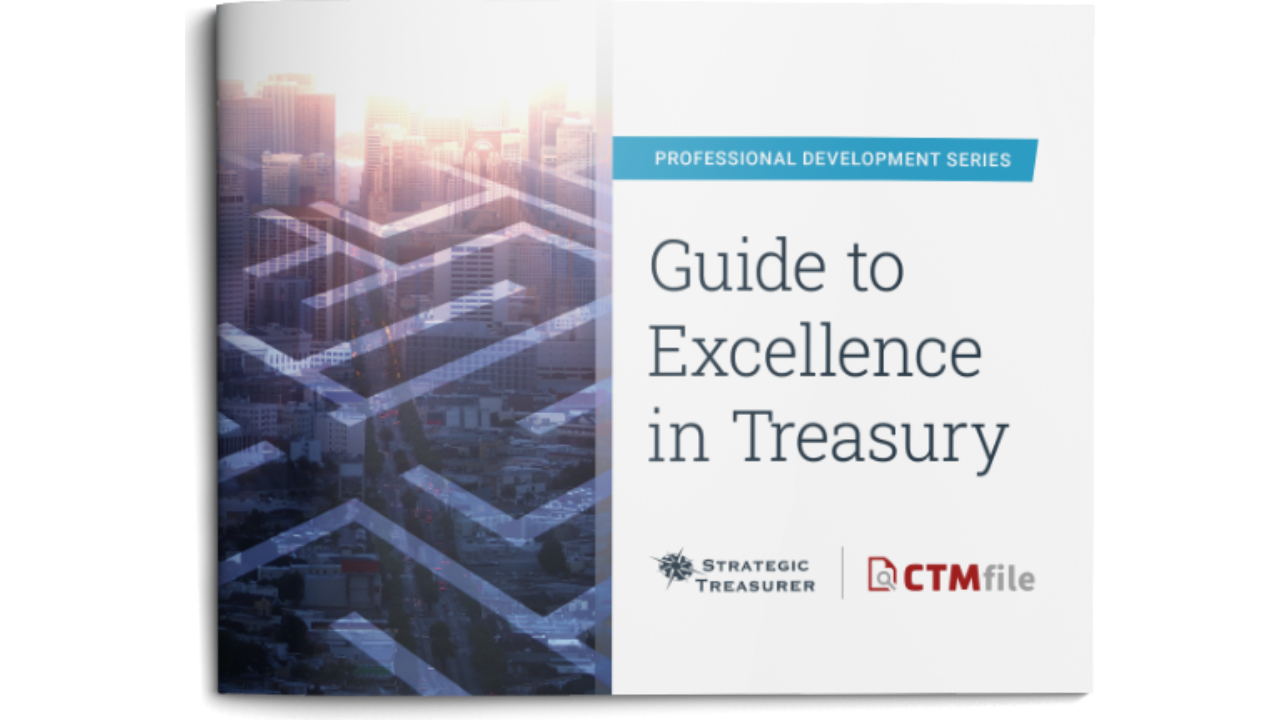
With insights covering everything from important steps for the new treasurer to leading practices for securing resources, overcoming blind spots, staff development, metrics, technology, working capital, and more, the Guide to Excellence in Treasury eBook offers strategies and fine-tuned approaches to major areas of challenge for treasurers.
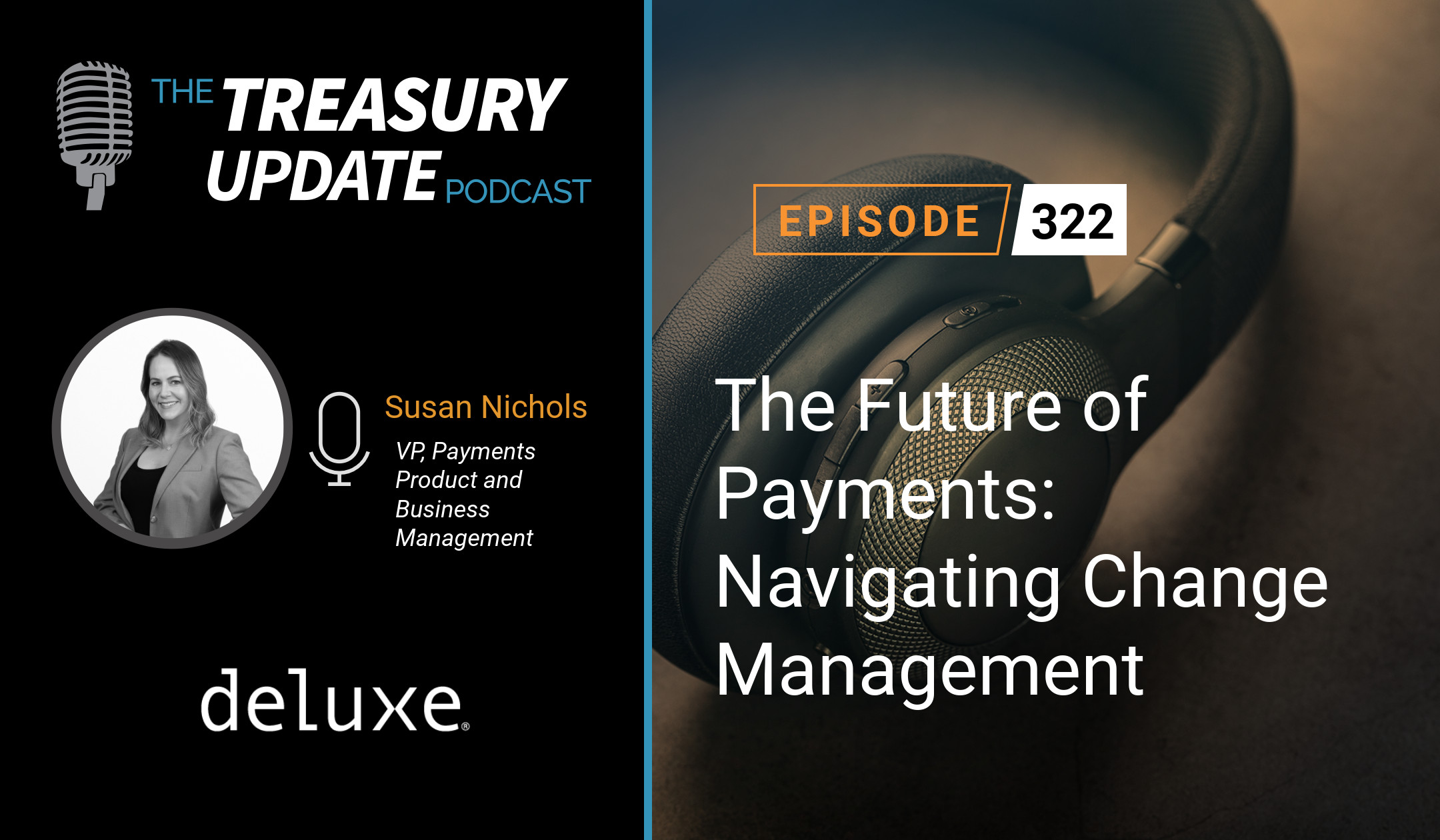
The Future of Payments: Navigating Change Management
In this episode, Craig Jeffery, Managing Partner of Strategic Treasurer, and Susan Nichols, VP, Payments Product and Business Management at Deluxe, explore effective change management for digital payments. They discuss balancing technology upgrades with managing internal and external changes, securing executive buy-in, and integrating digital solutions smoothly. Listen in to learn more.