
Episode 336
CBDCs vs. Fiat Currency: The Future of Digital Payments with Royston Da Costa
In this episode, Craig Jeffery and Royston Da Costa explore the role of CBDCs in improving payment processes, offering real-time tracking, reducing delays, and complementing fiat currencies. They discuss how CBDCs provide a regulated alternative to cryptocurrencies. Listen in to learn more.
Host:
Craig Jeffery, Strategic Treasurer


Speaker:
Royston Da Costa, Ferguson PLC


Subscribe to the Treasury Update Podcast on your favorite app!



Episode Transcription - Episode # 336: CBDCs vs. Fiat Currency: The Future of Digital Payments with Royston Da Costa
Announcer 00:05
Welcome to the Treasury Update Podcast, presented by Strategic Treasurer, your source for interesting treasury news, analysis, and insights in your car, at the gym, or wherever you decide to tune in.
Craig Jeffery 00:19
Welcome to the Treasury Update Podcast. It seems like we’ve done a few podcasts in the same venue here in a row.
Royston Da Costa 00:27
We’re in a row.
Craig Jeffery 00:29
Royston, tell us what you do for your work, just as a quick reintro.
Royston Da Costa 00:33
No worries. So, I’m the Assistant Treasurer at Ferguson. We are leading distributed plumbing and heating products in North America, we are $30 billion business, primary listed on New York Stock Exchange, and secondary listed on the London Stock Exchange. I am primarily responsible for the Treasury technology within our group, and I look after the intercompany loan structure in the UK, as well as support our Treasury team, who are based in Newport News, Virginia, in the US on large ad hoc value added transactions.
Craig Jeffery 01:04
Excellent. So our episode today, where our discussion today is on central bank digital currency. There’s a few things we want to talk about. Is this is this gaining steam? What do banks need to do? Is this just noise that banks just need to wait, or corporations just need to wait until it passes. Maybe you could tell us, describe central bank digital currency versus other digital currencies. What’s what’s similar and what’s different?
Royston Da Costa 01:32
It’s a bit of it’s there’s so many different what we’d call cryptocurrencies, but just to kind of articulate, or trying to explain from my, my perspective, what a central bank digital currency is. It’s essentially a currency that’s been created by a central bank. So, we’ve got a few countries that have already issued their own central bank digital currency. I know that US are working on theirs. I believe the European Union are working on theirs, as is the UK government. I know I’m trying to think of a handful. I think Estonia is one that’s come of their own currency. I think there’s also Venezuela have got their own digital currency, so not probably one of the top 10 economies, but the important point is that if you look on the internet to see how many countries are actually in the process of either introducing their own digital currency or testing out or developing the own, it’s quite a significant number, that’s number that number is growing. Why is it different from what we call normal cryptocurrency? The element of volatility essentially is taken away because most digital currencies that were being introduced are pegged to what we call a fiat currency, so invariably be either dollar, sterling, or the euro, which is an important factor, because it then therefore means that this not that volatility that would exist as it seems to do with a lot of the cryptocurrencies. Why is it important? First of all, let’s start where we are. We are still struggling, frankly, with where payments are today, we use like any most corporates, Swift, which is the primary mechanism for messaging mechanism for making payments globally. Ironically, you know, when you ask someone what’s visibility of payments like today, well, we’ve got visibility, Swift GPI, absolutely, if you’re making a payment from A to b with limited or rather with no intervention in between, there’s no issues. As soon as a problem arises with that payment, it goes into a black hole, essentially. And quite often, and I’ve had this from experience recently, and I’ve spoken to other treasurer’s, it literally, is there’s no law regulation as to how long that payment can be held by the bank that’s got it and shouldn’t keep it, and certainly the bank that’s made the payment has actually no control over getting those funds back, which is absolutely ridiculous to think of in this day and age. It just doesn’t make sense to me with digital currency, that there’s no harm of that, there’s no fear of that happening, because every step of the way there’s a digital footprint of where that payment will be, and there’s no, and that’s just one why I say small benefit, it’s quite a significant benefit for where digital currencies would be a huge improvement. I think most people say, in terms of digital currency, they’re quicker, they’re more efficient, they’re more cost-effective, they cost less to process, and to some degree, whether this is a good or bad thing, it’s 24/7 There’s no real settlement cut off time like you have with fiat currencies, apart from, by the way, CBDcs, which are, say, central bank digital currencies, you’ve got certain banks that have already introduced their own form or version of digital currency, like JP Morgan, have Onyx. It’s quite widely known, but it only works within their own network, so you can only use that mechanism to pay and receive within the JP Morgan network, which is still a good start. My view, it’s a matter of time before banks will collaborate and. Begin to form their own network of like digital currency settlement process, but importantly for corporates, and that’s what I’m most interested in, is the frictionless settlement of payments, and most importantly again, is getting that full visibility absolutely vital, so that you know at any point in time, regardless, the payment goes effortlessly all the way from A to B, or it gets stuck somewhere. We are in a very good position to know where the funds are, and hopefully I say, hopefully the reason why it shouldn’t be, if you know where the funds are sitting, those funds should be returned instantly and not have to wait 810, days, two weeks, sometimes, because there’s absolutely no time frame for any bank to return those funds, which again seems ridiculous, regardless of the amount, by the way. So, yeah, CBD CS, I think, are important in many respects, not only for the reasons I’ve mentioned before, but it’s because they carry a certain amount of weight, as well. We’re looking at central banks for Europe, the US, the Federal Reserve Bank, the UK, Bank of England, and these are huge institutions. They carry a huge amount of weight. So, once those currencies come into play, that you can’t ignore it. And to me, that means that will also mean that they’ll widen the appetite and the use of what of digital currencies and how they can benefit corporates, and I think it’s interesting that the governments are looking at these currencies not from a necessary commercial perspective, although that’s important, I think it’s primarily from how can it benefit them, and there are countries that said they’ve already implemented these, these digital countries, and are using them to create facts.
Craig Jeffery 06:46
So, I want to go back to the Swift GPI, for example. You know, this this idea of I want something that’s that can move between institutions for making payments, and we need to have visibility, and GPI does provide quite a bit of that, even if some of the parties are using older technology, there’s at least some identification of, you know, at a more refined level where something has stopped. There’s also this transparency to how long did it take to occur, right? So that’s that’s created a speed up in the process, as opposed to why did that, you know, wire that overseas wire take three days or five days to settle, four days later, five days later, then you send research, and then they come back, and finally they wait as long as they can, and it squirts out and gets into the into the final account. Doesn’t that have the same type of characteristics of what central bank digital currency will have, that that there would be visibility among the stopping points, just maybe. How would you describe that as in terms of visibility compared to GPI?
Royston Da Costa 07:47
Yeah, I would say with the key point to remember when we talk about digital currencies, the underlying technology for that is blockchain, and with blockchain there’s a definitive link between every transaction that takes place, so it’s impossible to actually lose sight or effective lose a payment in the way I’ve explained early on the example I gave with Swift GPI. It’s still reliant on a fairly, in some ways, archaic process, although it might work really well. So when you say that, oh, there’s still that visibility that may be on paper the way it’s presented, but the reality and this is where I think it’s important to recognize the reality is completely different and don’t take my word for it the only way you’d find these things out in some ways is by experiencing yourself, because you’ll be done this, and this is why the article I wrote recently, I think, was posted by our group I belong to, called Treasurer Mastermind, on the broken state of correspondent banking, because I experienced this first time, and I thought to myself, I’ve been in Treasury over 36 years, and I still can’t believe that 20 years ago I had the same issue, I kind of accepted it. This is the state of this is how this is the norm. We accept the payment goes astray. You are the mercy of whichever banks got the payment to return the funds as and when they choose to see or when they see fit to return it. 20 years later, we’ve been told the same thing still exists within banking. The bank doesn’t matter how big they are that made the payment has absolutely no legal right or power to recall those funds in a timely fashion.
Craig Jeffery 09:35
Yeah, not through the, not through the payment system, it’d have to be like through courts or something.
Royston Da Costa 09:39
Well, if it’s not that the other bank were denying receipt, it’s just the way the system works, whether the recipient bank can choose to sit on the funds as long as they see fit, or whatever process they have, because it’s probably a manual process, it’s probably some team, some departments going through millions of payments, that’s whatever they do to try and identify. Day, as and when, and bear in mind this is having escalated within that bank and another bank that the pain was supposed to get to, using their combined relationship influence, still can get the payment back the same day, and that’s the state of first today with Swift GPR, which, as I say, we knew where the payment was. Now, with blockchain, that shouldn’t happen or shouldn’t exist, for the simple reason that we’ve got the digital transaction that occurs when you make that payment. So, the fact that if it’s gone astray shouldn’t mean someone has the luxury or the privilege of just saying we’ll sit on this for how long do one, we’ve got the digital footprint, give back the payment, there’s a handshake, basically, or we’ll just debut your account, that’s how it would be in my view, is how it would work, and frankly, Craig, let’s be, let’s be clear about this, we’re in 2024 we’re going to be in 2025 next year, Why are we still talking about getting a payment back, like as if it’s the dark ages? I mean, we should, you know, banks should be ashamed in some ways about the way that their customers are having to sometimes almost beg them to return the funds, and bear in mind, as I said before, this doesn’t matter whether it’s a $200,000 payment, in some cases it’s been $25 million I mean, that’s ridiculously outrageous, that this should even be a subject we talk about. So, this is why I say, you know, when we think about what’s happening around the world, in terms of not just technology, in terms of the way the world’s evolving, and we see this generation, I think it’s like over 70% don’t have a bank account, they have an e wallet. There’s an appetite and an expectation, more importantly, that says why. Why should I accept the way things have been done for last 100 years or 50 years? I can get a faster payment been made to account in seconds, and I know it’s more challenging when you talk about returning funds, but nevertheless, there’s an expectation, and it should be possible when you think again, talking about CBDcs and digital currencies, for this type of activity to be done a lot more efficiently and more effortlessly, because one fact you’ve got to remember in all of this, as much as it’s kind of painful to kind of describe it, the amount of time it takes up a treasury individual to try and resolve one payment issue like this is then becomes kind of a bit more, I would say, clear why it’s so important that we don’t have these type of issues to deal with going forward, and come back to again, CBDC, we’ve got the mechanism, it works with certain countries already, admittedly the more the larger economy is a bit more complicated, but you know they’re hopefully going to come up with their currencies fairly shortly, I believe China’s already got their digital currency out there, I don’t think it’s going to necessarily replace the, you know, their main trading currency, if you like, but it’s an alternative currency you can choose to use as well, so that’s the important factor to bear in mind. At some point, there may well be kind of migration that takes place, but for now it’s kind of like alongside your fiat currency.
Craig Jeffery 13:18
Bring up an idea, mention idea, and talk about the potential implications to see how you might describe that the idea of you might have good visibility with GPI, there might be some parts where it’s opaque, but you talked about the ability for retrieving funds or settling funds, which seems to be far more compelling to me that now they’re no longer stuck, you have the ability to resolve those, but part of the difference of the newer methods versus the older methods. Older methods are you send a, you send a payment, it goes through, let’s say, your bank, which might have a correspondent bank that sends it, maybe it goes through Swift, maybe it goes directly through some other, you know, account that they have at a partner bank, who then settles it to the to the end state, and nobody can see it. It loses its transference because it’s like handed off. It’s like the telephone game, where you say a message at the beginning, by the time it gets the end, it’s distorted, right? And you just don’t know where the conversation is going. Whereas with a ledger or with a network, when you have a network, that information is placed somewhere, and that information is changing as it’s being touched. It’s not being transported and have stuff added on as it goes, because it’s there. If it’s missing some payment information, you don’t have to reject the payment. It’s like you need an address. Okay, so now the address gets added to it. Now it passes, it doesn’t have to come back, try again, try a third time, whether it’s on the GPI network or it’s on a private ledger, then it’s a, it’s a properties of that payment that people are looking at, as opposed to handing off to me, that seems to be super. Extremely valuable, because now it’s like, hey, there’s one point of truth, because we all are looking at the same thing. If it’s deficient, we can fix it, and then there’s no dispute about sending it back or other areas. The difference might be on some of the other digital currencies, it might be public, they’re public distributed ledgers, everyone can see them, they may not know what goes behind them, whereas these would be more protected. You only, you can only see the transactions you have a right to see, and the details that go with them. And so you have immediate transfer and availability, and transparency matters, I guess. As you think about the changes are happening with central bank digital currency, as they’re being worked on, is the main issue going to be our banks on board and moving to do this quickly, or is it some other issue?
Royston Da Costa 15:55
Well, funny enough, I don’t think that’s going to be, let’s say, a question that the banks will have the luxury of answering, because with the central bank being the driver, I believe the commercial banks we will have to follow, because central banks hold, kind of, most countries, there’s Western countries, will hold the reign, so to speak. Now, I don’t see the central bank necessarily enforcing anything necessarily to start with, because I think it’ll be a kind of a question of choice. But if I was sitting within a commercial bank’s seat and the central bank came up to me and said, “Would you be interested in joining this network, I think I’ll be more than likely to say yes, please, but there’s something else I wanted to bring into the quite into this discussion, but I think it’s very important as well, in terms of digital currency, as such, which is trap cash. Again, this is an area where I feel like I know, because we’ve got areas of the world that are still very restricted around how cash flows in and out the economies, and I don’t know how far the future will be, will go before that can be completely resolved, probably never, but certainly in terms of most parts of the world, but I do believe that pain point is beginning to disappear with digital currency, because there are already countries who historically would not allow you to take their local currency out of the country, but will allow you to convert it into cryptocurrency at the moment, and it’s an interesting development that that is being allowed to happen because it makes it doesn’t give particularly companies that have cash trapped in those economies to get the cash they need out of their economies, but also to continue investing in there as well, but I think from the economy itself’s perspective they’re not then also presumed being exposed to any kind of run if you like on their currency, because it’s cryptocurrency that’s being used rather than their own.
Craig Jeffery 18:06
So central bank digital currencies have the one of the added benefits over some of the other digital currencies is that they’re they’re backed by a central bank and a taxing authority, is that that’s an advantage. The anonymity to some extent, of the other digital currencies is viewed as an advantage in other areas. Will central bank digital currencies replace or some or all of the other cryptocurrencies?
Royston Da Costa 18:36
It’s a good question. Actually, I personally, I can’t see that happening. It’s the way the world works. I think you know we generally operate in the kind of free laissez-faire markets. It’s good to have choice, but again, when you look at time frames, and say, you know, there’s so many things that you can argue, you know, think about the banking world as a whole, 14,000 banks, or at some point I can see that shrinking, because that’s kind of how I see the world going. There’s still going to be some small banks that exist in terms of local, but as we get into a more digital state of world, the degree to necessarily have a bespoke local bank serving a community because of the particular advantage they have to offer, particularly say this generation come into play and aren’t particularly bothered about having a local branch. I just inevitably see that beginning to shrink, and again, fewer banks, fewer larger banks, but also the fact that we’re going to be dealing more online rather than in physical cash, you know, that’s another area that will eventually kind of, you know, disappear in my view. To answer your question, I don’t see cryptocurrency disappearing, because it’s, it’s almost like, well, it is another currency in itself, right? If you’ve got. You’ve got the euro, can you see the dollar disappearing? I didn’t see that happening, or the Chinese one, or remember, just praying no. So, utopia, maybe one day there could be one world digital currency, of course, that I can see that, whether it’d be my life to doubt it, but yeah, for sure. Because why would we need to have so many different currencies if the world could work or operate in one currency, but I think if it’s so far removed from that potential that it’s pointless even trying to discuss it today. But no, I think for now cryptocurrency definitely has its place. It’s amazing how many different versions or cryptocurrencies exist out there. I know Bitcoin and Ethereum, but there’s so many others that also exist. As long as there’s demand, the supply will be there. So it’s kind of the age-old economics, right? Demand, supply, but for me, central bank digital currencies are trying to address, I would say, a bigger problem, but a much wider aspiration. If I put it that way, it is for me a definite step in the right direction. Hard to put it at numbers, but from a percentage perspective, I would see digital currencies probably in when it’s fully evolved, probably being 70% of the world economy in terms of transaction flows, but when that timeframe would be at this stage, I can say.
Craig Jeffery 21:31
Plus 10 years, 10 years or more?
Royston Da Costa 21:34
Within 10 years, yeah, yeah, within 10 years, but when exactly, probably more latter, more later towards the 10 years, because it really will depend on, you know, the major economies and how they get on with their introduction of digital currencies, because when they, when it begins to permeate society, and you see the generations beginning to use the currency and begin to be more familiar, then it becomes almost second nature. It’s almost like, in some ways, you think I’m trying to think back when you know we, as they didn’t have a smartphone, didn’t have the internet, or whatever, and now we all take this grant for granted, have an e wallet, you know, you can go to a coffee shop, bizarrely, I’ve only just got into the hang or the habit, I’m sure you sound very familiar with this. Using my phone to pay for four goods I’m still used to, or used to be used to taking on my card and tapping it. Now you can use the phone. The point may I’m making is that there’s a generational shift, mind shift, not just in terms of me, but also this journey of how we’ve embraced this technology and now take it for granted, so I think with digital currency it’ll be the same once it begins to be rolled out by the governments and people begin to use it. We still have in the UK parents that have to, I think, in some cases pay maybe less so by check for certain school trips or whatever. I think more and more schools are now getting sort of set up accounts, digital accounts, where you can transfer them, you know, electronically, but it just, you know, there’s still checks being used in the UK. I know you guys have, you have a system which is much more sophisticated, more clearing checks, but it’s strange that we haven’t got rid of our checks yet, it’s still using checks.
Craig Jeffery 23:23
I hear you on that. I don’t see, I don’t see too many checks. Businesses certainly print them, send them, they convert into wages. The last vestiges of places that take checks, it seems, are schools and churches. And then most of many of those private schools will all move to digital. Many of the churches have moved to digital.
Royston Da Costa 23:45
Insurance companies. Love sending checks out if you, they owe you any money. And in the other place, they also, the government, HMRC, or the Quinlan IFRS, they will send you a check, any kind of thing. I thought you were kind of encouraging people to pay online. So this is why I feel like digital currencies for me is going to be a huge step forward.
Craig Jeffery 24:06
So we talked about 10 years. I want to try to put you on the spot on a couple other things. So will the pound sterling merge with the euro or join the euro before or after central bank digital currencies become sweeping abroad? You said those were within 10 years.
Royston Da Costa 24:21
Well, officially, I’m so say, well, first of all, you can never say never, but I was going to say never, but in itself I don’t think pound will join the euro, that’s non-negotiable in terms of digital currency. There’s a possibility, in my opinion, that could happen if it is to the benefit of course of our economy, I could, you know, from a digital currency perspective could be interesting development. Yeah, I’ll put that on there.
Craig Jeffery 24:53
Is that more likely that they would join with the euro or with Canada, Australia, and. Zealand.
Royston Da Costa 25:01
Well, I’d say certainly more likely with the euro, because we’re much closer to Europe than in terms of trading partner than those other countries. But it’s an interesting thought, because, like I said before, I can see that digital currency kind of collaboration, if you like, or ecosystem being broadened by just like you have trade agreements, but it all will depend on, you know, how these, how our economies see, you know, everyone wants to know, they’ll only do it, obviously, if they think it’s going to be benefiting, beneficial to the economy, so it’ll also depend on how they perceive that will benefit the economies, and because I don’t see that necessarily replacing their, the kind of their sovereign currency at first. Anyway, the potential impact could be very minimal to the person on the street. It would probably be more beneficial for their trading companies, you know, the companies that trade export import, to see whether they would, you know, sort of see that benefit being particularly useful.
Announcer 26:08
You’ve reached the end of another episode of The Treasury Update Podcast. Be sure to follow Strategic Treasurer on LinkedIn, just search for Strategic Treasurer. This podcast is provided for informational purposes only, and statements made by Strategic Treasurer LLC on this podcast are not intended as legal, business, consulting, or tax advice. For more information, visit and bookmark StrategicTreasurer.com.
Related Resources
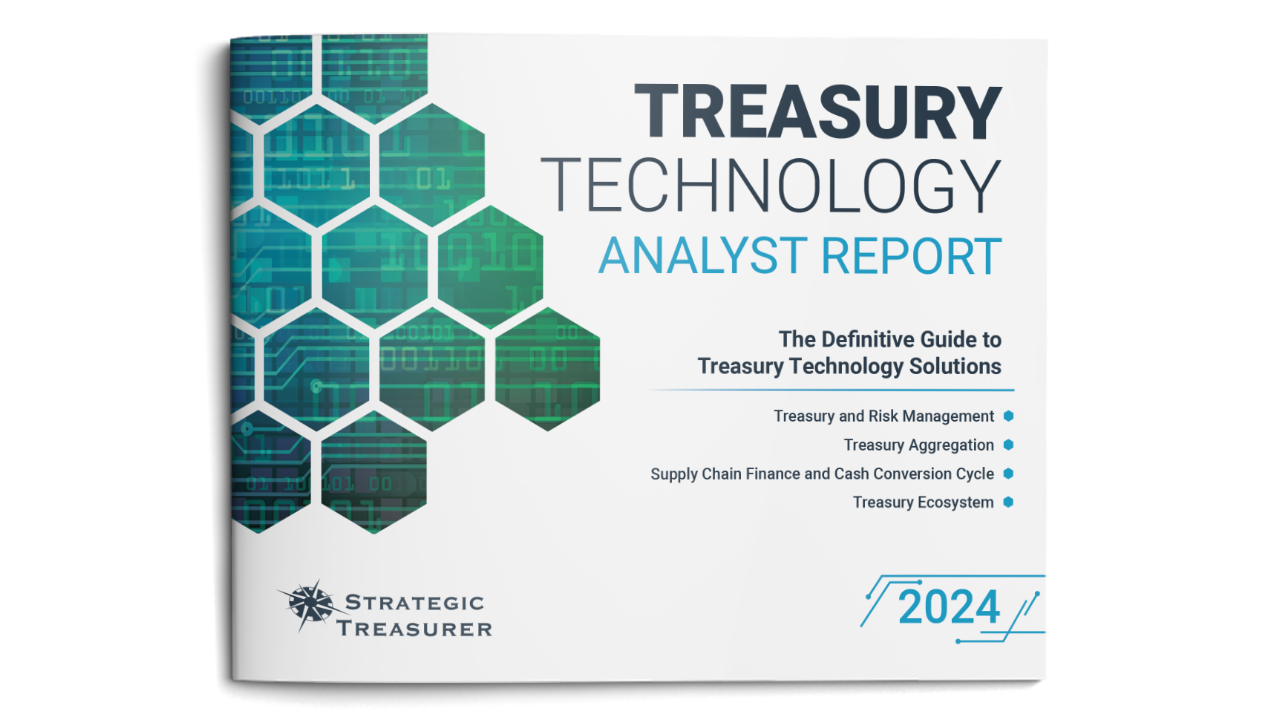
Treasury Technology Analyst Report
Researching new treasury and finance technology can be overwhelming. Strategic Treasurer has stepped in to help. Explore our definitive guide to the treasury technology landscape and discover detailed, data-based coverage of:
- Treasury & Risk Management Systems
- Treasury Aggregators
- Supply Chain Finance & Cash Conversion Cycle Solutions
Learn more about these technologies and evaluate some of the top vendors in each industry.
The Treasury Technology Tipping Point with Royston Da Costa
In this episode, Craig Jeffery and Royston Da Costa discuss the tipping point for treasury management systems (TMSs). They explore whether TMS providers will embrace new technologies, including AI, to offer enhanced services to their customers or stick with more legacy, inflexible technology structures. Listen in to learn more.