
Episode 329
Short-Term Investing Series by Federated Hermes – Part 4: Election and Fed Actions: The Interaction of Fiscal and Monetary Policy
In this episode of the Short-Term Investing Series with Federated Hermes on the Treasury Update Podcast, experts from Federated Hermes, Sue Hill, John Mosko and Steve Chiavarone, join Craig Jeffery to discuss the intersection of fiscal and monetary policy amid recent Fed rate cuts and the impending elections. They explore how the Fed’s adjustments to interest rates and possible election outcomes could shape market expectations, inflation, and policy changes.
Speakers:
- Craig Jeffery, Managing Partner at Strategic Treasurer
- Susan Hill, CFA – Head of Government Liquidity Group, Senior Portfolio Manager, Senior Vice President, Federated Investment Management Company
- John Mosko, Senior Vice President, Liquidity Management Division, Federated Securities Corp.
- Steve Chiavarone – Head of Multi Asset Group, Senior Vice President, Senior Portfolio Manager, & Equity Strategist
Visit federatedhermes.com for more information.
Views are those of Federated Investment Management Company as of 10/28/24 and are subject to change based on market conditions and other factors. These views should not be construed as a recommendation for any specific security or sector. Due to various risks and uncertainties, actual events, results or actual performance may differ materially from that reflected or contemplated in any forward-looking statements. Nothing contained herein may be relied upon as a guarantee, or a representation of the future. Duration is a measure of a security’s price sensitivity to changes in interest rates. Securities with longer durations are more sensitive to changes in interest rates than securities of shorter durations. Bond prices are sensitive to changes in interest rates and a rise in interest rates can cause a decline in their prices. Federated Hermes is not affiliated with Strategic Treasurer. Although the information provided in this presentation has been obtained from sources which Federated Hermes believes to be reliable, it does not guarantee accuracy of such information, and such information may be incomplete or condensed.
Speaker:
Susan Hill, Federated Hermes


Speaker:
John Mosko, Federated Hermes

Speaker:
Steve Chiavarone, Federated Hermes

Host:
Craig Jeffery, Strategic Treasurer


Subscribe to the Treasury Update Podcast on your favorite app!



Episode Transcription - Episode # 329: Short-Term Investing Series by Federated Hermes - Part 4: Election and Fed Actions: The Interaction of Fiscal and Monetary Policy
Announcer 00:05
Welcome to the Treasury Update Podcast presented by Strategic Treasurer. Your source for interesting treasury news, analysis, and insights in your car, at the gym, or wherever you decide to tune in.
Craig Jeffery 00:19
Welcome to the Treasury Update Podcast. This is Craig Jeffery. I’m your host today. Our episode is called Election and Fed Actions: The Interaction of Fiscal and Monetary Policy. I’m here with a trio of folks from Federated Hermes: Steve Chiavarone, Sue Hill and John Mosko. Let’s jump in with a discussion about what do the markets look like post the Fed’s recent rate cut of 50 basis points?
Susan Hill 00:44
Let me start. I have to confess that I did not have a hawkish 50 basis point rate cut on my bingo card at the September 18 FOMC meeting, but the Fed did, in fact, ease by 50 basis points. And I’m a product of the 2008 financial crisis, so I’ve been spending the past couple of weeks waiting for the next shoe to drop, and yet it hasn’t. I think we’ve heard from the Fed that the first move was maybe a catch up move, that it doesn’t mean anything about, you know, the future course of policy action, that you know we shouldn’t draw any conclusions from starting off with that 50 basis point rate action. And in fact, after the recent really pretty strong Employment Report for the month of September, I’m pretty sure they wish they could get that 50 basis points back. So the market looks a little bit different than you would expect from that, that Big Bang move, it’s actually pricing in a little less of Fed easing and a little more shallow path to an ultimate terminal rate that’s a little bit higher than we saw going into that meeting. So today, if you look at the Fed Funds Futures contracts, you see two more potentially two more gradual 25 basis point rate cuts the rest of this year, and then successive rate cuts into 2025 reaching a terminal rate, somewhere around three and a quarter percent in late 2520 26 a little bit different than than the, you know, two and three quarter terminal rate, or neutral rate, that we saw heading into that fed move so from a rate perspective, although, you Know, the Fed, these did ease by 50 basis points. You do see that reflected in very short term treasury bills, those yields are down as you would expect, since the Fed’s expected to continue to to cut rates. But out the curve is is dramatically different. You say, yields across the Treasury yield curve higher by 40 to 45 basis points than we saw leading into the Fed action.
Steve Chiavarone 02:44
From our perspective, we were, we weren’t expecting the Fed to do 50, but we were kind of hoping that they might leading up into the meeting, you’d seen the unemployment rate move up, you know, more than three quarters of a percent, which historically had been a little bit of a warning sign. Now we think it’s different in this environment, because that pickup in the unemployment rate is a lot about folks entering the labor force, in particular, non US born folks entering the labor force. And so that’s really not an economic signal as much as it’s an immigration signal. But we also saw not just employment indicators, but inflation indicators and financial conditions indicators ease over the prior three months at a pretty rapid pace. What the Fed did, in effect, I think, by going the 50 basis points, is they allayed any fears in the economy of them being behind the curve. And what’s happened is, as the economic data has come in, a little bit stronger, as Sue had mentioned, is I think you’re now seeing that reflected in the yield curve. So short rates are down reflecting the cuts. While the path of those cuts is seen to be a little shallower, they’re still expected to come right we’re still looking at something along the neighborhood of 200 250 basis points of total cuts in the cycle as the base case expectation. But the market’s less worried about growth than it was a month or two months ago. And I think you’re seeing that, and as a preview to what we’re going to talk about a little bit later, you may also be seeing political considerations pushing up that 10 year yield that steeper yield curve is having some interesting effects, right? Not just, not just in the shape of the yield curve itself and the returns of different segments of the bond market, right the belly of the curve doing better than the long end of the curve. But you’re seeing that all the way out the risk curve, even in equities, where growth stocks, as an example, which are more sensitive to long rates, have been okay, but value stocks, cyclicals, dividend payers and small caps, which are all more sensitive to the short end of the curve, have outperformed since, since that rate cut. So I think it’s been pretty benign, whether or not you know they should have done the 50. In retrospect, given the economic data that com that’s come out afterwards, you know that that is what it is, but the market reaction so far. I think, has been pretty, pretty benign, unless you’re in the kind of long bond space where you’ve taken some pain.
Craig Jeffery 05:06
How uncertain are we about the rate cuts that are coming this longer, slower glide down to maybe 325, what’s driving that? What are some of the other drivers to this, the speed that they might be reduced or slowed.
Susan Hill 05:22
I get a lot of questions about, why is the Fed doing this right? We see you go out to dinner. You see a lot of people out. You see certainly sectors of the economy still booming. And so why is the Fed lowering rates now, inflation still out there, and I think the answer really lies in the Fed’s dual mandate. Now, central bankers across the world and advanced economies usually only have like one specific official mandate, and that’s to that’s for price stability, to control prices, to battle inflation. The Fed in the US has has a dual mandate, so it has to worry about inflation. Also has to worry about achieving maximum employment the other side of its mandate. And if you take a step back and not focus on the trees, but but look at the forest, or take a step back, you know, from the from the day to day, you can realize that that we’ve definitely seen progress in inflation, in spite of the fact that we might not see prices where we want them to be, they definitely have have come down from the peaks and the worst of the pandemic. And from an employment perspective, the unemployment rate, you know, has been moving up, and definitely labor markets are softening. So with the Fed’s mandate, the balance of risks have shifted. They are worrying more about the effect of their restrictive policy on employment than they are necessarily on that inflation side of their mandate. And then I’ll repeat what everybody’s heard for years, that the monetary policy works with long and variable lags. We don’t know what they are, but we know it’s not action taken today having an effect tomorrow. The Fed’s really got to get underway to reduce that restrictive policy. So that’s why they’re easy. What will determine the pace really determines the data that they see. You know how that’s different from what their current expectations are? You can look at geopolitical concerns. You can look at the storms and the impact, you know, of the of the storms on the economy, just any little thing can affect whether they go today or tomorrow or in 25 basis point moves or or 50 basis points. But make no mistake, they’re moving towards easing policy. It’ll continue that way.
Steve Chiavarone 07:31
Yeah, I’d add. You know, we see the economy as having kind of three potential paths, so our, our base case scenario, which is the bulk of the probability, is one, where economic growth is slowing, but not not materially. So you know, maybe it’s going from two and a half percent GDP growth last year to something like one and three quarters to 2% in 2025 it’s one where inflation is easing, but it’s not immediately at the Fed’s 2% target. And let’s be clear, yes, the Fed is committed to a 2% target. I also think that they’re demonstrating some comfort, informal comfort, if you will, at about a two and a half percent level, which is about where kind of inflation measures are seem to be right about now. And in that environment, we think that the Fed wants to get to neutral over a reasonable timeframe. So not be restrictive, not be accommodative. We think that’s somewhere around 3% on the federal funds rate. And we think that a kind of 18 month path to getting there is a kind of slow, steady path. So that would imply after the 50 basis points in September, you get 25 in November, December, you get 25 per quarter next year, and then two quarters into 26 and you’re kind of there. And that’s a pretty benign environment. It’s really what I would call a normalization environment. And we would say that, you know that that’s greater than a 60% chance. Now there’s two risk cases on either side of that. One risk case is that the economy is more resilient than we expect, that it might even re accelerate some or that inflation stays sticky. It doesn’t settle into this two to two and a half percent range, but maybe it re accelerates towards three or a little bit higher. In that environment, you’re going to see them pull back, you know, then maybe it’s, you know, 100 or 150 basis points over that 18 month period, not 200 or 250 again, we’d give that something like a 10 or 15% chance, but it’s out there. And politics, by the way, could increase the likelihood of that, of that outcome. Likewise, on the other side, growth could slow more. Right? Remember, the unemployment rate, or unemployment in general is not a linear trend. The old adage that, you know, it takes the stairs down and the elevator up, you know, the unemployment rate, and that’s one of the reasons why, I think you’ve seen the Fed start to act here. Because when you start to see some weakening in the labor force, it can accelerate quickly, at least it does historically. And so, you know, the downside scenario here is. Growth slows more than we expect, not just to one and three quarters or 2% but it goes to zero. Unemployment moves up significantly higher. Then you’re going to see a lot more Fed rate cuts. You’re going to see more of the 50 basis point variety, and you’re going to see them front loaded again. Even there, we see that as something like a 20 or 25% probability. So, you know, base case is they’re going on this nice glide path inflation and employment. You know, the dual mandate will determine whether or not they’ve got to move more significantly and quickly, which, right now there’s very little evidence of that, where they move more slowly, which, there’s some evidence of that, but not enough that that it’s the highest probability outcome.
Craig Jeffery 10:39
John, anything you want to weigh in here?
John Mosko 10:42
You know, I think that the consumer is probably still going to drive the economy. I, you know, and I still think employment sticky. If there’s some real issues for the for I think regulators and and the government how to handle things right now.
Craig Jeffery 11:02
So we’re looking at a 18 month runway of interest rate decreases. You know, that might be a 25 basis points a clip and adjusting for economic change. Is that what we’re we’re saying is the base case.
Steve Chiavarone 11:17
Just mind the wise philosopher Mike Tyson. You know, everyone has a plan until they get punched in the face. So, you know, that’s the base case. But we’ll see. We’ll see if the economy behaves and participates in that base case
Craig Jeffery 11:30
Before we move on to the elections, which are, which are upcoming and are underway. Let’s do some quick introductions. Sue, Steve, and John, if you could each just introduce yourself to the audience who may not know you.
Susan Hill 11:42
Hi. I’m Sue Hill with Federated Hermes. I’m a Senior Vice President, Senior Portfolio Manager, Head of Government Liquidity at the firm.
Steve Chiavarone 11:49
I’m Steve Chiavarone. I’m the Head of Multi Asset at Federated Hermes. I’m also a Senior Vice President and Senior Portfolio Manager.
John Mosko 11:58
Hey everybody. I’m John Mosko, Senior Vice President and Head of Liquidity Sales with Federated Hermes.
Craig Jeffery 12:06
So we’ve got the team. Thank you each, and you can find information about these three in the show notes if you want to connect with them or share any other information, as well as a link to Federated Hermes. Now let’s shift over to the outlook on elections. I mean, certainly there’s a feedback loop between elections in the market. I’m in Georgia. We started early voting already, so there’s people going to the polls. We had the first day was a record day. It seems like it’s pretty, pretty underway. So what are some of the implications of the election? What’s the situation we’re we’re looking at, I know, I know, when we prepped, you talked about three potentials there. Could you give us a rundown on the situation?
Steve Chiavarone 12:48
Yeah, I think what’s incredible is, you know, when we did the prep for this call, it was, you know, week ago, or whatever the case was, and the race has moved meaningfully, really, since then, both in terms of the betting odds and in terms of the probabilities of what the balance of power might look like. You know, if you look at where the polls stand today, and you know, we’re inside of, you know, we’re inside of a month until election day, you know what you’ll observe is that former President Trump is polling significantly stronger against vice president Harris than he did against either President Biden in 2020 or Secretary Clinton in 2016 he’s polling better by anywhere between four and 8% nationally, and he’s polling better in each of the swing states. Right? Arizona, Nevada, Wisconsin, Michigan, Pennsylvania, North Carolina and Georgia. In addition, we have seen over the last couple of weeks a lot of early voting results. And as an example, if you look at the state of Virginia, which is not necessarily expected to be a battleground, although it might be, what you’ll find is that early voting is down generally, because we’re not in the pandemic that we were four years ago, but counties that voted for President Trump four years ago, that turnout there is down 8% counties that voted for President Biden, four years ago, turnout is down 36 37% and the big Democratic cities in Virginia might be down anywhere between 4050, or 60% now that pattern seems to be repeating itself, also in places like Pennsylvania, New Hampshire. I just saw the early returns from Georgia this morning. You’re seeing that same pattern where there’s a big increase in Trump counties relative to what we’re Biden and this time will be Harris counties, and you’re also seeing that in parts of Arizona. So because of those trends, what you’ve seen is that the race has gone in the betting odds from roughly 5050 a week or two weeks ago to a 16 point lead for former President Trump in the betting odd. So he’s up roughly 56% to something like 42% sometimes even as high as 57 or 58 when you look then at the balance of power and what the most likely outcomes coming out of the election are betting markets. And I think these are, these are fairly intuitive, given what’s going on, the betting markets are suggesting that there’s about a 40% chance of a Republican sweep. That’s the most likely outcome at this point of the election. Next to that is a divided but democratic led government. So a president Harris with a Democratic House, but a Republican Senate. The math is extraordinarily difficult for the Democrats in the Senate, because Joe Manchin is retiring, West Virginia is going to going to kind of flip. There’s at least two or three races then that they would have to win, even, you know, to keep the Senate 5050, where they’re trailing significantly. Montana has won. There’s recent polls that have the Senate candidates down in both Ohio, Wisconsin. There’s a couple others that are in play. And so there’s the overwhelming likelihood, I think it’s about a 75% chance, is that the Senate is going to go Republican come election day. So that second outcome of a Harris presidency, a Republican Senate and a Democratic House, that’s about at a 22 23% probability, third and fourth, or a Democratic sweep and a Trump led divided government. But at these at this point, those are less than 20% Those are, those are kind of increasingly shrinking, if you will. So the most likely outcomes here, as we sit, you know, middle of October is either a Republican sweep of both the House, the Senate and the presidency, or a divided government, where you have a president, Harris, Democratic House, but a Republican Senate.
Craig Jeffery 16:52
So what’s, what’s some of the impact on growth, inflation rates across a number of these areas? There’s all kinds of different economic policies. Is there a, is there an outlook here of what that will look like? And just you talked about divided, I always refer to that as gridlock. And in many ways, I speak of I speak of gridlock as beneficial because it makes things more measured. There has to be a little bit more consensus. It always seems like that that bodes better economically for the country, but what the impacts on taxes, tariffs, regulations of the next administration, because we will have a new administration.
Steve Chiavarone 17:30
So I’d start by saying that gridlock is a little bit less gridlocky This time, right? The comfort that you would normally take in gridlock, I think you can take less and a couple of reasons why. If you think about the issues upon which are most impactful to the economy, it’s things like taxes, tariffs, regulation and immigration. Well, tariffs, regulation and immigration are increasingly done by the executive action pen, so you don’t really have as much of a congressional check on those issues as you do others. Taxes, generally, does require legislation, but not this time. Remember the 2017 Trump tax cuts, or the personal part of that right? The corporate side is permanent, but the personal tax cuts expire in 2025 so you don’t need you don’t need legislation to have a change in the tax code. You simply need nothing to happen to have a change in the tax code. So there’s going to have to be some negotiation on that front in terms of kind of growth, inflation markets. You know, if you assume that both sides are going to spend an equal amount of money, and there’s nothing that’s occurred in my lifetime that would suggest that that’s not the case. If you assume that they’re both going to spend, you know, they’re going to spend like money is going out of style, then what you look at is everything else that they’re going to do. And you know, the Democratic agenda is one, generally speaking, of maybe a little bit higher taxes, probably not much new on tariffs, probably more regulation and probably a little bit of looser immigration policy. All things being equal, those are a little bit countercyclical, right? Because higher taxes and more regulation tend to restrain growth some, but it’s also a little bit disinflationary. More people in the country is disinflationary. Not having a tariff war is less inflationary. So when you think about those three economic scenarios, on the margin, a Democratic agenda is probably more in terms of that risk. Case of slower growth, more rate cuts, it’s probably more bond friendly outcome, or at least will be perceived to be a more bond friendly outcome, and it’s probably one that favors large companies that do a lot of international business. So think large cap equities. Think big tech as an example. If you think about the Republican agenda here, it’s one of lower taxes, but tariffs, it’s. One of less regulation and a tighter border. Again, broad generalizations, but you get the idea that is probably pro cyclical, right? If you cut taxes and you reduce regulation, that’s generally beneficial to growth, but if you impose tariffs and you have less labor supply, that’s inflationary. So all things being equal, that increases a little bit the risk of that hotter economy fewer rate cuts. So that’s less bond friendly. You’re going to like cash more. You’re going to like liquidity products more because they don’t have as much duration risk. You’re probably going to like credit a little bit more in a pro cyclical environment, and you’re probably going to like smaller caps and cyclicals on the equity side, right? Less regulation. A small a smaller company has to comply with 100% of the regulation with 10% of the revenue. And so it’s, it’s a kind of more cyclical, small cap credit, heavy, shorter duration trade, as opposed to a more bond friendly, longer duration, high quality, growth, trade.
John Mosko 21:03
Steve, how long you think that’d take to manifest itself? You know, I think we’re going to go through. I mean, they all talk about the first 100 days. But you know, at what point again? Let’s pretend scenario one, our sweep. Does that get implemented? I mean, obviously the tax cuts could be implemented? Well, I don’t know. Can anything be implemented quickly?
Steve Chiavarone 21:25
Yeah, so I’d answer your question, John, two ways. I think in terms of the market reaction, we’ve seen two previews of the our sweep trade, right? We saw it kind of take hold in the markets in July after the first debate between President Trump and President Biden, right? Where you saw the long bond you saw long bond yields rise. You saw a yield curve that steepened. You saw small caps and cyclicals and dividend payers outperform. I think you’re seeing that right now, actually, over the course of the last two weeks, right? You’ve seen that same kind of dynamic. Now, part of it is also economic data. Part of it is expectations of the Fed. But those are all, those are all kind of related, right? And so I think you’re seeing a previous the market is trying to sniff this out today, or at least has over the next couple of weeks, in terms of the policy actions actually coming to fruition again, on things like the border. There’s a lot that you can do with the executive pen in terms of the flow. Now, that doesn’t do anything about folks that are currently in the country, but it certainly can kind of stem the flow of folks coming in or not, regulation, deregulation, again, a lot of that can be done with the pen. So I think you’ll see a flurry of that right around the inauguration if, in fact, it’s our sweep, and we’ve got the, you know, Elon Musk coming in and cutting all kinds of regulations and department that’ll obviously take a little bit more time, I think, on tariffs again, you know, it depends on what you’re doing, if you’re if you’re implementing or increasing tariffs in places where we don’t necessarily have a free trade agreement that can happen quickly, and you’ll see some of those actions happen early. If it’s renegotiating the usmca, just like the last trump administration, that was a kind of more drawn out process that required negotiation and that takes some time and creates a longer period of uncertainty. And then on taxes, I think you’ll see those tax change regardless of which administration we’re dealing with, you know, probably come down to the wire at the end of 25 right? If those, if those tax cuts are going to expire at the end of 25 maybe it gets done a little bit sooner. If you have a unified republican government, obviously, if you have any kind of divided government, you should expect that those tax cuts will get solved at the last, you know, second of the last day of the year, you know, in that game of brinksmanship. So probably by the end of 25.
John Mosko 23:53
Where’s the debt ceiling play in all this?
Susan Hill 23:56
Good question, because I was just sitting here and thinking, Well, you know, I don’t know who’s, you know, who’s going to win? Necessarily, at this point we have broad brush strokes of policies. We can guess, you know, kind of at a high level, you know, one candidate over the other and what will take place. But I think at the end of the day, neither candidate is going to make the fiscal picture better. You know, it’s just a question of which is less worse in terms of scenarios. And we have, in January, the reinstatement of the debt limit, which was suspended in the middle part of 2023 which, you know, depending on the outcome of the election, depending on the composition of Congress, could make this particular go round, you know, a little bit on the challenging side, but it really just depends on how things unfold over, you know, over the course of early November and beyond, perhaps just just to see how bad it really could be.
Craig Jeffery 24:57
Looking at these different scenarios, and the fact that there’s, you know, variability on what could occur. What advice or suggestions do you recommend to the corporate investor? Right? You talked about one’s more favorable for cash, one more favorable but longer on the bond side. Is there anything that’s a good middle ground for, you know, either scenario of, you know, I guess the sweep of one party or a divided, divided branch government.
Speaker 1 25:24
Say, from my perspective, we’ve found that when you’re primarily guided by your view of the fundamentals on the economy, things like your expectations for inflation, things like your expectations for Fed policy, your expectations for the unemployment level, I think you want to base your decisions primarily on that right. You can take politics into account as either an accelerant or a countervailing wind against your views, but we’ve generally found that making investment decisions primarily on expectations of politics is not a fruitful game. I would argue that, as you look out today, you know, our view says that inflation is coming down, some growth is slowing, some the Fed is cutting, and we think that inflation settles at somewhere around two and a half, a real yield of about 50 basis points takes the 10 year, I’m sorry, the federal funds rate To about 3% at equilibrium, and 100 basis point term premium means that you want about a 4% 10 year yield at equilibrium. And that means, you know, from our perspective, that the 10 year is pretty fairly valued here, and that two year yields or shorter, right, are going to come down, not to a terrible place, not to a place of no yield, but they’re going to come down. And so if you’re looking for a total return opportunity, we like the belly of the curve as an example, right? And so you know, if you’re in cash, that’s fine, you’re going to be getting some yield for quite a while. If you’re looking for a little bit more total return, a move out to the one to three year, part of the curve is probably the most fruitful move here. Now if politics changes that on the margin, sure, you know, maybe if, if you get a Harris victory, and that’s viewed as Bond friendly, and you incrementally, want to take a little bit, you know, out further super I wouldn’t do it in advance, you know, likewise, if there’s a Trump victory, could there be some expectation that it’s bond unfriendly and and maybe you want to keep a little bit more in cash, sure, but I would not make that move in advance. I’d make the move based on the fundamentals. Be aware of the potential market reactions to one political outcome or another, and let that be a marginal, but not a primary driver of my investment decision making.
Steve Chevron 27:36
So from from my seat in the front end of the curve, and what I do on a on a day to day basis. Obviously, I’m, I’m a little bit biased towards the Liquidity Markets, but our decision process, although the political side is I’m going to use the word fun, there’s probably a better word to use, but fun to watch and fun to follow, and important clearly and in the long run. You know, my day to day is driven, driven by the Fed and by my my fed outlook, and what they they may or may not do in in the upcoming weeks and months. So to a certain extent, you know, we’re simply focused on a gradually easing fed front end. Rates will still remain at pretty attractive levels for a while, until the Fed gets down to that neutral zone. And I think that means that cash products, liquidity products, will continue to be attractive for the investor.
John Mosko 28:26
Craig, I agree. You know, obviously talking my position at the company, not unlike Sue, but still, I think the opportunities for corporate practitioners, I think what drives a lot of their behavior is the potential for regulate regulatory changes, and what the cost of those regulatory changes could be, and how those changes could affect their individual not only businesses, but industries. So I think a defensive posture by practitioners and the use of their cash in deploying it leads me to think that liquidity products will be attractive at least into the first half of 25 and then determine the shape of the yield curve as to their behavior.
Craig Jeffery 29:13
I think all this makes sense if you have, if you have a short term needs, and you’re, you’re putting your assets out, you’d put them, you’d match the duration anyway, right? You have a little bit on the margin about where we might pull or move out if you’re operating within the envelope, but it’s you’re not if you’re not speculating, you’re still matching. So that’s great. I’d love any any final thoughts you have on the outlook of the markets, the interaction of fiscal and monetary policy?
Speaker 1 29:41
Yeah, I’ll start off. I think what we’re in right now is a little bit of a calm before the storm, right? There’s two things that we know. We know that the Fed has embarked on a rate cutting cycle, right? The speed and the duration of which is still up for grabs the market’s trying to understand. That as we get incoming economic data, similarly, on the election side, we know we’re going to have an election. What we don’t know is, when we’re going to know the results of that right? Is it going to be an early night, because there’s a clear trend. Are we going to be embroiled in kind of uncertainty around a number of states? When are all the ballots counted, etc? You know also we don’t know is, will there be legal challenges in a variety of ways post the election that create some uncertainty, but one way or another, we’re confident that we are going to have a new administration at some point between now and next January, and there will be changes to fiscal policy, just as we’re there’s going to be changes to monetary policy. And so I think what you what you’re seeing right now are, is a laying out of scenarios investing towards a base case, but being prepared to pivot based on changes from either the fiscal or the monetary side. And it’s going to entail some volatility, but nothing we haven’t seen before.
Craig Jeffery 30:59
So base case. Be prepared to pivot. Excellent. Thank you. Steve. Sue, any thoughts?
Speaker 2 31:05
I am a, let’s call it seasoned veteran of the Liquidity Markets. I’ve been with federated Hermes for 34 years. They think the one thing that I’ve learned is there really is never a dull moment in our space. And what we what we think will happen, rarely does, at least completely. So I just look forward to the times to come.
Craig Jeffery 31:25
John, any, any, any final thoughts from you?
John Mosko 31:29
To Sue’s point, the only guarantee is uncertainty and just being adaptable, and the fact that the folks, Craig, that listen to these podcasts need solutions. The market provides it for them, and we’ll get up on the next day and do business.
Craig Jeffery 31:47
Well, Sue ,Steve, and John, thank you so much for this edition of the Treasury Update Podcast.
Announcer 31:57
You’ve reached the end of another episode of the Treasury Update Podcast. Be sure to follow Strategic Treasurer on LinkedIn. Just search for Strategic Treasurer. This podcast is provided for informational purposes only, and statements made by Strategic Treasurer LLC on this podcast are not intended as legal, business, consulting, or tax advice. For more information, visit and bookmark StrategicTreasurer.com.
Announcer 32:26
Views are those of federated Investment Management Company as of October 28 2024 and are subject to change based on market conditions and other factors. These views should not be construed as a recommendation for any specific security or sector due to various risks and uncertainties, actual events, results or actual performance may differ materially from that reflected or contemplated in any forward looking statements. Nothing contained herein may be relied upon as a guarantee or a representation of the future duration is a measure of a security’s price sensitivity to changes in interest rates. Securities with longer durations are more sensitive to changes in interest rates than securities of shorter durations. Bond prices are sensitive to changes in interest rates, and a rise in interest rates can cause a decline in their prices. Federated. Hermes is not affiliated with strategic treasurer, although the information provided in this presentation has been obtained from sources which Federated Hermes believes to be reliable, it does not guarantee the accuracy of such information, and such information may be incomplete or condensed.
Related Resources
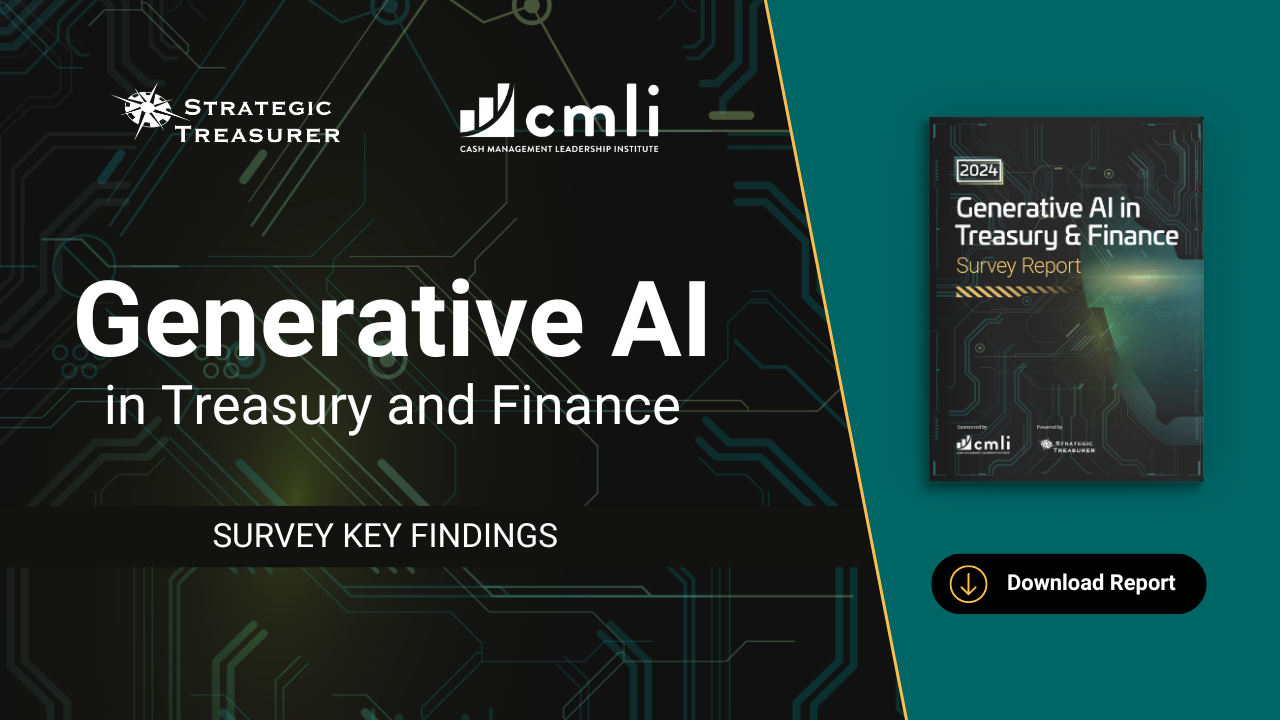
Generative AI in Treasury and Finance Survey Report
Artificial intelligence (AI) has become one of the hottest topics for discussion of late. The growth of ChatGPT and Gemini has increased treasury professionals’ level of familiarity and has spurred additional thoughts and actions. The 2024 Generative AI in Treasury and Finance survey captured the current AI use for treasury activity, as well as future plans.
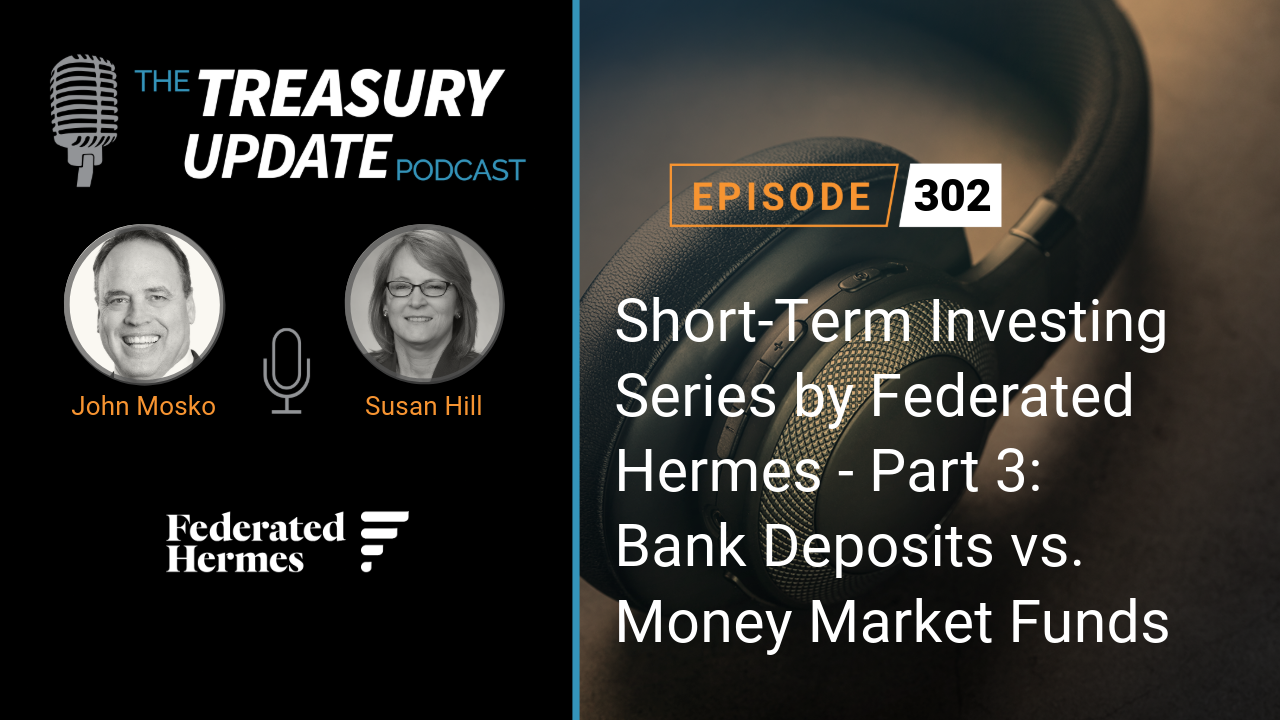
Treasury Update Podcast Episode 302
In this episode of the Short-Term Investing Series with Federated Hermes on the Treasury Update Podcast, experts from Federated Hermes delve into cash investing options, discussing bank deposits and money market funds. Explore the latest on safety, liquidity, and yield, plus the impact of recent bank failures and FDIC actions. Understand the pros and cons of each investment strategy in today’s ever-changing market.