
Episode 333
The Treasury Technology Tipping Point with Royston Da Costa
In this episode, Craig Jeffery and Royston Da Costa discuss the tipping point for treasury management systems (TMSs). They explore whether TMS providers will embrace new technologies, including AI, to offer enhanced services to their customers or stick with more legacy, inflexible technology structures. Listen in to learn more.
Host:
Craig Jeffery, Strategic Treasurer


Speaker:
Royston Da Costa, Ferguson PLC

Subscribe to the Treasury Update Podcast on your favorite app!



Episode Transcription - Episode # 333: The Treasury Technology Tipping Point with Royston Da Costa
Announcer 00:05
Welcome to the Treasury Update Podcast, presented by Strategic Treasurer, your source for interesting treasury news, analysis, and insights in your car, at the gym, or wherever you decide to tune in.
Craig Jeffery 00:19
Welcome to the Treasury Update Podcast. I’m Craig Jeffery, your host today. Our episode is called Treasury Technology Tipping Point, and I’m joined by Royston De Costa. Royston, welcome.
Royston Da Costa 00:30
Thank you, Craig.
Craig Jeffery 00:31
It’s good to be recording with you face to face. It’s a different feel than me and my studio, you in your office, and a large body of water separating us.
Royston Da Costa 00:41
Some things technology can’t fix in that sense, or replace, I should say.
Craig Jeffery 00:45
So this is a bit of a provocative title, right? Treasurer Technology Tipping Point. What, what is the tipping point? And as we’ve, you know, as you talked about that idea, you know, there’s this technology changes, and if we look at them as mountains, you get onto a new type of technology, and very few are on that mountain. Eventually, everyone starts to cross over through the valley of inefficiency as you get rid of your old technology with a new one, and then there’s the next one after that, and the next one, and so it’s always, hey, this is new, it’s shiny, it’s not as effective as the old stuff, or it’s not as complete, and then all of a sudden it becomes it reaches this tipping point, because it’s just too big, too fast. So, maybe you could talk to me about what do you mean by the tipping point, and what’s what’s making you think about this next tipping point?
Royston Da Costa 01:32
Right. Okay, so this is obviously my personal opinion and view about the tipping point, but I like, again, I have to kind of repeat in some ways, the way I see the technology that we work with, and particularly how the TMS world seems to be today, very much in some ways a story. If you think about, and certainly in terms of where my role within Ferguson, when it started back in 2010 I want to say post-economic crisis, there was a kind of re review of where we were with treasurer and technology. The new board came on board, said CFO said, Look, we need your, we need these processes to be more automated. There we had number systems, but they were not joined up. So we did that, and then we put in our first cloud-based solution, 2015 And in fact, you know, if you think of the terms of the time frame, most TMSs were pretty much chugging along, providing functionality. I don’t think there was any groundbreaking TMS. In fact, today I can’t think of any one particular TMS that’s sort of doing a particular cutting-edge technology that no other TMS is doing, but we’ll get to that. I just want to make sure I complete that journey path. 2015 cloud-based solution, then we put in about probably in total we’ve got about 13 cloud-based solutions. Very fortunate for us, that was pre-pandemic. So, when it came to the pandemic, plus some other factors that our company had done and put in place, we were relatively unfazed by the remote working, because we’d already been set up to do that. A number of companies were caught short because they hadn’t gone onto the cloud, and so therefore now I think they recognize the cloud is kind of way forward. To be honest, I don’t see the – I mean, the cloud is important, don’t get me wrong, but in the future I’m kind of a fan of the kind of the data cloud, I think it’s called, or where you know you can have multiple solutions on one platform mainly because of the KYC challenge that we have in terms of data sharing. Let’s look at specifically what’s happened since the pandemic, because that, without question, in my view, has been an accelerator in many respects for some of the technology and certainly the TMS providers, and it should have been rightly so. The other thing that’s interesting that has also happened since then and rightly so again is some banks not all, but some of the largest banks in the world have been investing huge amounts of investment in technology, which is good, and in fact some of them are beginning to partner with fintechs. So there’s an element there where I’ve seen as well from a report I saw recently from Tito Every in Europe that suggests that a number of companies are switching from in-house banking to using their banks. Now it makes sense to a degree where, if you’ve got banks that are investing the technology and providing the solutions that you might be running in house, then why on earth would you want to do that and spend that effort and money when you can get the bank to do it for you, so there’s elements of that where it makes sense, and the banks are beginning to permeate that space, potentially might have been held by TMSs in the past, so there’s a bit of kind of land grabbing taking place, but I don’t have a problem with that, as long as the corporates are benefiting from it, for the TMSs, in particular, I think. Where their challenge comes in is what’s different on the tin that they’re offering their customers today versus what they offered five years ago, 10 years ago. And I’m being a bit harsh, I know, but I still maintain you look at the technology that has evolved, look at what the back. Banks are doing what are the TMS is doing now. Again, I’m not trying to chastise the TMS instead, because I believe that they have a service to offer. We look at different technologies pretty much every month, and so often they’ll come up with a fantastic solution. It really is cash pooling, payments, cash visibility, but all these solutions are fantastic up to a point, because they’re all reliant on the banks, so they can only do so much in terms of giving you the kind of like window shopping, almost saying, “Oh, wow, you can actually do this, this, and this, but as soon as you get to the part where the bank’s involved, you’re kind of like, “Oh, well, sorry, but depends who you bank with, depends whether they can offer that, and most invariably they don’t offer that solution. I get that that’s the challenge, they can’t do much about the degree, but I feel that that’s got to change as well, because on one hand, the banks have less of an excuse and shouldn’t continue dwelling on the fact that they’ve got legacy system that they can’t do this, this, that, the other, because that’s not going to last long, especially with this generation who don’t typically have a bank account anyway. So, the concept of actually being tied into a bank is kind of like not really the same as my generation, but I think with the TMS is where I see the game changes, and I’ve maintained this before quite often, and this some 40 still exist to a certain degree. Most TMSs will look to give a solution that they believe, and I feel that quite often when we say to a vendor, and this happens sometimes quite across the board, not just TMSS, what it is. First of all, they don’t ask us the question, what is it you need, and secondly, if you do tell them what you need, they interpret that in the way they want to deliver that solution to you, and I think the tipping point I’m referring to, we’re getting to that point where corporates are getting fed up, really fed up with the banks and the TMS to agree, because where the banks are not offering those solutions to those pain points like KYC, and we’ve got the technology in blockchain to do that. There’s fintechs that offer that already, and with the TMS, is where every time you say, oh, can I have just this simple report or this simple change, either you get response that says, oh, you’re the only customers to ask for this. I’m sorry, I’m going to be a bit facetious. There’s 7 billion people on this planet, and you’re telling me I’m the only person that asks you this functionality on your system. I just, anyway, there’s that, but there’s also the fact that there are certain pain points that are synonymous for the majority of corporates, so the very least, if we’re still talking about those pain points today that we talked about five years ago, 10 years ago, 1520, so on, so forth, there’s something wrong there, and that’s where the tipping point comes in. So, when I say tipping point, what I’m referring to is that I see in 12 months time the TMSs that are more willing to embrace whether it’s the technology or whatever functionality they need to embrace to provide the corporates the solutions they need that they are crying out for, they’re the ones that will have kind of, let’s say, the most promising future, the ones that aren’t, I feel, are at huge risk of being discarded and ignored, almost put to one side, because again, you’ve got this element of remember, each year goes past, we’ve got a changing demographic in the workplace. I know that at the moment, I think there’s someone said somewhere we’ve got the widest range of age groups, or generations, I should say, in the workplace, which is not a bad thing, because it’s kind of one’s sharing experiences, but let’s say the Boomer generation, as each year goes past, certainly by the year 2030 in theory, should have exited the workplace, which means that the generations that are in situ a will are much more familiar technology, because they’ve grown up with it, but be, more importantly, will be the decision makers, and are some, in many cases, are the decision makers. So that’s beginning to, I think, will have an impact on what technology and which systems, and you know, sort of what corporates are going to be doing certainly in treasury going forward, and my view is that this generation, particular, are much more engaged in whatever is frictionless, whatever is efficient, you know, everything is kind of, you know, we talk about faster payments, that sort of experience, so anything that sort of comes up and says, ah, yes, we’ll leave that with this, we’ll come back to you in 12 months time. Once we do output, I think we’ll go to vendor B. They’ve already got the solution in place. That’s where I see this tipping point beginning to really take hold.
Craig Jeffery 09:52
That’s interesting. It’s different than I thought. What you would say, you know, the people that are in the workforce now that are becoming supervisors and managers are. Are probably digital first, they’re not digital natives, but they’re digital first, not digital halfway through my career. That expectation and the impatience is there. The impatience might be a negative term if you’re from my generation or mindset may say, oh, they’re impatient, but is it? I mean, if the capability exists today, why aren’t we using it in this type of application, we’d see it all in our individual lives technologically, and we see it in certain areas in business. Why not throughout all of Treasury? And so impatience would be, we’re not going to tolerate slow moving for no good reason, and it’s hard to have a good reason. I mean, the biggest reason is we already have technology that does some of it. If you’re a company that has it, like we look at moving to the cloud in 9695 96 banks were installing their desktop applications. It was going over the private networks, not over the internet. And then it quickly moved to the cloud, as quickly as they could. They moved everything to the cloud. They moved to SaaS offerings before technology providers. Technology providers started really around 2000 2001 is when they started selling, you know, they call them application service provider SAS. By 2005 or six, more systems were sold in that new type of tech than an underlying systems. Now the more expensive systems were more involved. Those are still largely going on an installed basis. By the time you got to 2014 or what was the time your company switched 2015 So you already had technology in place. It’s a very different decision to say I’m going to rip out something that’s working, working pretty well, versus I’m doing something completely manual, but then the development speed, the cycle time, how things, how things move, there’s a different valuation on that, that’s a tipping point too, because it’s the mindset of I’m not going to tolerate the poor process if it’s really poor, and then there’s also a tipping point, is I need to move on to new tech, because we’re slowed down, some of the development on the new tech is five to eight times faster than on the previous generation of technology, and even if the previous generation of technology has more capabilities, making the decision to move to something that’s growing much more rapidly, increasing its value to you far more rapidly becomes an easier decision the longer that time frame runs.
Royston Da Costa 12:27
And I like, you know, the word you use in patience is actually very apt, because this to me demonstrates, and it might be a bit harsh, but I think it’s a fair, it’s a fair example to use the difference between the generations, so a good example for me would be, and it’s probably less likely so, but if you go back a couple of years, supermarkets, maybe four or five years ago, I think it’s less so now, because they’ve kind of really migrated to the kind of self checkout, self service checker, but when you look at the demographic that typically goes, typically goes through a person who’s checking you out versus the self checkout, invariably it’s someone who’s older goes through someone who wants to be served by someone rather than someone who’s younger, and there it’s not just about the technology, in my view it’s about being quicker, they just want to go in to get their shopping and get out as quickly as possible, the same applies when you’re getting coffee or tea, most times in terms, and then we can go to a different subject in some ways, because this kind of typifies to me the behavioral patterns, and I think why it’s important, although I’m not an expert on this subject, just purely when we looked at some of the impacts of the pandemic, I’ve found that the younger generation are much more comfortable, let’s say, with communicating with their peers online, they are keen to meet face to face, but kind of a bit more focused, a bit more specific, and interesting. There’s another survey that came out from, I think, it was Sifted, sponsored by the FT, and this will, this is my shock, you, in a way, did impress me at first, said communication is improved by 50% as a result of AI. In addition, IQ goes up by 20 points as a result of AI. I think it’s very high level. You can see why it’s because you’re dealing with less mundane manual driven tasks, if you’re using AI, it heightens everything up to a point, and we’ve said this, and I’ve said this in terms of treasury, when you’re not having to press a button to get a report out, but you’re actually looking at the report, you’ve got the time to analyze report, that’s where the value starts getting added in. A third point I want to add very quickly on the whole point about tipping points. I believe the next 12 months will be a tipping point for treasurer’s. Is we’ve always been not just tasked but expected to demonstrate where we add value, whether it’s how we manage exposures, liquidity, you know, thinking of KPIs. The technology is there now the. Technology is there for us, and to enable us to quantify how we’re adding that value, and this is where again I come back to the TMS. Is what are they doing to help us to quantify those those metrics? Because frankly, they’ve got the data right, they’ve got the data, make it simple, make it easy, and this has always been a challenge for a lot of GMSs. Is reporting, so this is where I feel like now, with the AI involved, generative AI, we sold treasures can go on to Claude or use Python or wherever to give us the value and the benefit that we’ve been talking about in the cash flow forecasting piece. They should be possible for them to do it with KPIs, and not just KPIs. It was interesting in one of our banks, a very largest bank, said in terms of their API library, they’ve got literally 1000s of APIs, and it’s true, not all of them are relevant for us, but the fact is, you’ve got a choice, and API is again another area of terms of technology and AI of how you can look to using it where appropriate to improve some of your sort of processes and make it a bit more efficient, make it more automated. So it really is a bit of Alibaba’s cave, if you like. It’s there for taking, but we are limited by resource, we are limited by time. So, quite often we would turn to the banks, we would turn to our banking partners, our vendor of vendors to see where they can fill in those gaps for us. And it’s like, well, this is this an opportunity, huge opportunity.
Craig Jeffery 16:36
Yeah. Thank you so much, Royston, Treasury Technology Tipping Point. Yeah, yeah, yeah. Whether we use the term tipping point or point of inflection, there’s a point where things change, you know. We might use the term hockey stick, where things grow slow, and then then move up, and you know, depends on there’s a, there’s some contributing factors to that, which is probably the subject of another discussion. But the oftentimes in Treasury, it seems, as we’ve, we’ve done research over a long period of time, right, as consultants and researchers. When things get to between 15 and 20% then it, then it tends to be a tipping point. But if it’s largely driven through distributed technology, if the banks have it, and then it’s available, well, then it becomes, it accelerates from there. If it’s done individually, that transition tends to take a little little more time, because it’s has to be driven individually by company to make those changes. So, there’s a few of those factors.
Announcer 17:37
You’ve reached the end of another episode of The Treasury Update Podcast. Be sure to follow Strategic Treasurer on LinkedIn. Just search for Strategic Treasurer. This podcast is provided for informational purposes only, and statements made by Strategic Treasurer LLC on this podcast are not intended as legal, business, consulting, or tax advice. For more information, visit and bookmark StrategicTreasurer.com
Related Resources
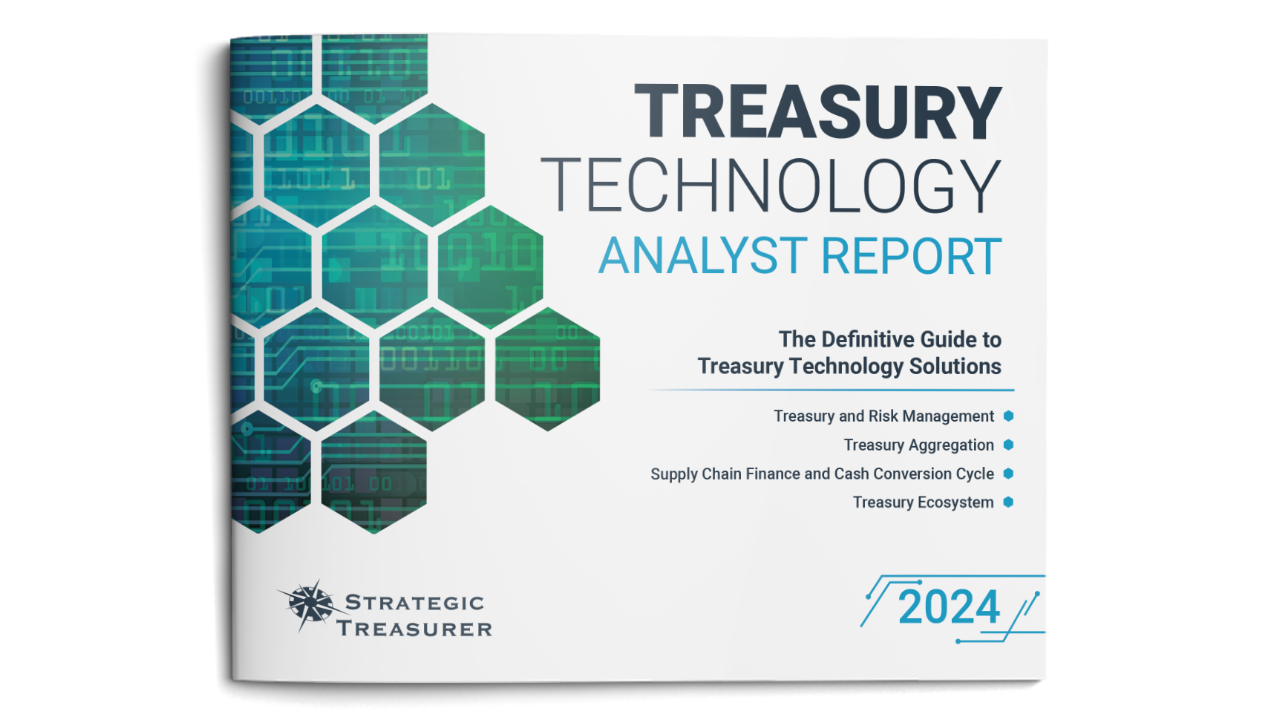
Treasury Technology Analyst Report
Researching new treasury and finance technology can be overwhelming. Strategic Treasurer has stepped in to help. Explore our definitive guide to the treasury technology landscape and discover detailed, data-based coverage of:
- Treasury & Risk Management Systems
- Treasury Aggregators
- Supply Chain Finance & Cash Conversion Cycle Solutions
Learn more about these technologies and evaluate some of the top vendors in each industry.
Generative AI’s Impact on Treasury: Workplace, Cashflow Forecasting, and Cybersecurity
In this episode, Craig Jeffery and Royston Da Costa explore the impact of generative AI in the workplace, with a focus on large language models (LLMs) and tools like ChatGPT. They discuss how AI is transforming cashflow forecasting, enhancing cybersecurity, and strengthening risk management. Listen in to learn more.