
Episode 323
Exploring Generative AI, ML, and RPA in Treasury with Royston Da Costa
In this episode, Craig Jeffery and Royston Da Costa discuss how generative AI, machine learning (ML), and robotic process automation (RPA) are transforming treasury functions. They provide real-world examples of current applications, discuss expected trends for the next 2-3 years, and explore emerging technologies like ChatGPT, Microsoft Copilot, and augmented reality. Listen in to learn more.
Course on Generative AI in Treasury
EuroFinance panel on AI with Royston Da Costa and LeeAnn Perkins
Host:
Craig Jeffery, Strategic Treasurer


Speaker:
Royston Da Costa, Ferguson PLC


Subscribe to the Treasury Update Podcast on your favorite app!



Episode Transcription - Episode #323: Exploring Generative AI, ML, and RPA in Treasury with Royston Da Costa
Announcer 00:05
Welcome to the Treasury Update Podcast presented by Strategic Treasurer. Your source for interesting treasury news, analysis, and insights in your car, at the gym, or wherever you decide to tune in.
Craig Jeffery 00:19
Welcome to the Treasury Update Podcast. This is Craig Jeffery. I am here with Royston da Costa from Ferguson. Today’s episode is titled Generative AI and Machine Learning in Treasury. Royston, welcome back to the Treasury Update Podcast.
Royston DaCosta 00:34
Thank you, Craig. It’s actually been a while, as you, I’m sure, recognize. In fact, I think it’s been about a year since our last podcast, and all I can say is, wow, so much has actually happened in this last 12 months, but definitely great to be back.
Craig Jeffery 00:50
So much has happened. We probably should schedule something every quarter, but I guess we let that. We let that slip. The discussion about generative AI and machine learning and Treasury. There’s this, this idea that everything is converted or nothing’s being done, and that the truth probably sits somewhere in the middle. I’d love to hear what your thinking is on generative AI, machine learning in Treasury, maybe we even get into things like coding and some of the tools.
Royston DaCosta 01:18
Absolutely, absolutely. So just a few other points I want to add. You know, the company I worked for for the last 22 years has been mainly domiciled in the UK. For most part. We are now domiciled in the US as of the first August this year. So we are a fully fledged US company going to the New York Stock Exchange. We still have a second listing on the London Stock Exchange, but my role will continue as is, and I’m based in the UK. The other point I want to mention, particularly in relation to this podcast, is I am now also a senior lecturer on a course called the impact of generative AI in Treasury, which I appreciate you agreeing to, having the link to that course if anyone’s interested on this podcast, what I want to just lay out, before we start talking about generative AI or AI, is, forgive me, but I like to go basic. And I feel like, you know, when we think about where we are today, we’ve got a wide demographic, frankly, of not just society, but treasurers that have different levels of, let’s say, experience and understanding or knowledge about technology when and I’m going back, I’m afraid here, when we look at the Internet, what initially start off of what they call web 1.0 was designed, really for people to find information. It wasn’t particularly interactive. It was back again, as you can imagine, 1990s it was only dedicated for users searching the data. It was sometimes also known as the read only Web. Then you got web 2.0 which I believe came around the early noughts, not 2000s where point two zero is more by the participative social web, where you had, like, a more enhanced version of incorporating web browser technologies such as JavaScript frameworks, and it really became more known for participating in contribution. I think where we are today is what they call web 3.0 and this is where you’re really looking and what technology is looking to build up going to the future web 3.0 is really known also as the read, write and execute web. So it’s really about content creation now, on top of everything else that we’ve had access to. And so this now leads us, very neatly, in my view, to the benefits of generative AI. Because generative AI is really very much focused on content creation now, very high level to start with, before we get into the into the weeds, as they say, benefits of generative AI, you can interrogate historic cash flows, for example, in Treasury to obtain great transparency and understanding of those cash flows and payment patterns. It’s obviously more interactive in terms of how we need to understand those flows and any that payment passes that exists. The other point to bear in mind, this is more generic to AI. Huge benefit AI, and why we are excited by AI is because vast amount of data can be analyzed in a fraction of the time it would take, not using AI and with greater accuracy. But there is a health warning on these statements I’m making. I have to stress, AI is not perfect. We all kind of recognize that, so we need to bear in mind that, and this is why I keep saying with technology and technologies like AI, as much as they will make us more and help us be more efficient. We still need human interaction. We need treasurers. We need Treasury teams to validate that data that we are receiving and kind of integrating, if anything, what I believe, with the technologies that we’re using that the AI. And then they’re going to automate some of the processes. They’re going to lift us up to a level of more efficient and more intellectual. Call it that if you want. Let’s put a different analytical way of interrogating the data. So whereas before someone, let’s say, press a button to download a bank statement with AI, potentially, you don’t have to do that, but you will have more time, potentially, to look at that bank statement now and think about, Okay, does that look right? Is that bank fee correct? And that sort of thing, and even those areas can be further automated, but I’ll stop there for now, because I want to make sure we cover the main topics. As I said, generative AI is really about content creation and using pre trained models and large data sets chat. GPT is an excellent example of generative AI, and no surprise, it’s becoming the go to tool, in my view, whereas previously might have used Google or search engine or what have you, they’re becoming go to tool, particularly for industry, but even in Treasury, you can pretty much get most information from chatgpt around whatever you want to know about in Treasury, it’s quite a useful resource. But again, health warning applies. You need to make sure that the data you’re looking at makes sense, and it’s, you know, they’re not sometimes could be an inaccuracy in there. So it’s still being developed and evolved. In terms of other examples, I mean, there’s, you know, the emerging technologies that you know, obviously they just been gradually adopted for content creation. There’s also regulation analysis, which I believe Citibank are using to interpret new regulations, analyze the impacts and model scenarios with the whole content creation, it goes into a fast area of generating reports, supporting employees and then creating marketing materials. Before I stop, I just mentioned one other example, where believe MasterCard and Visa are leveraging AI to enhance fraud detection, where MasterCard, using gentle predict and detect stolen card details from the dark web and visas, Visa protect are scanning billions of transactions to identify and intercept additional fraudulent activity in real time. So this is all a good thing, I believe, in terms of improving security for banks and customers, and obviously, hopefully potentially saving substantial amounts annually. One other point I’ll mention. I believe it’s MasterCard that partnered with a neo bank in in the Netherlands called Bunq, spelled B-U-N-Q. They are offering their customers a AI app, driven app to manage their bank accounts, where you can interrogate the account if they want to look for a particular payment, how much they’ve spent. Some banks already offer that. But this is going that step further where it’s kind of introducing a standard for customers who just a bit like chat GPT, kind of type in, when did I last pay this person? Or what’s the most efficient way to make this make this payment, that sort of thing. I see that being kind of huge benefit. And one of the very many benefits that AI has to offer.
Craig Jeffery 08:09
Yeah, as you were, as you were talking through those, the distinction between the future, you know, the possibilities of Gen AI, or even AI and Treasury, and then what’s being done, the art of the practical. You know, as you talked about that, it was, it was helpful. People are using it for forecasting, gathering data, making projections on the warning side. I want to talk about that a little bit too, because you mentioned that AI is really fast and quite accurate, but it does bear caution. I’ve, uh, I’ve been describing it this way. You tell me, if you think it’s still warranted, it’s Gen AI is like a far faster, far more accurate intern. You still have to check what the intern does, but it’s really pretty fast, and if you give the intern the wrong type of task. It does a terrible job at those.
Royston DaCosta 09:03
That’s an interesting analogy. I think it’d be a bit unfair both to to judge it our and the intern in certain in different ways. But no, I think you’re right to kind of look at it like that, because there’s an element of where, you know, if you I see where you’re going with that. Because if you had an intern, no, you know, you would typically not just put them in a situation where you think, or you can say, okay, that’s our hedging policy. Just execute it. You know, it wouldn’t be fair to them or to the company, because, you know, they’re an intern, they haven’t got the experience, necessarily. And even with someone who’s a full time employees, that fair bit of experience, we still have the checks and balances, because that’s the nature of Treasury, which never gets a situation. I’ve always maintained this. Think again of AI, if you look at I think FX hating is a great example, because you can literally automate that whole process if you wanted to, from start to finish. In other words, the collecting of the data. For your forecast from the business units, using algorithms to sending it automatically to a trading platform, getting it executed automatically. And then, obviously the back end is not so much a risk, in my view, getting it all confirmed and kind of recorded in your TMS solution. But I believe that that front end is very critical because of the risk involved, you know, you put the wrong number or amount in, it could be huge, huge implication for for the company and for the individual concern. So for right, for good reason you write to to kind of suggest that there’s that we need to have a mindset that says, you know, we wouldn’t do that with a with any of the employees leave alone someone’s just joined. So why should this technology be any different? And I get that when we look at technology, sometimes we get it’s easy to be seduced by the fact that, because it’s so seamless and it’s kind of almost in the background sometimes, and used to let it run, that we don’t have to check it. But interesting enough, it’s not just in the case of AI, and I think it’s the way AI does get a bit of a bad rap, because there’s almost this expectation that it’s got to be perfect, because it’s technology, and everyone talks about it, everyone thinks it’s amazing, and it is, but I don’t see why we forget the basic principles in Treasury when it comes to checking, making sure that the data that we’re handling is correct and accurate. So for me, let’s start with trying to answer your question by saying, AI, for me, is initially getting the information and the process that you need to accomplish and achieve a lot faster, a lot quicker. So as long as that’s achievable initially, great, you’ve got a result. The next step is also as critical, which is then to say that data that you’ve now received. What did you do before when you generated that data yourself? Maybe if you’re involved generating that data yourself, you might say, Well, I’ve already checked it, so I’m kind of comfortable it’s correct. And may have a more, you know, sort of closer relationship how you check the data to make yourself comfortable. But surely there was still if, depending upon the amount of data involved in that particular specific process, you would have still wanted someone else to double check that, say, in a hedging scenario, because that’s, again, a good example. You’re talking about going out to the market hedge. Let’s say a billion dollars. Did you? Would you really, any company be comfortable allowing one person to do that hedging all the way through with no checks at all? I’d be very surprised. So that check exists in that process, I would say it suggests that automate the bits where possible that take the longest time, which we’ve already discussed, and then have that check, and still use that check regardless the fact that AI is involved, but perhaps in a way more so, just to make sure that there’s not a initial issue In the in the calculation or the process. Because bear in mind as well, where you’ve got a process in the company, where they’ve been hedging for years, they’ve got a tried and tested method, AI is only just come in. So how can we just assume that’s going to work overnight? There needs to be a time frame for that process, for each company, obviously, to evolve to make sure that they’re comfortable, almost 100% comfortable, that that process is now working and correct, but I still think to avoid that eventuality. So let’s say you’ve completely time tested your process and you’re 100% confident works. I still want that check to take place before you go into the market to execute just purely as a like a payment again, payment approval process. Why do we have payment approvers? Even though the process mostly is automated all the way to the point where the payments being released, because we always want to make sure there’s no, you know, sort of nefarious activity involved, or there’s not some silly arrow, someone just missed something. It’s our nature and tragedy to be good gatekeepers. You know, companies cash and our company’s processes. Sorry, but the long winded answer, but I thought was a very good question, important to address in that at that length.
Craig Jeffery 14:15
You were asserting and making the point that, why would you just turn something over without running parallel. And why would you give up some kind of checking, a reasonable check, checking process that wouldn’t make sense to do that. So I think you’re, you’re spot on, and that there’s that danger of, hey, here’s this black box. It’s smart. It spits something out. We rely on it. It can be used to good ends and not good ends. I’ll give a couple examples, and you can tell me if, if you have other examples or things that help make the case. So you can ask questions of AI and Gen AI that are really helpful, and you can ask questions that it’s not going to be able to do a good job on, you know, finding some kind of pattern, and do a projection on historical information. We already see that. Working well in areas because it’s looking at historical data. You can compare it to existing forecast. It can do pretty well at that. Currently, there’s some companies that do a fantastic job, and they have multiple years of forecasting receivables extremely accurately, and it does that. You can say, what are the interest rates going to be in the future? Well, that’s not necessarily a good thing to do. Or or how will, how will Treasury adopt technology in 10 years? It will take information that people have written on the web, right? It’s not thinking this, and then it’s going to make other stuff up, and it may or may not be accurate. May be more accurate than someone who’s not thinking about things. It may provide some good ideas, but it creates things from, like you said, the data set, and if the data set is not if the data sets historical, that’s great, but it’s not always great about future things that are not just statistical trends.
Royston DaCosta 16:03
It’s a brilliant point you’re making, because this is the crux of when, again, coming to that age old question is, Will technology replace treasurer, Treasury team? And this is why I say it can’t at the moment, because we’re so far away from getting to a state of where, you know, technology’s 100% foolproof, particularly when I’m talking about foolproof, I’m really referring to mainly treasury, because a lot of what we do in Treasury, I believe, is very much based on subjective decisions, where I’m getting excited about this Technology, and Treasury is mainly because to get to those decisions, we’ve had to use technology that’s been part dated, and this still is, to some degree, not in the same person, but generally in terms of the world that we have to work with. I’m thinking of mainly banks and some of these other companies that still believe or not issue checks and not talking about the US, per se, but I’m talking about, you know, certainly the UK and so the point, in some, in many ways, is that we still need to make sure, if you like, that when we are when we use technology, and we should to try and replace all these inefficient processes. I don’t think anyone, in my view, has an argument with that. You know, if you can get your bank statements automated, statements automated, your in your payment process automated to a point, but it’s when you talk about data and how we use it in Treasury that you then have to almost recognize They still need to be a process for analyzing, understanding, and that’s an important part as well, by the way, you know, quite often, like you said, the black box churns out the data. Do we fully understand how that data is being produced? Because that’s just important as checking that the actual numbers make sense. And you know, before you kind of act upon them, in many respects, what you refer to, also about the historic nature of some of this technology, the data that’s been posted by the security it does. You have to also split that in some ways, because if you’re looking, I guess, at just purely, let’s say vendor supply data, you know, who have you paid in the last 20 years? And that, in my view, is fairly signed. It’s fairly binary. There’s no shouldn’t be any wrong answers to that. But if you then go into an in an area where you’re asking, sort of what like you suggesting, almost not just the future, but also what the most companies think is the best way to handle this type of challenge. Let’s put it that way. You can’t say for sure that’s going to be very accurate. It might still give you a sort of like the 8020 rule, maybe 70 to 80% accuracy. But because it’s subjective, it’s only going to be based upon what people, what contributors have put into the internet for you to accept that the answer is reasonable. So there you have to be. And I I’m not going to go into because it’s not my area, but I can imagine in the marketing arena, you know, any company is involved in marketing retail, that could be a huge challenge for them, because how reliable is that data for them? Because it’s really very subjective, but really within treasury, I think that’s you have to kind of form a segregate when you’re looking at this, the different types of data, and I’m sure there are more, let’s say, accomplished treasurer’s than myself, or, you know, going into coding, could probably argue that even then, you could probably install some sort of parameters around that data to make yourself more comfortable that that data is accurate and more reliable, but as a very general kind of view of how AI works and the data that’s available today, it’s got to be skewed without question.
Craig Jeffery 19:55
A couple of things I wanted to dialog on, was. Um, the use of tools like chat, GPT, Microsoft, Copilot, etc, even tools and how people are ready and positioning themselves for this. I want to make this statement because I think it’s helpful as we think about the evaluative concept of, how do we look at what we get back from some of these tools, how do we double check? Or how do we look at these things? It seems to me that Treasurers and those in Treasury are used to being able to understand is this directionally correct, is the magnitude proper? They’re not worried about down to the cent, but they they should know if it’s proportional Correct, right? You know more than the Pareto Principle, more than 80% they’re gonna, they’re gonna know if the system generates, you need to, you need to hedge a billion dollars here, and you’re like, our annual revenue, 700 million. How is this possible? It’s like, well, somebody entered a number on, like, their practice of looking at things going forward and knowing rough sizes from an analytical perspective should help them more than many other disciplines, especially as you’re forecasting you’re looking at risk. It seems like that discipline is far more helpful than someone who, let’s say, let’s let’s reconcile things down to the penny. There’s a lot of ways of checking. How do you how do you tell reasonableness? Well, that checking factor has to be reasonable. It’s not that the math is correct, that it’s unreasonable. And you can see that sometimes I I remember reading a report about the growth of the payments business and a well known, well, actually a multiple, well known payments analysis firm you know, predicted the total revenue on some of the payments business to be, what would be more than, would grow to be more than 10% of the global economy, the global GDP, and it’s like, that’s not possible. It’s like, it’s like, There’s no way that’s going to happen. But if, if you take these assumptions and these rates of growth and you extrapolate them into the future, you can get something that’s like, that’s not going to make sense, you know, it’s like, we’re not going to pay 15% on everything we make just to do a transaction. And so I think there’s some, there’s some element of, we have to have a mindset that manages that treasurer’s use of of AI and their historical ability to, you know, evaluate things in terms of proportionality, direction, magnitude really is a will be an advantage for them with this technology. Well, sure.
Royston DaCosta 22:37
And it’s interesting. When you while you were saying all that, I beginning to think again. It’s funny how this I feel this discussion is not just about technology. In many ways, it’s about the way that the treasurer is having to evolve and adapt to the world we’re living in in this day. It sounds a bit philosophical, but I think in many ways I’ve given me a bit of an analogy here. I’m going back a long time now, but in my earlier career, I came across a treasurer, as much as we had a policy to hedge, and I keep talking about the 8020 rule, and that kind of applied. Then, if you asked him, What do you think rates were looking like, or will look like could be US dollar, Sterling cable in a year’s time, he lick his finger and put it up in the air. But like, you know, they used to say, how which way is the wind blowing type thing? And that’s his way of how he approached that type of question, that type of scenario. I think most today would be mortified, including myself, if you were to offer that as an answer, even if it was to, you know, so let’s say to your CFO, but, and of course, it wouldn’t be accepted. Wouldn’t be acceptable for sure. The point I’m trying to make is, very simply this, we are surrounded by technology, regardless whether you work in Treasury or just as a human being, if you’ve got a smartphone you have got, and they say they use examples that panic, the technology on your smartphone today is like, I don’t know 100 times better, probably, you know, more than that, than what they had on the first landing on the moon, just purely in terms of power. But even then, I’ll say, you know, you look and you think about as a person, and you, if you you want to go out for the day, and you’re not sure what the weather is going to be like, you check your weather app, and that gives you some indication as to what the weather’s going to be like. It’s not scientifically 100% foolproof, but it’s the nearest and the best thing we have to what the weather. And this is probably not the best analogy, but I feel like in Treasury, that’s what’s changed for us today. In fact, there are certain companies now this is another good example. I know one, in particular, algodynamics, who do commodity hedging, and they use quantum computing. And again, quantum computing is the next level higher and more, like 10 levels higher than AI, because it’s using its huge power in terms of how computers work to process data everyone’s interested in our. Want to go into detail now, you can look it up on the on the internet, but it’s basically using really, really technical, you know, where computers are using digits, you know, binary digits, ones and zeros. Quantum Computers what they call qubits, which are one zeros and a high between one and zero, but exponentially. It’s very, very powerful. And they’re large companies that IBM, Amazon, they have what they call supercomputers to to to that use quantum computing to process that data. But the point I want to make, very simply is this, that with this technology that we have at our at our fingertips, let’s call it, there’s the potential now to literally forecast and possibly hedge to 1880 to 90% accuracy. That’s pretty impressive compared to when maybe even five years ago we would have not said, I mean, most cases, you could argue it’s going to be a 5050, case, you know, if you were really speculating, which obviously we don’t. But I’m just saying, when you think about the markets and what you were saying early on about the future, but I think that’s where this technology that’s developing, that’s being made available, and some of the solutions that are coming out there are, there’s there’s becoming that, there’s the greater level of accuracy that’s being built, especially, again, that’s the front end, potentially. But if you look at the back end, and as more data is being produced and being refined to get to a place where you know effectively what your payment patterns look like and what your you know your kind of potential exposure is going to look like, I don’t think there were, you know, we’re going to have a say. You know, we know for sure, with 100% accuracy, what the dollar staying rate will be in 12 months time, because that’s the way the world works. But there’s an element where you can probably embed like options. You know, when you get options, you can probably hedge within a narrower range than we could have done before. Definitely, the data is the big game changer in equipping treasures today, I believe, and going forward in having a more accurate and meaningful conversation and potentially report that they can, they can present to their CFO, to their board when they are proposing a particular, you know, sort of strategy. But I heard this other sort of rather amusing anecdote as well, which is, you know, I think it’s like, unlike an economic forecast, or very similar to kind of economic forecast, when you get it wrong, you know, you get full blame for it, for sure. But when you get it right, no one really passing on the back for it. I mean, that’s the nature of the game, right? So I feel that’s also kind of lesson learned, if you like, from how we use technology and how we you know, we’re not going to get a huge amount of credit for trying to forecast or trying to predict what’s going to be 12 months. We’re we’re really only you know in terms of key responsibilities here, to manage the risk, nice, to manage the volatility, and so whatever tools at our disposal, I think we should use, to fullest extent.
Craig Jeffery 28:07
What are some of the tools and activities that people in Treasury should be doing or experiencing now to ready themselves for the next phase or the this ongoing growth of the use of AI? You know, we can talk about how it’s going to do everything with risk management or write reports and do analysis. It’s certainly doing some things today. Companies are using it to provide forecast to check for fraudulent items, both anomaly detection, which is more on the machine learning side, but also detect other patterns and capture things like your examples on the on the card side. What should they be doing today?
Royston DaCosta 28:49
We use expression in the UK, called horses for courses. In other words, depending on what your company’s how to set up, what structure is, it will really depend what you decide to what will be best for your company. Three main areas that I’ve noticed, there are a lot more, by the way, that AI is having a huge impact in Treasury is cash flow forecasting, risk management and cyber security. I mean, these are the easy kind of flow, hanging fruit. Top Layer, I think you’ve done a survey yourself. I remember last year great where you interviewed a few 100 treasurers, and they kind of pretty much said the same thing in terms of focus. You want to go back to the basics in some respects. And I also am a great believer. I think people do recognize this when you think of technology. Is it hype? In other words, are we just looking for a solution that hasn’t got a problem for it? You know, that’s the look scenario. So that’s why always say, even when you’re looking at sort of, you know, implementing any sort of technology, trs solution, rather, look at your processes, look at how you’re set up, look at where the pain points are, and make and. Identify what it is you think are the loopholes that need fixing, and obviously make sure, at the same time, you’ve got some sort of road map with some objectives at the end of that, because that’s obviously important. And we kind of went through that journey after that, folks, and back in 2010 after the economic crisis, 2008 where new senior management that came on board said, you know, we we’ve got some technology, but we want that automated. Want to be kind of more integrated, bit more slick. And that was a good objective. And we identified the processes that were kind of, let’s say, little bit manual, bit clunky, and looked and began to fix them. Today, you could say there’s, there’s a huge array, really is a huge array of solutions out there. I mean, I certainly was impressed by the number of solutions that are coming up that could be very, very interesting and useful for treasurers. So I know one treasurer that is quite advanced in how he’s using the technology, but he gets a summary of his emails, you know, so for the day almost. I’m not saying he doesn’t need any of these emails, but it depends how you set them up as well. Say, in the Monday morning, you come in and you want to interrogate, what are the most critical emails that you need to address. And you know, you know he knows how the filters that he needs to put in there to make sure he gets the right output.
Craig Jeffery 31:19
If we talk about RPA, Python, using Microsoft pilot, pilot, or chat, GPT, and using in the fourth area, using the tech that might come in a treasury management system, what should someone in Treasury do? Who? Who should do something in this area? If, if it makes sense, should someone have skills in RPA? Should there be someone who’s helping with Python coding?
Royston DaCosta 31:44
The easy kind of knee jerk reaction would be, is to get someone into Treasury who has high kind of very technical skills in terms of technology, you know, because it would make it easier, a bit like it might be a project manager who has that skill set for project management, but may not necessarily have the Treasury skills, because what you need is, in some ways, someone who can get something done quite quickly, but you can’t have to guide them in terms of what you need done and where you want to get to. But in the longer term, I would expect I would want, pretty much every person in Treasury to have some understanding, some knowledge of how machine learning, rpa, you know, sort of gentle AI works because let’s, let’s talk about machine learning. Now, whether we know it or not, machine learning, we’re probably using it already. A very simple example for me with machine learning is spam filters. I use them. I’m sure most people have come across them. If they’re not using them. And what you’re doing there is you set up a filter within your email, as you know, to block or stop any spam coming through, something set up by a company, something you might set up, but it’s also used finding finance, for credit scoring and for detection. There’s an element of predictive analytics that it’s being that’s being used because AI and machine learning algorithms can be used to predict, you know, sort of market trends, asset pride movement, asset price movements and and potential risk events. So that’s that’s also beginning to become more widely used. But also you have trading systems, which I alluded to earlier on, using algorithms. That’s machine learning, the bit that I said earlier, I was not comfortable with, in terms of executing investment strategies based on complex scenarios or analysis. But yeah, all those very I think, examples, also, sorry, mentioned financial applications, where loan decisions, credit underwriting, as I said, for detection, already probably good examples of where machine learning has been used to great effect. When you look at rpa, which is robotic process automation, what you’ve got there then is really best way of describing that is taking a manual task and mimic mimicking human actions. So for example, you’re getting an email within an invoice. Attach. Typically, a human being would have to the email, look at the invoice, and then process it accordingly. RPA allows you to do that automatically and effectively, intelligently, including error handling. So I feel there’s a kind of probably very good, simple, but brought great examples of how you differentiated too in terms of how it’s being used widely. I would say, certainly for say, manual press and bank examples. I believe Australian New Zealand Bank and Bank New York Mellon both automate customer onboarding, data validation and email marketing is how they use it there. There are some companies that use RPA for their finance strategy tasks like loan origination and data entry. Yeah. So with Python, this has become the next level in which shocked me at one point, because when we last spoke last year, I always imagined that these. Coding languages would not really be something that we would the mainstream Treasury folk would need to get involved in. I was felt that okay, maybe treasurer’s that will focus on and actually studied it and wanted to do something with it, whereas I feel like it’s, again, bit like chatgpt, it’s becoming more democratized, because I’ve actually seen firsthand. So to be clear, with Python, what I mean, it is a programming line language, and it can be very powerful because because of what it is. But do I, or anyone needs to actually, need to actually understand and be able to code in Python? Simple answer is no, and the reason for that is because you’ve got application at chat GPT. And I think about metric Claude, AI is another good example. And there are a myriad of other potential applications you could use, could do that heavy lifting for you. So you literally can go into chat GPT and you can say, I’ve got this data, and I need this data to be structured into a report by maturity and by, I don’t know, by currency, let’s say, very simplistic. It will create the programming language for you, which you can then feed into another program that will generate the report. You need be very, very careful of what data you put into chat GPT and thereby the internet, for the simple reason that once you put that data in the likes of chat GPT or any of those search engines, it becomes fair game for anyone using the internet. That’s how you get this sort of information, if you like, from chat, GPT, or any of those applications. When you’re asking it something like, you know, where do most people go on holiday? What are the best places to visit in this particular country? It’s basing its response on what’s been fed into that, into the internet. So I think that’s one thing I’ve kind of definitely learned as a health warning, is that you don’t want to put anything that’s sensitive that’s sensitive. I mean, obviously you can put in completely, you know, sort of arbitrary data, and you get the structure or the report that you need. Once you get that report or the solution that you want, then perhaps feed in real data or whatever it’s you know that you’re working on. But just be very careful about how you know, they do say you shouldn’t really put any, you know. Again, like GDPR, you know, the very stringent regulation you want to be very careful with, with that particular area, in terms of Treasury, I feel like you know you don’t need to go down that path. If you’re not, you know, you’re not particularly keen, you can use these other applications to get to the same potential devastation. Again, Python is very, very powerful in terms of automating repetitive tasks, analyzing data and visualizing how that would work. It’s got, it’s got very powerful libraries called pandas and matplotlib. We’ve got financial modeling, which, again, a lot of treasurer’s, lots of treasury functions are involved in. And so this, again, Python would help you build complex financial models, forecasting, budgeting, risk management, again, any large amount of data, it can help you to manage more efficiently. I mentioned algorithmic trading as well. So that, again, is a good again, Python is involved, and can be involved in developing your own trading algorithms and and obviously optimizing your investment strategies. The other area, which is becoming more powerful, because again, today, we, some degree, have been mainly reliant, let’s say, on mostly external technology, and some degree our internal IT colleagues. But what I’m seeing now, and you think of APIs, in this respect, application programming interfaces, a lot of times, only looked at as something that connects to the outside world. But actually, I feel that’s just as powerful to connect internally, and particularly if you have disparate systems like we have in Ferguson. So Python’s very useful, helping you to integrate financial systems databases and API is probably another good example where that can be done, but then result improve efficiencies and visibility.
Craig Jeffery 39:20
Well, thank you so much. Royston, there was a lot of extremely positive things about particularly about AI and Gen AI and machine learning and the technologies that exist. And I do think your two cautions are excellent, one on the accuracy and checking, and two on how we handle, let’s say, private data, corporate data. Thank you so much.
Announcer 39:48
You’ve reached the end of another episode of the Treasury Update Podcast. Be sure to follow Strategic Treasurer on LinkedIn. Just search for Strategic Treasurer. This podcast is provided for informational purposes only, and statements made by Strategic Treasurer LLC on this podcast are not intended as legal, business, consulting, or tax advice. For more information, visit and bookmark StrategicTreasurer.com.
Related Resources
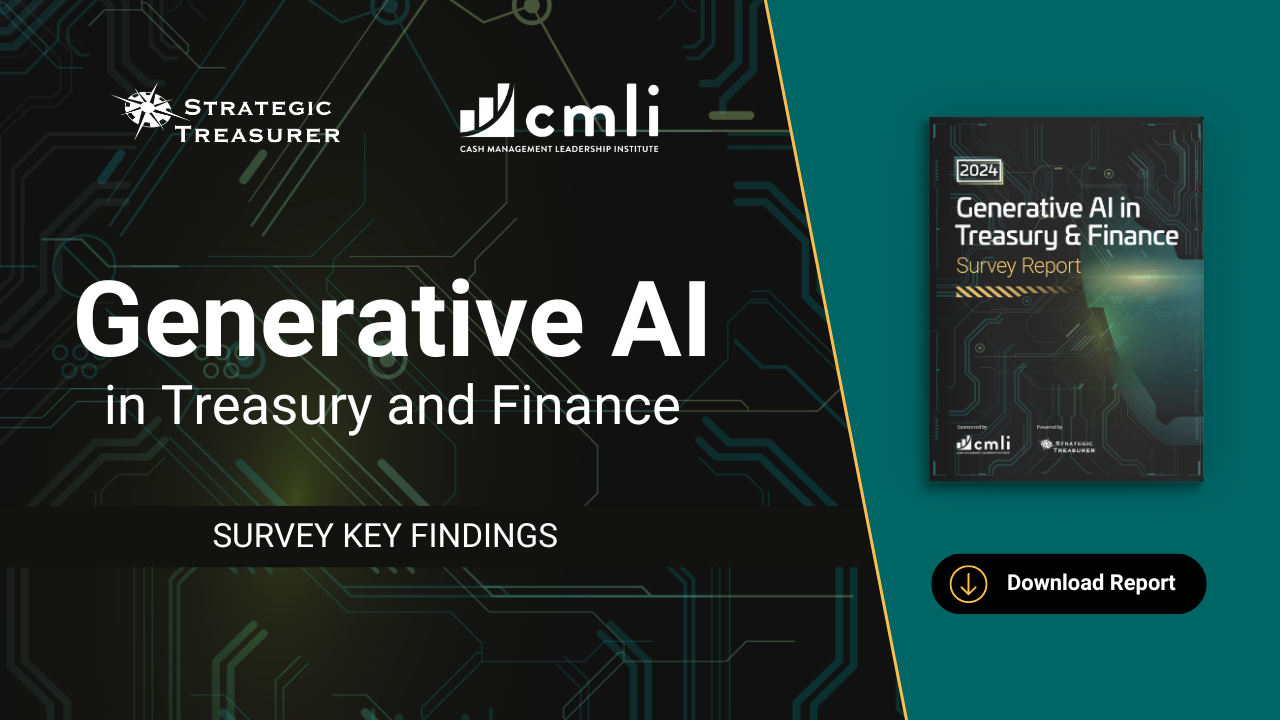
Generative AI in Treasury and Finance
Artificial intelligence (AI) has become one of the hottest topics for discussion of late. The growth of ChatGPT and Gemini has increased treasury professionals’ level of familiarity and has spurred additional thoughts and actions. The 2024 Generative AI in Treasury and Finance survey captured the current AI use for treasury activity, as well as future plans.
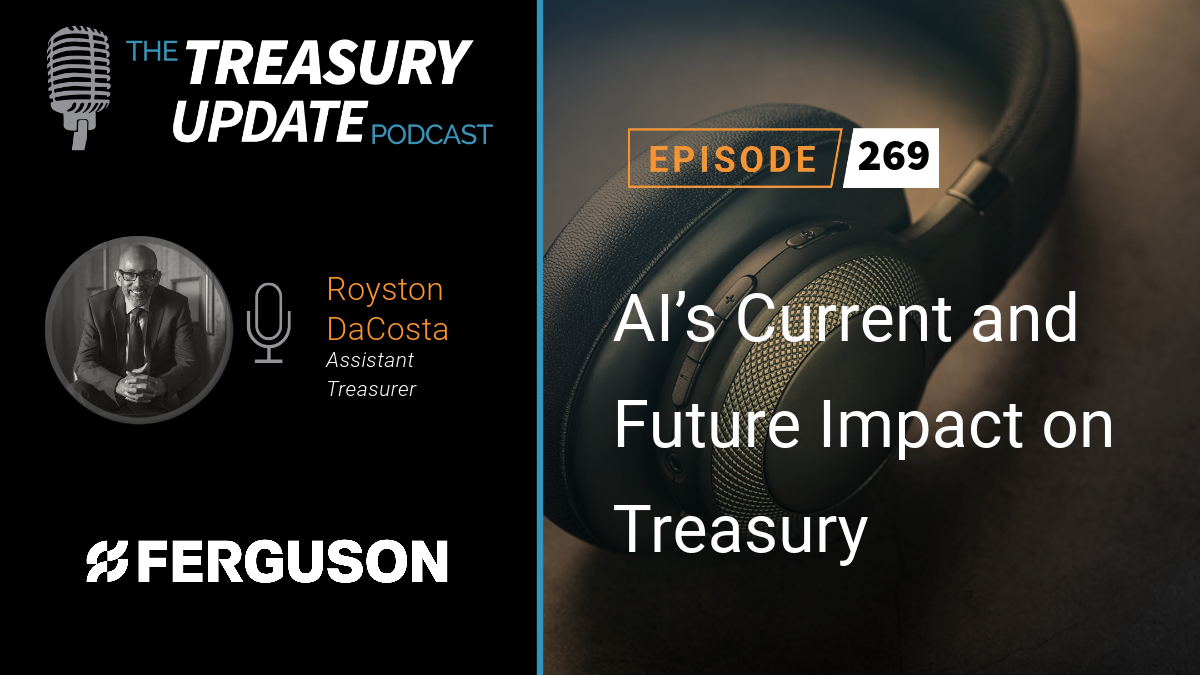
AI’s Current and Future Impact on Treasury
Have you been staying up to date on how artificial intelligence is transforming the landscape of treasury operations? Join us in today’s discussion as we explore AI’s current and future impacts with Royston DaCosta, Assistant Treasurer of Ferguson PLC, and gain insights into technology’s evolving role in shaping the finance world.