
Episode 322
The Future of Payments: Navigating Change Management with Deluxe
In this episode, Craig Jeffery, Managing Partner of Strategic Treasurer, and Susan Nichols, VP, Payments Product and Business Management at Deluxe, explore effective change management for digital payments. They discuss balancing technology upgrades with managing internal and external changes, securing executive buy-in, and integrating digital solutions smoothly. Listen in to learn more.
Host:
Craig Jeffery, Strategic Treasurer

Speaker:
Susan Nichols, Deluxe


Subscribe to the Treasury Update Podcast on your favorite app!



Episode Transcription - Episode #322: The Future of Payments: Navigating Change Management with Deluxe
Announcer 00:05
Welcome to the Treasury Update Podcast presented by Strategic Treasurer. Your source for interesting treasury news, analysis, and insights in your car, at the gym, or wherever you decide to tune in.
Craig Jeffery 00:16
Welcome to the Treasury Update Podcast. This is Craig Jeffery, and our episode today is The Future of Payments: Navigating Change Management. And I’m here with Susan Nichols from Deluxe. Susan, welcome to the Treasury Update Podcast.
Susan Nichols 00:33
Thank you for having me excited to be here.
Craig Jeffery 00:35
You know the idea of navigating change management seems to fall in favor and out of favor, depending on who you’re talking to, but in the context of making changes to payments, it seems so vital, both internally and externally, I wanted to get your thoughts and then maybe add to my own about what’s needed for successful change management within an organization, Particularly as relates to payments or moving digital with payments. And I was wondering if you could start us off on the internal side of the company, what’s necessary, what’s needed to make change management successful?
Susan Nichols 01:11
Yeah, well, I think with any change right, whether it’s part of moving to digital within an organization or not, you know, change really has to start at the top. Change typically needs to be sponsored and continue to be sponsored throughout the course of the change and make sure that there’s clarity on the vision, right? Why are we changing? People want to understand the why, and as it relates to just going digital and specifically with payments, you know, it’s all about not only helping ensure that the organization is ready for that change through training and resources and a formal change management program, but also ensuring that we have the external lens that our clients, that are vendors, that are other stakeholders, including regulatory bodies, potentially right that they’re ready for the change and they understand where we are going buy in is absolutely critical, and At this stage of you know, where we are in our business, normalizing change as a way to continue to grow is paramount.
Craig Jeffery 02:06
I think that makes a lot of sense. There’s there certainly can be resistance. And it’s easier to see resistance if there’s a lack of understanding of what’s being done, what’s the end goal? You know, one of the one of those famous quotes is, what if it isn’t broke, don’t fix it. And then other people have that quote. If it’s you, know, you need to break it, whatever, whatever the quote is. And so your comments are on the internal side. What has to be done on the company? There’s, there’s an external side to some of those have to deal with the vendor. How do you work with a vendor who’s helping you make changes. Some of the things that we’ve seen most helpful, I’d love to hear any feedback you have, as well as communicate clearly. And this is more than just having a weekly cadence of checking on the project management side, but communicating clearly about what’s working what’s not, thinking through things ahead the vendor, the vendor has done these things many, many times, but they haven’t done it at this company. And the company knows their internal culture, but they may not have done this particular project. And so that communication is essential to bring both people up to speed in that communicating clearly about redirection, change in scope, how to make sure things are going well. Seems to be another key area. Any additional thoughts on the change management with the vendor?
Susan Nichols 03:28
I think it’s just, you know, you’ve got to bring all the folks that are potentially going to be part of the change, or affected by change, kind of into the fold early. What you want to prevent is disruption, or what is perceived as disruption, right? Because generally, change is positive, especially in the context of business. And when things are perceived as disruption, right, it’s perceived by vendors or individuals in the company as really challenging the norm, challenging what’s comfortable for them. So if you bring them in early and you’re able to articulate the value of the change that they’re going to assist in, you know, helping you transform and go through. Then you’re going to have a lot more camaraderie, a lot more support and a lot more understanding, right? As you really work to change processes, which is really what you’re changing with a vendor, right? It’s typically going to be around the process side versus, you know, maybe a people and potentially a technology change as well, but more process driven.
Craig Jeffery 04:21
The other area of change management, or the other party in change management is oftentimes the customers, right? You? You mentioned some some aspects of that, too. And if we’re moving to digital, how do you pay our company? How do we pay you? Why is there value moving digital, from a information standpoint, efficiency standpoint, those factors matter and have to be communicated just like on the internal side. Here’s what we’re doing, here’s where we’re moving. Maybe it’s we’re only paying digitally, we’re only receiving digitally, or it’s, here’s one option, here’s why this may be superior, that communication needs to take place early on, or you don’t get the adoption. And you’re looking for either on the inbound side or the outbound side, and therefore it reduces or discounts, which are cost benefit analysis may have been.
Susan Nichols 05:08
Right, with customers. I mean, it’s the change is actually changing behaviors, right? We are all creatures of habit, so I think that’s pretty difficult at times for people to really change behaviors. So outside of just communication and really putting the value proposition of the change through the lens of the customer you may even have to consider incentives when you get into your kind of customer base, and helping them, kind of enabling them to go through that change. So that’s that’s sort of a unique aspect when you think about the customer base, but at the end of the day, right? The change, especially going digital, it, you’re going to get a lot of value on the back end, right? You get the ability to do automated, hopefully, onboarding, to ease that you know, the ease the ability to board new customers and to take advantage of a product that a customer might want to start using. You’re going to get, you know, more streamlined billing. You’re going to get more information, access to data and reporting, hopefully that you you know you probably haven’t gotten in the past, and that is the kind of change that’s happening today, right? It’s not just change for change sake. It’s changed to improve processes. It’s changed to reduce the manual aspects of many things we do today. It’s changed to make us better and faster and stronger honestly, and to deliver a better client experience. So I think if people can just realize that that is the catalyst for most change, especially for customers, that they might have more tolerance of going through the change pain that tends to come with, you know, just changing behaviors.
Craig Jeffery 06:32
I like how you’re saying that, you know, it made me think about, how do you understand how impactful a change will be? And there is that natural resistance to it, like, why make a change? There’s pain in making any change. There’s some effort. Is it going to be worth it? And sometimes it’s almost impossible to see what that benefit is up front. And I’ll give a silly example. I remember the first car I got that had Bluetooth. I was like, This is ridiculous. This is not necessary. This is excessive. Nobody needs this. And then I punched it into my phone, and I did a call on the drive home, and I was completely convinced before, if they hadn’t bundled it with the car at that time, I would have thought that was kind of nonsense. But now it’s like, if you wouldn’t look at a car that wouldn’t have that, and sometimes that’s the way with better information, better data, that that works in the process, but we can’t always see that up front. Change management is one element of making changes for the future of payments, or any type of, you know, move to digitalization, with payments and the either, our questions are sometimes difficult because it’s a bit forced, but how important is change management compared to the technology changes?
Susan Nichols 07:50
Yeah, you know, that’s that’s an interesting one to me, because it’s really hard to decouple those things, right? Technology changes typically do transform a business. So there’s going to be some kind of downstream change that people are going to feel right when there is a technology change, whether it’s the how they do something or the way they interact with whether it’s a customer or other stakeholder, to me, they kind of go hand in hand. Technology changes are really part of what I consider kind of true organizational change management, but there’s also the people size. So when you think about change management, that’s why I believe you really need robust programs to ensure that the change that’s happening from a technology perspective, or more broadly, gets completed. But even more is protected, because people are again going to go back to the what’s comfortable, and so you really have to continue to help them understand through their lens, right, why they want to do something the new way. And I think with B to B right in our world, not just thinking about like consumers, but in the B to B space, it’s not necessarily the what, right. I think most people are comfortable with what people want to change, or, you know why? It’s always the how. And so I think that just goes back to making sure that people are brought in early so they can help influence, kind of how things change, and give some insight to those that are driving the change, so that they they don’t stumble along the way, right and they get, they get better buy in and success.
Craig Jeffery 09:17
How do you do that in the context of without disrupting anything, and it’s maybe that’s the wrong question too, because any change is going to have some disruption. If you say it’s going to be perfectly seamless, I think people know that it’s like that. Rarely is it perfectly seamless. There’s lots of moving parts. So maybe you could comment about that, about how can you make change management working into the process without, maybe not without disrupt anything, but that without disrupting as much. There’s people that are the naysayers at the front end, and that can be just resistance for the sake of resistance, but other times, those are people that are really good at identifying here are all the impacts that will cause a problem, and if they can. Then, if you can get them to identify everything you’ve you’ve got your whole list of things that need to change, from a communication standpoint and or a system standpoint.
Susan Nichols 10:09
Yeah, I mean, I think to your point, right, like there is no change that doesn’t have some level of disruption. So I think, you know, quickly addressing the fact that there will be impacts, I won’t use the word disruption, but call it impacts to individuals or the way they do things is important. You don’t want to lose credibility and be sure that you’re out of touch right by by believing that there won’t be any kind of disruption. But in terms of how you do it, you know, I think you got to really start with fostering a culture that supports change. Normalizing change is a really important aspect, I think of business going forward. You know, change has always been sort of this thing that gets done within a certain period of time, and a program runs from this date to that date, and we’re done. But at this point, with the speed of just disruption and product management and the way that we are just continuing to just kind of speed up, honestly, we have to just constantly be changing. It’s a normal part of business today, and so I think normalizing the change is really, really important. I think it’s also really critical for companies to know that this will feel like, in total, a second job for most people. And so where you can to limit disruption, I would say it’s very important for companies to invest in both a formal change management person or team that can help, again, kind of be enabler of change, right, and be the guardian of that change, even after the fact, but also in professional services that can really come in and augment the team. So you can look at your partners, you know, like a deluxe right, and say, What? What are the resources can they offer me? Can they they, can they give me just staff augmentation? Can they bring in some trains, SMEs or subject matter experts, right, that can help me look at my specific environment and my my set of circumstances and navigate that change? So I think there’s a lot that can be done. And oftentimes people just sort of say, here’s what we’re where we’re going, and let’s do it without really augmenting the team to be successful.
Craig Jeffery 12:08
That’s oftentimes under resourced. Change management, communication, plan, bringing people along. Really, really good, good points. I’d love to hear a little bit about your background and your current role at Deluxe.
Susan Nichols 12:20
Yeah, so at Deluxe today, I am actually leading our receivables processing products, so all of our payments processing products that are within the B2B organization. So that includes, specifically product management, solution consulting, as well as our go to market and business management functions. So it’s a pretty broad scope. The products that sort of fall in the space are those that support, you know, processing paper. So paper checks like lockbox and RDC, as well as our digital payments products like Ebill and elockbox. So we have a number of products sort of that fall under my purview.
Craig Jeffery 12:56
Digital and and paper. You know, I think my initial thought of Deluxe not too many years ago, less than a decade ago, is they’re the check people. Is really surprising what a digital payments company and information company Deluxe has become with this long history of of growing. So that was, that was that was surprising to me, even as someone in the industry you mentioned earlier on the podcast, Susan about getting that high level buy in from your C suite. You know, not just setting the tone, but but having the commitment to do that. How can an organization someone embarking on a payments transformation or digitization program? How can they get that type of buy in?
Susan Nichols 13:40
Yeah, I mean, people talk about bringing bringing those along in the journey, right? And I think that that applies the C suite to your executive level team as well. But I would start by being sure that you can clearly articulate sort of the problem to be solved, right? And specifically think about the business case for change. You know, companies want to be stewards of capital, and so it’s important they understand, why are we changing? Because with all change, you know, again, there’s typically a couple different components. There’s a technology change that is likely, as well as potentially people and process changes. So it’s important to assure that they are very clear on what what issue is being solved by undergoing a change. And then I would recommend really bringing them along in the sense that presenting them with alternatives, helping them be part of the decision making process on how we’re going to change, because then they’re bought in right once they have been part of that decision process and they understand they’re able to sponsor the change, they can help you navigate roadblocks and things that might arise throughout the course of the change effort, they can also help invest in ways to isolate the complexity. Back to the comment about managing disruption, maybe that’s bringing in some outside help, right to really isolate that complexity and that disruption. So it’s very important to keep them to make them part of the initial change decision. Making process, in my opinion, and then obviously ensure that they’re lockstep with you on how you are accomplishing that change and how that changes is going throughout the process.
Craig Jeffery 15:08
You know, extending on that, how much of that is removing roadblocks or impediments or or resistance in different ways?
Susan Nichols 15:17
I think a good bit of that. At the end of the day, our executive teams at our businesses have the ability to make decisions that allow for, you know, roadblocks, to get moved, to reprioritize things, to tell somebody that does something a certain way every single day, right that they want it done this way, or to help them say, stop doing what you’re doing for this period of time and start doing this so that we can accomplish a change. It’s important to have that level involved, just to help drive that change throughout the organization. And, more importantly, going back to the to the vision of the change. Why are we doing this? You’re going to, you know, reminding people, and whether it’s an external party or an internal party, on why the change is happening is so important, and continuing to put it into the lens that you know can be received by that individual is also important. It’s going to feel different for everyone. And so leaders who can bring a sense of empathy to a situation, drive that change, help them prioritize what’s on their plate to support it, are going to be the ones that success or that are successful. And hopefully your leadership team can do that.
Craig Jeffery 16:23
Susan, the next, the next area I wanted to talk about and hear your thoughts on was the importance of digital payments and taking manual steps out of the equation. And I always think, what causes inefficiency? Well, it’s manual processes and poorly designed processes those create defects. Defects are extremely inefficient, and so one of the key areas is having a good process. The other is taking those manual steps out of the equation. That’s where errors are introduced, where defects come into play. I know you have some stories about this and you have some examples, but I’d love to hear some real world examples about this.
Susan Nichols 17:00
Yes. I mean, I think there’s, there’s there’s kind of two aspects to this, right? There is both kind of the digital product aspect of this that our customers can, you know, use, but there’s also the digital experience, right? And there’s a digital experience that both our external partners or vendors are experiencing as well as our internal employees. So I think, you know, there’s, it’s critically important to try to take the manual steps out to prevent issues. But we have to just make sure that we sort of baby step folks, depending on where they are and what the current process looks like, not everyone is ready to leap, you know, straight to the end state. So just helping educate and train along the way is really important. You know, within our space, we have a couple of we had an issue this year where we were able to actually go and read a bunch of contracts in a different way. And what that means is, we were able to leverage AI in a digital process, where instead of having a tiger team of numerous folks, you know, manually pooling contracts, reading them, right, we were actually able to use technology and digitization to digitize information out of those contracts, capture it, summarize it, and ultimately tell us what we needed to know in fraction of the time. If you can imagine that allowed a bunch of people to continue to do the job that we need them to do every day in supporting our clients. And so, I mean, that’s just one example internally, and then you have products right that our customers can use to help, you know, ensure that they get straight through processing in a more, you know, in a faster way. So as a legacy check company, right, we’re very, very proud to manufacture and process paper checks, no doubt, but we have also developed digital solutions for our clients so that they can, you know, get easy access information, have straight through, processing, receive, you know, receive their deposits faster, automate activities that take a lot of time, right? Like matching an invoice, you know, to a payment and applying cash, those are all things that we are looking and very focused on, making sure they’re they’re automated and digitized so the people can focus their time elsewhere, but it’s a lot of change, right? So we have to make sure, again, that we employ the right change management techniques, that we go at a pace where adoption can be they can occur, and really enable all of our clients to be comfortable and for us successful.
Craig Jeffery 19:16
As we wrap up, I wanted to start a little bit of a discussion about leading practices for implementation? What do you need to look for or be aware of? And you brought up a bunch of those. What are leading practices for implementation? That there’s a that there’s senior leadership buy in, that the C suite explains what’s being done, why it’s being done, and this is always in the context of a lot of priorities. So the end is in goal. It’s clear. I think the other two other things that seem to be clear is that there’s a very formal project management process and and a formal change management process. This, this ability to communicate throughout the process to understand how change impacts the customer, community, internal part to. Participants, particularly, you know, through implementation, through the white glove service, or the ramp up time and then post those. Seems those things seem to be key areas for implementation, having that defined, making sure people have the resources they need, for project management, for it, for for change management, those all seem to be essential leading practices for implementation. Any comments on those or anything else stands out as something we don’t want to miss or forget?
Susan Nichols 20:32
Yeah, I think you summarized that really well. The one that I think I would just sort of double down on and make sure is really understood, is you really need to spend time identifying the uncertainty that surrounds the change that’s challenging someone’s kind of comfort level that’s challenging, you know, a process that somebody, whether it’s again, internal or external, has been doing for many years a certain way, and start talking about it right? Talk about it proactively, get their input so that you can execute the change in a way that they feel sort of bought in. I think in addition, you need to really understand your company’s tolerance for change. Every company is unique depending on what change has already occurred, depending on the type of business you are, every company is going to have a different appetite or tolerance for that change. So that’s that’s an important thing to be aware of as you embark on a large change kind of or transformation project. And then lastly, the one thing I did not talk about as a leading practice is whether you have a formal project or program or not. Whoever is driving the change, whoever is sponsoring the change, and the folks that are enabling that change must be willing to iterate and evolve and take feedback and speed up here and slow down there, and really just just try to manage that disruption as much as possible. If you’re not willing to listen, then it’s going to be again, very, very hard for whatever change that you spend time and money implementing to be adopted and protected and continue to be sustainable over the course of the next year. So I would say really that iteration process and feedback processes is very important.
Craig Jeffery 22:13
That’s great, that the iteration process requires that adaptability or flexibility, that that seems so, so crucial. No, no, plan survives without some change. Susan, thank you so much. Really appreciate your input.
Susan Nichols 22:27
Yeah, you’re welcome. I mean, I think we should just remember, right, that in any business, change is normally good. It can be very uncomfortable based on what you know or what you don’t, but it’s being in the dark that makes people feel like it’s a disruptive change. So it’s best to manage that change in a way that makes it feel productive instead.
Announcer 22:48
You have reached the end of another episode of the Treasury Update Podcast. Be sure to follow Strategic Treasurer on LinkedIn. Just search for Strategic Treasurer. This podcast is provided for informational purposes only, and statements made by Strategic Treasurer LLC on this podcast are not intended as legal, business, consulting, or tax advice. For more information, visit and bookmark StrategicTreasurer.com.
Related Resources
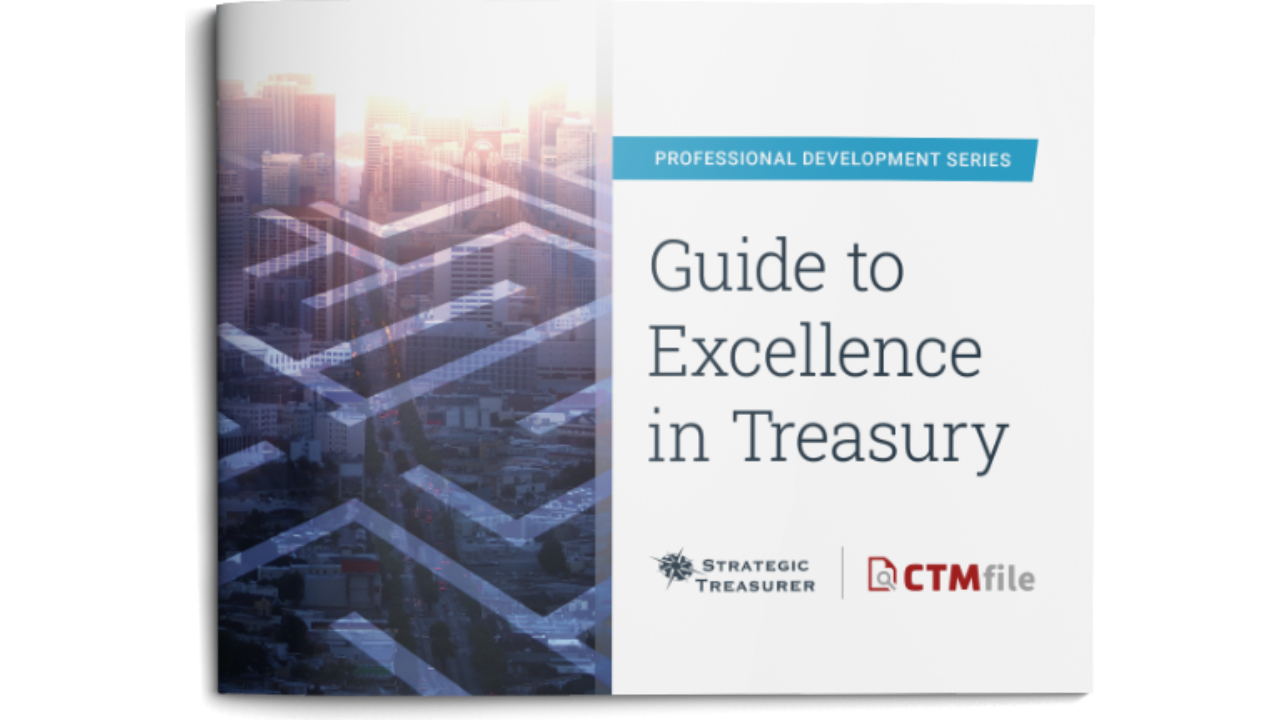
Guide to Excellence in Treasury
With insights covering everything from important steps for the new treasurer to leading practices for securing resources, overcoming blind spots, staff development, metrics, technology, working capital, and more, the Guide to Excellence in Treasury eBook offers strategies and fine-tuned approaches to major areas of challenge for treasurers.
Prioritizing Relationships over Transactions: The Importance of Payments in Customer Experience
Payment processing is no longer just transactional. It’s now about weaving payments seamlessly into the customer journey. In today’s podcast, Craig Jeffery, Managing Partner of Strategic Treasurer, and Layne Kight, Sr. Product Manager of Digital Payment Solutions at Deluxe, discuss customer expectations across industries like healthcare, utilities, and banking. They discuss how those industries cater to expectations, as well as practical ways the industry has improved over the past decade. Listen in to learn more.