
Episode 340
The 25 Questions and Answers That Will Define Finance & Treasury in 2025 with Craig Jeffery
In this rapid-fire Q&A podcast, Craig Jeffery explores the future of treasury in 2025, sharing insights on the key trends shaping the industry. Topics include AI, real-time payments, ESG, digital assets, cybersecurity, and more!
0:00 Intro
1:07 Interest rates
1:43 AI cash forecasting tools
2:14 DeFi solutions for Treasury
2:35 Blockchain
3:02 Real-time payments investing
3:46 ESG factors
4:20 Working capital vs liquidity
5:52 Digital assets
6:28 Cross-border payments
7:03 Cloud TMS
7:54 AI analytics
8:47 Real-time global cash visibility
9:36 Machine learning in cashflow forecasting
10:24 Risk insights
11:02 Embedded finance
11:52 FinTech’s vs Banks for corporates
13:14 CBDCs use in corporate treasury
13:52 Supply chain finance
14:28 Cybersecurity
15:38 Automation
16:12 Faster payments
16:46 Risk vs. Optimizing cashflow
17:28 Innovation vs. security
19:04 Multi-currency
19:33 Are treasury departments ready for 2025 fintech risks?
21:17 Outro
Host:
Jon Jeffery,
Strategic Treasurer


Speaker:
Craig Jeffery,
Strategic Treasurer

Episode Transcription - Episode #340 - The 25 Questions and Answers That Will Define Finance & Treasury in 2025 with Craig Jeffery
Announcer
Welcome to the Treasury Update Podcast presented by Strategic Treasurer, your source for interesting treasury news, analysis, and insights in your car, at the gym, or wherever you decide to tune in.
Jonathan Jeffery
As we roll into 2025 I wanted to do a 25 questions and answers that will define finance and Treasury in 2025 with Craig Jeffrey, so this will be a speed round 25 questions. We’re going to try to cover it efficiently, but still get some good information out there. Craig, welcome to the show.
Craig Jeffery
I’m glad to be here. It’s do I have to answer within 25 seconds, within a minute, within a minute, within what?
Jonathan Jeffery
We don’t have too many rules, but we’re going to try to be strict, one minute max per answer. Be clear and concise, provide context, but avoid over explaining, and then stick to the topic.
Craig Jeffery
I don’t like being bullied on podcasts.
Jonathan Jeffery
You’ve done you’ve done this to a lot of speakers on our FinTech Hot Seat. So I thought this would be a great.
Craig Jeffery
Okay, let’s do it.
Jonathan Jeffery
Flip the rolls around. So starting out, question number one, how will changing interest rates influence corporate cash management strategies in 2025?
Craig Jeffery
Answer number one, changing interest rates. They’re decreasing. They’ve been decreased. And expectation was four decreases by the Fed earlier they adjusted that two interest rate decreases. There’s more discussion about maybe one. So changing is a decreased expectation of lowering rates potential shift up maybe in the second half of the year, depending on what’s occurring. So being flexible, it’s not a it’s not only it’s not on a glide path for the whole year, perhaps.
Jonathan Jeffery
Question number two, will AI powered Cash Forecasting tools replace traditional methods by the end of 2025?
Craig Jeffery
They will continue to grow in use. We’ve had multiple years of using some of these tools on a more limited basis. That’s going to grow in 2025 I would look at this to be replacing more forecasting methods over the next three years, but we’ll see the continued increase and accelerated increase in 2025.
Jonathan Jeffery
Question number three, are decentralized finance solutions a viable option for corporate treasury in 2025?
Craig Jeffery
Yes, there will be several viable options. I would like people to think about digital commercial paper as one potential option that, on the defi basis, the use of blockchain will be viable in this environment.
Jonathan Jeffery
Okay. Number four, will blockchain technology continue to remain niche in 2025?
Craig Jeffery
It will expand in 2025 but I think it will. If you said three years, I would say, No, it will not be niche in 2025 it’ll remain niche, but there will be some uses, more broad based uses, in Treasury, corporate treasury, in 2025 okay, there’s some people out there trying to prove you wrong. We’ll see who, who’s right in the end.
Jonathan Jeffery
Question number five, should companies prioritize investing in real time payment systems to stay competitive this year?
Craig Jeffery
If you have use cases where fast payments, immediate payments, makes a difference, then you should invest in those in this next year, certainly, there’s new payment rails that are not just because they’re fast, but because they can provide better information and a better experience for you and your trading partners. You should be investing those over over time, if you haven’t already. So it depends, depends on your use cases. For 2025 Generally, yes, you need to take advantage of the new payment rails when you invest is less important, the fewer use cases you might have at the forefront.
Jonathan Jeffery
And question number six, ESG seems like it’s not been on the headlines as much lately. How much will ESG factors influence cash management decisions in 25?
Craig Jeffery
I think ESG will vary depending on the company. I think it’ll maintain about the same level of importance in 2025 environmental in the European area, governance continuing to be more important in the North America region. I think they’ll stay. It’ll probably stay at the same level with a slight increase.
Jonathan Jeffery
Okay, you’re doing pretty good on time. For each of these we’re staying well under the one minute. Question number seven, is working capital optimization more important than cash liquidity in today’s market?
Craig Jeffery
No, the Well, I mean, it’s more important in people’s minds. I mean, cash liquidity is a broader category of which working capital management could be, you know, subsumed or be a part of that. The focus on liquidity is clearly more on the top of minds of treasurer’s and senior financial people. Working Capital might go up to number one, sometimes go down as far as number three, and what people are focusing focusing on. So this still remains. Is important, but it’s not more important than overall liquidity. Okay, could you state your sources the left lobe of my brain? Well, I mean, it’s but if you look at some of our surveys, I don’t remember some of the information from our surveys, but working capital management, optimization and some of the recent surveys is, is still important, but not as important as people are looking for liquidity. So on the opposite side, maybe the right lobe of my brain is telling me we are seeing a pickup, with a lot of the supply chain financing vendors offering another method of advancing so this is a quick round. I’m not balancing off completely, but I would, I would give the 5545 advantage to liquidity over working capital for 2025.
Jonathan Jeffery
Okay. Question number eight, will Treasury teams increasingly manage digital assets like crypto in 2025?
Craig Jeffery
Being very technical, yes, but very slightly more. I mean, it’s not like people are abandoning it and it’s not like people are adopting it heavily. I don’t expect cryptocurrencies to be handled at all. I would expect a few more companies to pick it up in 2025 but pretty much flat. And it’s not anywhere near it’s on the very tip of the hockey stick, if there ever will be a hockey stick in this environment. So that’s niche as well. Will remain niche as well this year. Yes.
Jonathan Jeffery
Question number nine, How crucial is the role of Treasury in managing cross border payment complexity in 2025?
Craig Jeffery
It’s their core responsibility. So it depends on the organization. How much you have, and is that much cross border activity you have, and is that activity growing or not? So the more it’s growing, the more important it is. If it’s being flat, it’s it’s less but generally, yes, I mean, there’s expectations of significant volatility, with the goal to, you know, keep your risk level in line with your appetite. They’ll, they’ll be more managing of that, and pay more attention paid to that in 2025.
Jonathan Jeffery
Question number 10, is a shift to cloud based treasury management systems inevitable for most businesses in 2025?
Craig Jeffery
I think for those that haven’t shifted, yes, I think that’s that’s a shift that’s going on. There’s nothing that will slow that down in 2025 that shift will continue. Everybody should be on it. Almost everybody should be on it. I think you have a huge case to make if you’re not going to move to cloud. I mean, in so many areas, it’s been dominant, and there’s different types, cloud software as a service, cloud native or platform as a service. The shift to the newer technologies has been going on for 20 years. There’d be very few use cases where that doesn’t make sense. So if you’re not using cloud based TMS by the end of the year, you’re well behind the times. You really need to prove your case. Why you wouldn’t move that way.
Jonathan Jeffery
Okay, question number 11, will AI driven analytics completely transform cash management processes by December of this year?
Craig Jeffery
Well, with the with the date that close, I would say, No, will it completely transform it? No? Will it start to transform some Yes. Will it completely transform most of these by 2030, yes. So with the date a little closer, I’d say we are seeing some transformation. We will see that accelerate. The capabilities are growing. The systems that offer that are expanding rapidly, and so now it’s available to more people. So the shift will be rapid. It just won’t all be by December 2025 it’ll be interesting if this AI adoption is at the start end of going parabolic, or if it’s just a steady uptrend, I’m gonna make you draw a parabolic curve on the chart to see if you know what you’re saying, it’s going parabolic.
Jonathan Jeffery
So question number 12, can Treasury Departments realistically manage cash visibility in real time across global operations in 2025?
Craig Jeffery
I would say yes. The majority can manage it in a current basis. That the only challenge I have is the word real time, because not every bank is set up to provide, you know, up to the minute, the real time, like within eight seconds, 12 seconds, timing. So if we’re rigid on that definition, the answer is no, too many of your banking partners won’t offer that. If it’s very current intraday activity, think minutes, not seconds, then, yes, some companies are achieving that so, but not everything’s connected with APIs, kind of the streaming flow of information. So that’s a pretty hedge of an answer. But you said we have to keep it under a minute.
Jonathan Jeffery
Question number 13, should every treasurer be implementing machine learning for cash flow forecasting in 2025?
Craig Jeffery
Well, every is every single one, every single one, no, not every single one. Should do it for companies with a certain level of complexity. You know, you’re in multiple banks, maybe you have different types of flows that have different characteristics and. You, it makes sense we had a system that also supports some of the machine learning this pattern detection, and offers that through the system that can become a pretty simple ad and can make a lot of sense. So the answer is no for everybody, but there’s quite a few who can and will be able to take advantage of it within their existing systems, not building their own, but using tools that exist.
Jonathan Jeffery
- What is the best way Treasury Departments can use data driven insights for better risk management this year?
Craig Jeffery
Okay, so for risk management, I’ll think of exposures that you have, foreign currency, commodity, interest rate, what’s the best way they can use data driven insights is get the data into a place they can access, a data lake, a treasury system, a platform that they can do and then run, run some of the models on that to understand your exposure, to figure out what you need to do with that exposure, to bring it in line with your risk appetite, and then do whatever trading or however you’re managing those risks from that standpoint.
Jonathan Jeffery
So number 15, will embedded finance offerings redefine how companies handle cash management by the end of this year?
Craig Jeffery
It will, it will redefine that will be transformative. And so when, when you ask the question, embedded finance, embedded finance, embedded banking, embedded treasury, is the bank’s information and services embedded in the systems that the companies are using, whether it’s an ERP, TMS, you know, some other admin system. And so that’s happening. So banks like Citi are on a huge push to make their their banking services available wherever the clients need to use those. That includes corporate clients, clients, and that is, that is significant. So that is starting to transform how people are doing it, and that transformation will continue to pick up. And they’re not the only bank doing it.
Jonathan Jeffery
Question 16, can FinTech partnerships offer more benefits than traditional banking relationships in 2025 so is this for banks or for a corporate?
Craig Jeffery
For corporates, there are a number of direct FinTech relationships that are very logical for for corporates to do. It’s something that doesn’t exist. It has great capabilities and it and it’s fine to be neutral. There are also a very large number of companies that will do well to partner with the banks who are partnering with fintechs. The more adversarial relationship of fintechs and banks from a decade or so ago has morphed into much more collaborative environment, less less competitive, more collaborative, where they’re integrating the fintechs into their platforms, and so you’re taking advantage of the relationships you have with the bank, coupled with some of the leading providers of some of the tech. So that hybrid environment is is very strong. So the decisions, whether it’s going directly or going through your bank, those are, those are decisions, but the FinTech providers are, are leading most of the banks in these different areas. So it sounds like a no, because you’re probably going to get FinTech relationships through your traditional banking relationship. Anyways, there’ll probably be more of those for sure
Jonathan Jeffery
Yeah. Okay. Number 17, how will the introduction of CBDCs reshape corporate treasury this year?
Craig Jeffery
I think it’ll be almost no impact whatsoever. I mean, like the US doesn’t have that out. I think this is a multi year thing before there’s an impact. So this is just an area to watch, not watch super closely, but pay attention. I don’t see that as a 2025, activity specifically to the US and Europe or worldwide. For most areas, it’s multiple years before that’ll become real. And I can’t really qualify if that’s a five year or 15 year, but not this year.
Jonathan Jeffery
Number 18. Should Treasury Departments take on a more active role in Supply Chain Finance this year?
Craig Jeffery
Most companies should take a more active role of Supply Chain Finance. It’s another way to leverage your balance sheet. Get a third party in the mix so it’s not win lose on receivables payable. It’s another way to tap it. Interest rates are elevated. They’re not as high as they just recently were, but they’re off of zero. And so this is another flexibility for the company, it also provides a greater way to support your relationships. So that would be a yes, okay.
Jonathan Jeffery
Number 19, will the increased focus on cybersecurity force Treasury Departments to overhaul their systems in 2025?
Craig Jeffery
There’s definitely an increased focus on cybersecurity and a definite increase in awareness of how dangerous, the dangerous it is with criminals who are targeting companies to get at not only their data, but to get their cash. So they’re doing that, and this is this is showing more vulnerabilities that exist, and not just from a general cybersecurity but from how do we secure? Or overall payment processes. This will force Treasury Departments to really focus on the systems, processes and structures that they use to protect their cash and their most liquid assets. But is the threat strong enough that people will actually take action in overhauling their systems? The threat is strong enough that some are either overhauling their systems or adding functionality to existing systems, not necessarily throwing out a system, getting a new system as much as strengthening a system, bringing in other security services and controls to protect it.
Jonathan Jeffery
Question number 20, can automation eliminate the need for human intervention in cash reconciliation in 2025?
Craig Jeffery
Yeah, I don’t know that it’ll ever eliminate it all completely. But can it make it so it’s, you know, some humans are focused on just a fair very few thorny issues. Yes, it’ll make it very, very efficient. They’ll only be handling the major exceptions and having to spend less time doing so, because it can serve that up to them. Well, here’s the exceptions. We don’t know how to match it. You you figure that out.
Jonathan Jeffery
Okay, 21 will the demand for Faster Payments push Treasury teams to adopt more advanced technology in 2025 I’m going to answer that?
Craig Jeffery
No, I think the need for better information and better processes, with a third priority of being faster, more speedy. I think those first two items is going to lead to the adoption of better technology, other things like payment formats, the new payment rails that exist will drive those changes both in 2025 and in 2026 2027.
Jonathan Jeffery
Okay, and 22 should Treasury Departments focus on managing risk over optimizing cash flow in unpredictable markets?
Craig Jeffery
That’s a hard one managing risk is we’ll probably take the lead. I think we have to manage risk because the threat and the delta that can be caused by that threat is so significant, so you can’t, you can’t not put that first in terms of what you’re focusing on, optimizing your cash flow is making adjustments for efficiency. Important. Shouldn’t be ignored, but is not as important as the life saving features, if you will, of managing risk. Interesting.
Jonathan Jeffery
Moving on to number 23 in what ways can Treasury teams balance innovation with security?
Craig Jeffery
As payment systems are becoming more and more complex, I don’t buy into the Faster Payments means faster fraud. We all say it, and the idea is that if you can send stuff faster, it becomes fraudulent more quickly, as opposed to a long, drawn out process. There’s a certain aspect of that where it’s true, but I would say faster better processes provide better control. It’s not just the speed element. We’re not we’re not seeing faster fraud from faster payment methods. So innovation, you know, innovation is is crucial, but it has to be done in the environment of security. And some of the new payment rails, for example, are designed with better security protocols and methods. There’s less exposure points. Therefore the surface area of attack is is reduced. Innovation has to assume that that’s a table stake something you have to have, you have to has to be secure. It has to be more round trip oriented that you can confirm, you can validate, you can check and see things through the whole process. You need to look through for a better process. A better process has security, your trading partners, efficiency and scalability built in. So the focus and innovation has to be better. Security is a part of that. So that’s the way to do it. Not just focus on one aspect or characteristic, but look at it comprehensively. What is better, what is better for this particular business and go from there.
Jonathan Jeffery
Okay. Question number 24 will multi currency Treasury strategies become outdated in 2025 as it becomes a digital first world?
Craig Jeffery
No, multi currency Treasury strategies will not become outdated in the even if the world becomes more digital. First, it won’t be Bitcoin Doge handling that in 2025 or 2026 or 2027 or until I retire, and people can say you were wrong.
Jonathan Jeffery
Okay. And the final question for today, are Treasury Departments ready to manage the risks of financial technology disruptions in 2025.
Craig Jeffery
At least 85% of them would be no, they’re not. They’re thinking about it. They’re concerned. They’re excited about new technology. They’re concerned that people are not keeping up, but they’re not thinking about all of the risk and all the opportunities at the same time. What are the implications of some of the changes in technologies? It’s a. It’s a fairly significant minority, a minor minority of companies that understand how impactful these changes are going to be. Treasury has a little bit of a extra coverage, because they tend to be thinly staffed, and it’s not like a heavily staffed group in some finance areas. So they’re always most, almost the majority, almost the majority of companies are not doing things they should do, and they state that. And so there’s there’s opportunities to pick up more tasks as they become automated. But the risk of of changing financial technology and the disruptions that they bring about or transform their their industries. This is from New Age core cohorts who won’t do let’s just call them, dumb tasks that can be automated. Those have to be automated. Your teams have to become more digitally aware. There’s digital natives coming in, but they have to be more digitally aware of what can be done and what’s changing, so that every time you make a change, you’re moving towards the future state. This is a significant area of risk. People are also concerned about it. They’re excited about it, but the majority, the vast majority of companies, are not taking a look at this closely enough.
Jonathan Jeffery
A little over a minute there, but was a good answer.
Craig Jeffery
Okay, do I gotta do I have to do that again?
Jonathan Jeffery
No, you’re fine. So we look forward to this year ahead, in 2025 we’ll be sharing a lot more information on all these topics that we covered here on the podcast, so stay tuned. And Craig, thanks for sharing your insights and predictions for this year.
Craig Jeffery
That was fun. Thanks.
Announcer
You’ve reached the end of another episode of the Treasury Update Podcast. Be sure to follow Strategic Treasurer on LinkedIn. Just search for Strategic Treasurer. This podcast is provided for informational purposes only, and statements made by Strategic Treasurer LLC on this podcast are not intended as legal, business, consulting, or tax advice. For more information, visit and bookmark StrategicTreasurer.com.
Subscribe to the Treasury Update Podcast on your favorite app!



Related Resources
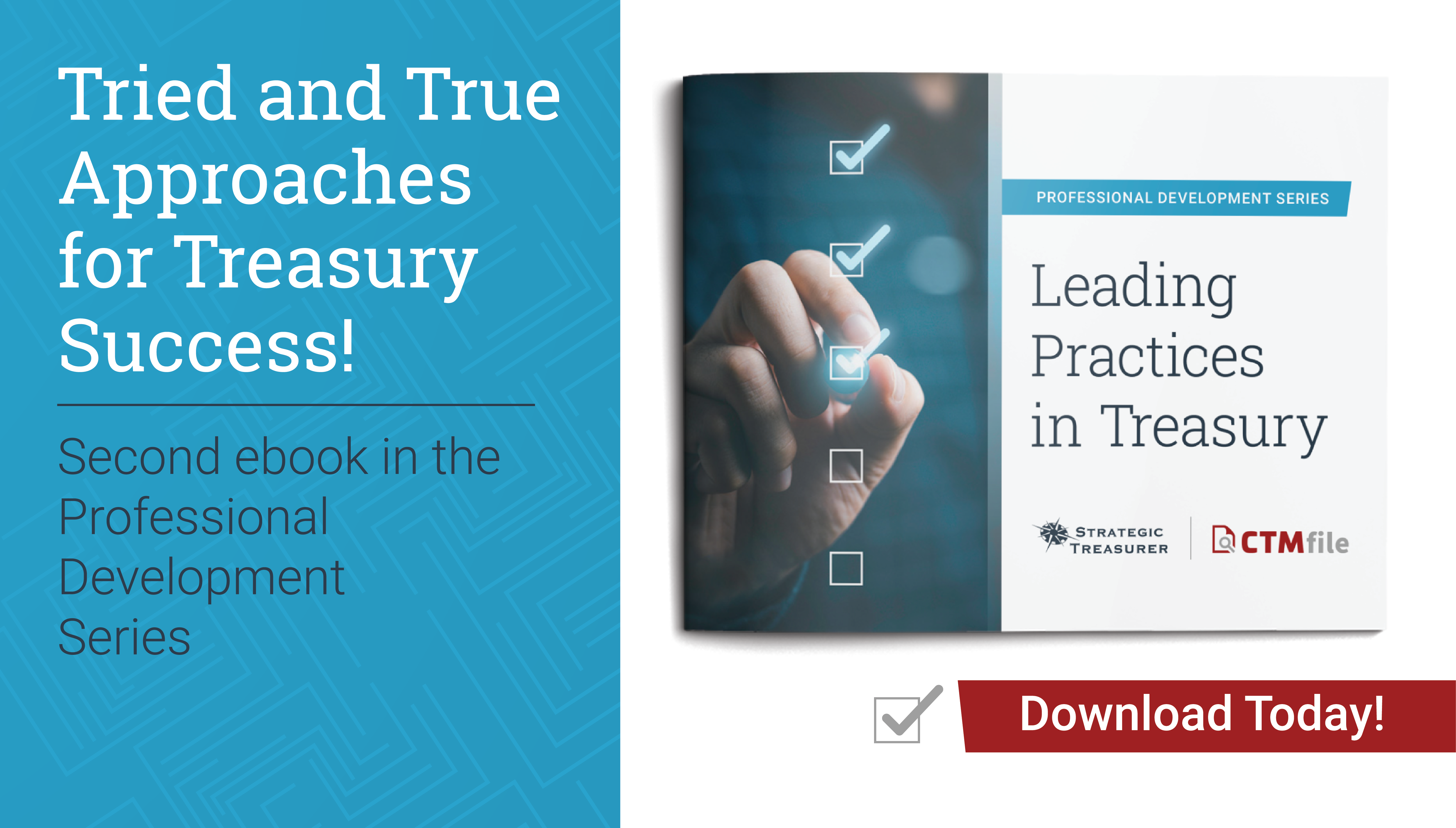
Leading Practices in Treasury ebook
This second installment in the Professional Development Series delves into leading practices for treasury’s daily tasks.
In this ebook, both new and experienced treasury professionals will find practical, focused recommendations and considerations to help hone their skills.With fine-tuned leading practices for bank relationship management, bank account architecture, forecasting, compliance, managing unknown risks, and more, this guide offers tried and true approaches that will help you and your organization thrive.
2024 Treasury Year in Review
Craig Jeffery reflects on 2024’s key treasury developments, including advancements in APIs and AI, major private equity investments in FinTech, and shifts in global markets. Inflation is easing, regulations are evolving, and supply chains are stabilizing. Listen to learn more.