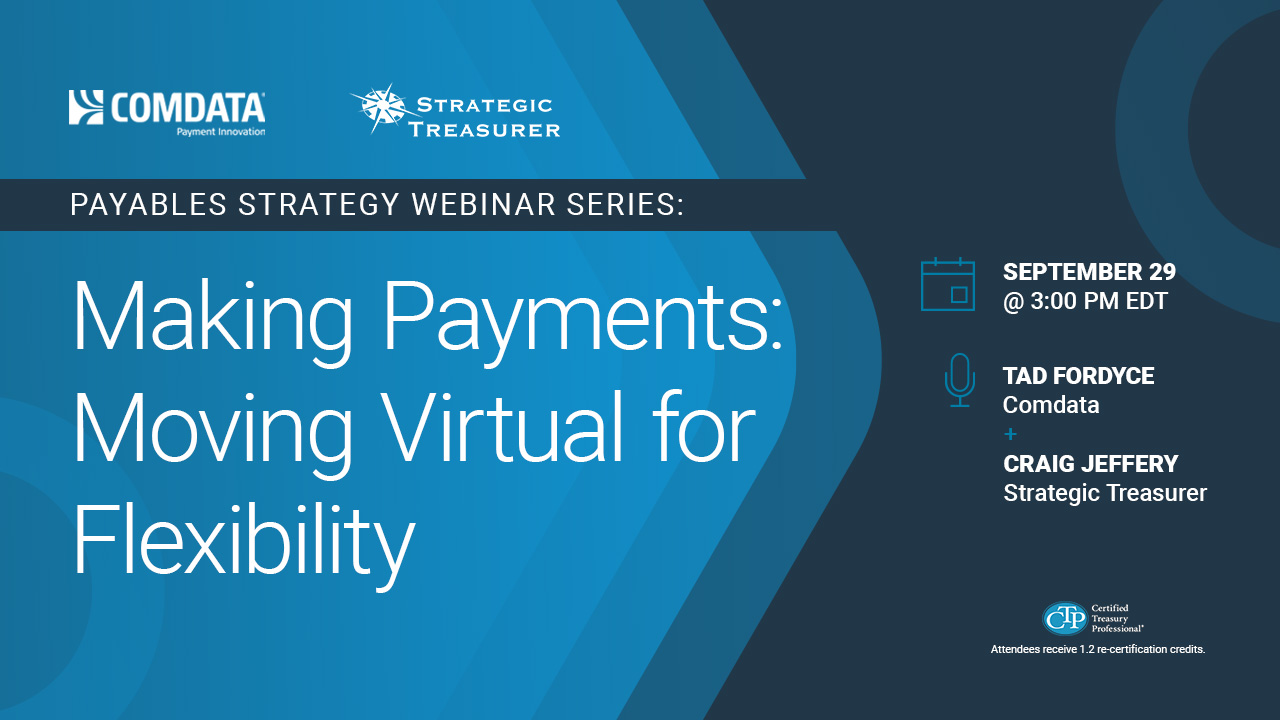
Join Craig Jeffery of Strategic Treasurer and Tad Fordyce of Comdata for a webinar on how virtualization functionally works to streamline the payment process, allowing your finance group to scale and adapt in a highly flexible manner.
Making Payments: Moving Virtual for Flexibility Webinar
Date: Tuesday, September 29, 2020
Time: 3:00 PM – 4:00 PM ET
Where: This is an online event.
Sure, making payments by card seems like it could be useful in some cases. But, very few think that card allows a company to increase flexibility. There can be a substantial concern that using card can make your payment process fragmented and more difficult. That seems to be opposite of flexible. To understand this properly we need to be more specific in defining our terms.
‘Fixed’ card numbers and ‘Virtual’ card processes have a significantly different methodology. Many are familiar with how Virtualization (using virtual card numbers) provides improved security over physical and Ghost cards. Few understand the application of virtualization as a way to add flexibility and value into the AP process.
This session will cover how virtualization functionally works to streamline the process, allowing your finance group to scale and adapt in a highly flexible manner.
If you encounter any issues with this webinar replay, please contact our team.
Download the webinar deck here:
Check back soon for the replay and presentation deck.
You may also be interested in:
Webinar: Modernizing Treasury: Improving Visibility, Forecasting, and Payments | November 18
This webinar will explore how treasury teams can modernize cash and liquidity management through enterprise-wide access to bank data, more accurate forecasting processes, and greater use of real-time information.
Webinar: Treasury’s Q4 Playbook: Liquidity, Performance, and AI | November 17
This session delivers an actionable blueprint to de-risk refinancing walls, deploy battle-tested working capital maneuvers, and realize value from agentic AI.
#433 – Seismic Shifts in Payments: Fraud, Regulation, and Validation (SouthState Bank)
In this episode, Craig Jeffery and Wes Bryant of SouthState Bank explore the overlapping changes reshaping payments, from instant payment rails and richer ISO 20022 data to evolving fraud threats and Nacha requirements.